Forensics Europe Expo returned to Olympia London on 1 and 2 July 2026 for two busy days of talks, demonstrations and networking, and the digital forensics stream covered plenty of ground. A couple of threads in particular stood out: the ever-expanding list of everyday objects that can quietly hold evidence — video doorbells, smart toys, games consoles — and the growing pressure that AI-generated media places on how far digital evidence can be trusted. Both served as a useful reminder of how quickly the field is shifting — and, judging by the exhibitor floor, of how hard the tools are working to keep pace. With next year’s event already confirmed for 22–23 June 2027 at ExCeL London, there will be plenty more to discuss when the sector meets again.
Meeting the Exhibitors
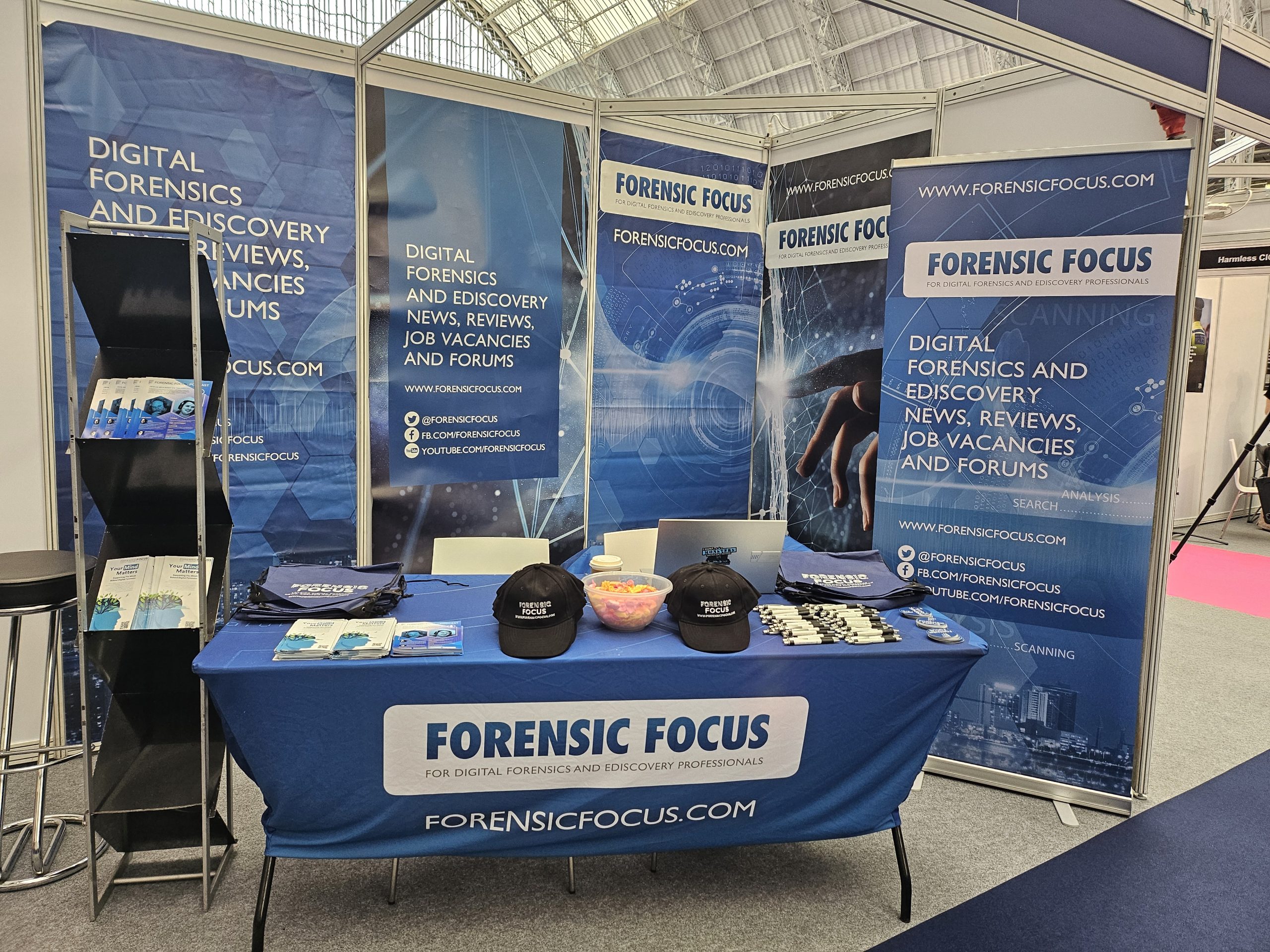
As in previous years, we were there with a stand of our own — a welcome chance to meet readers and catch up with advertisers in person, and to hand out plenty of merch: baseball caps, pens, bags, laptop stickers and a few other bits. If you picked something up, it was good to see you; if you missed out, do say hello next year!
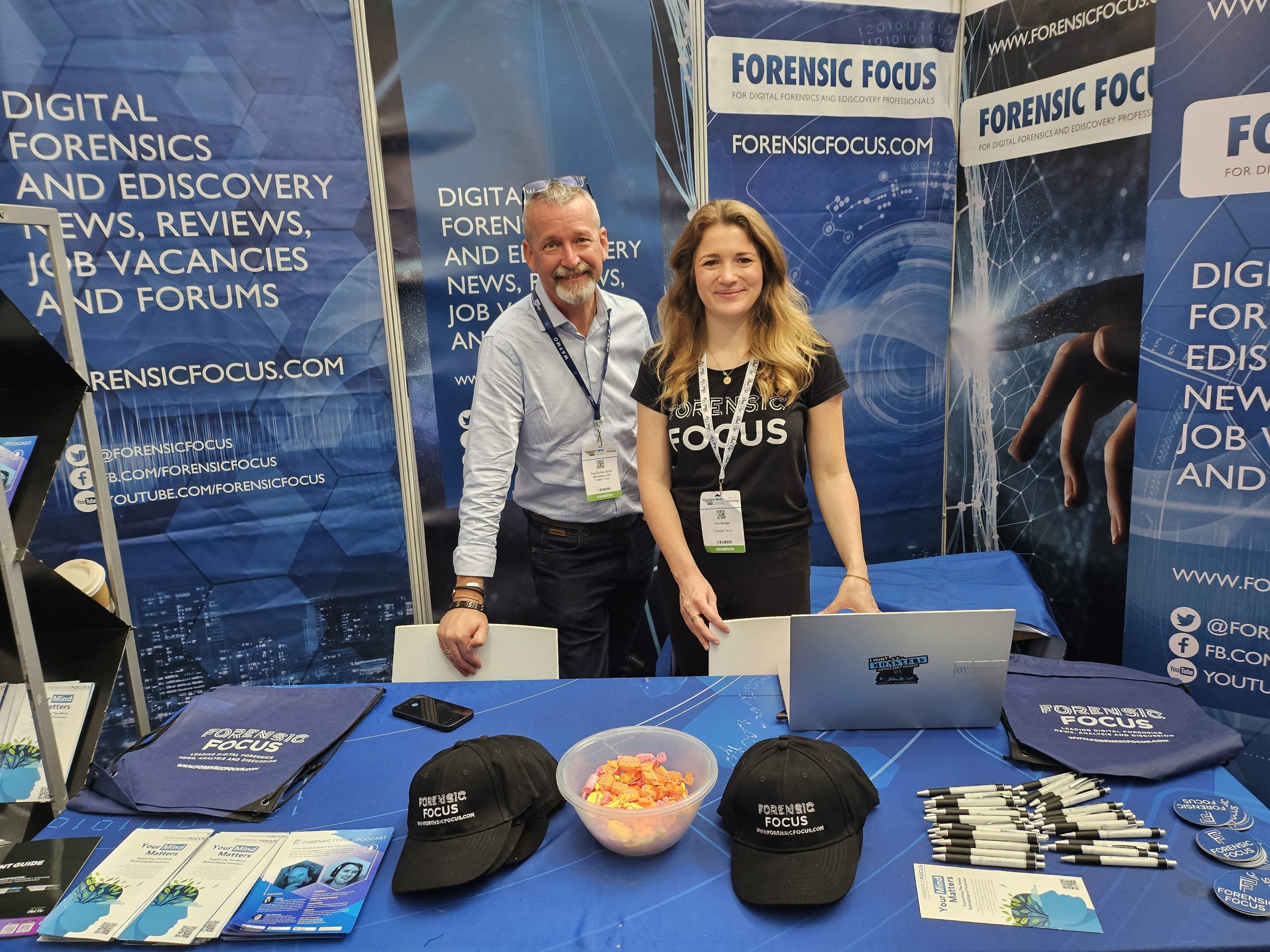
Beyond our own corner, the hall was worth as much time as the conference programme, with more than 60 exhibitor stands.
It was great to see Leica Geosystems, recent guests on the Forensic Focus podcast, whose forensic digital twin work also featured in the conference programme (more on that below). We also spent time with the team at Detego, and stopped by MSAB — who, as well as delivering one of the standout talks of the digital stream, quietly took the unofficial prize for best stand giveaway: a multifunctional pen doubling as a torch, stylus, screwdriver and spirit level. A fitting piece of kit for a company whose message that day was all about looking beyond the obvious tool for the job.
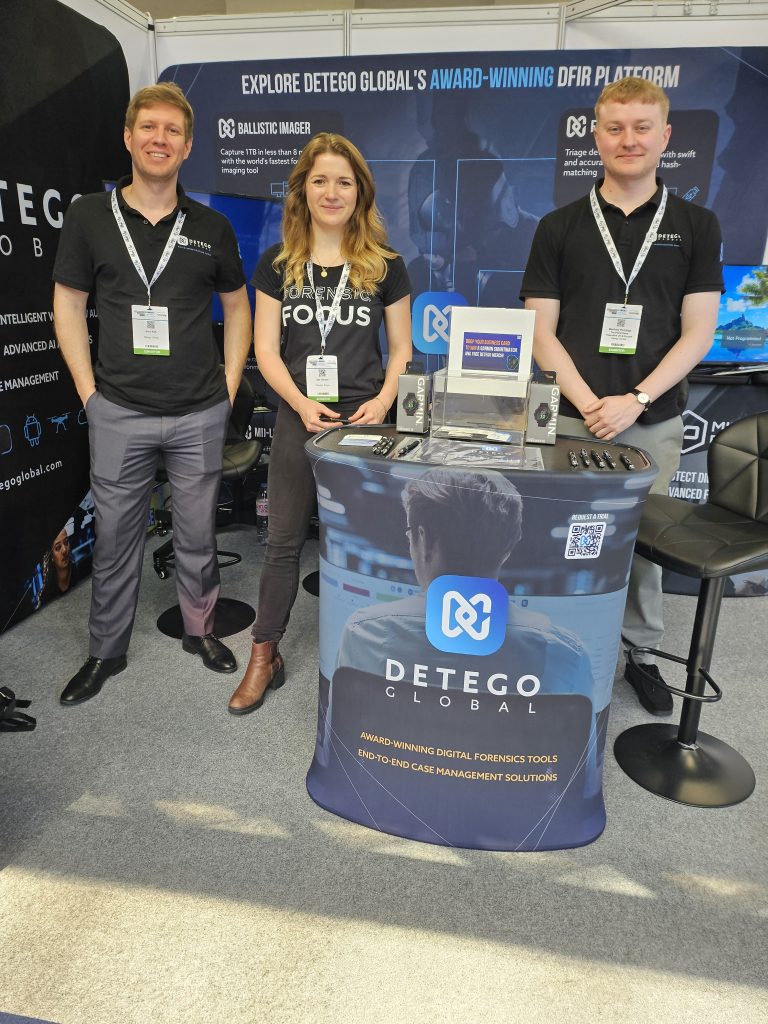
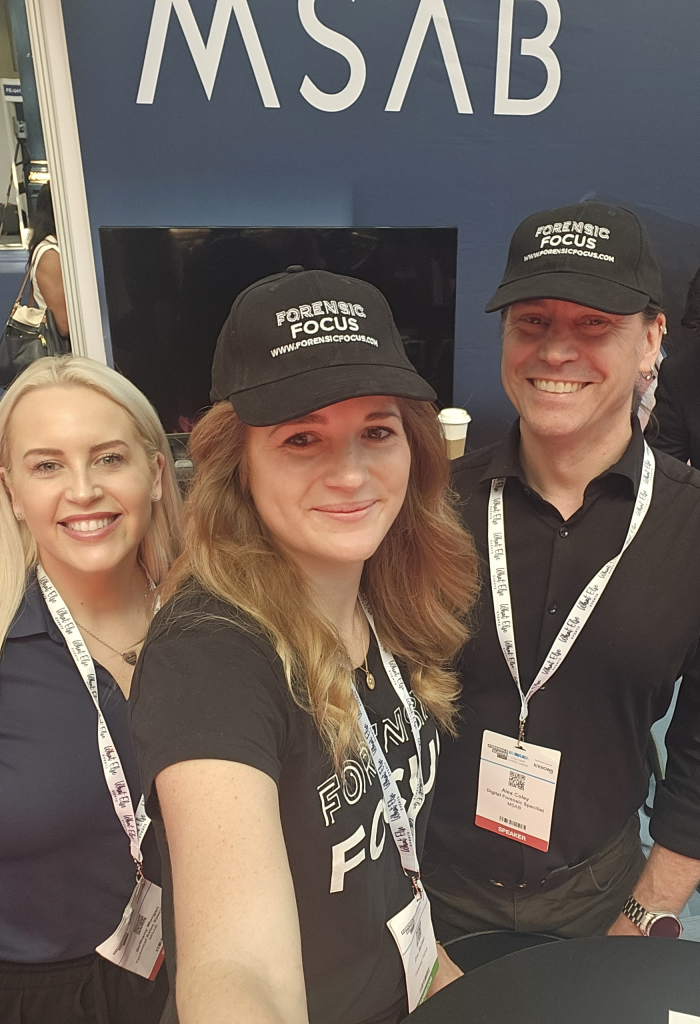
Other notable stands included Addressable, where it was a pleasure to talk to Dan and hear about what they do. Their platform, Spectra, tackles a problem familiar to anyone working crypto cases: conventional blockchain analytics can trace how funds move, but not who sits behind a wallet — so Addressable adds an off-chain layer of “device intelligence” that links wallet addresses to the real-world devices behind them, picking up the trail where on-chain tools run cold. Amped Software, whose image and video authentication work fed directly into the deepfake session, and IntaForensics, the digital forensics firm behind the doorbell talk, both helped round out a busy and productive floor.
Everyday Objects as Evidence
The talks were where the show really earned its place in the calendar, and the digital forensics stream in particular threw up some genuinely useful sessions. A clear theme emerged across several of them: the sheer, sprawling range of ordinary consumer devices that now hold evidential value — and how easy they are to overlook.
Carl Osborne and Jake Blythe of IntaForensics set the tone early with “Decoding the Doorbell.” Their argument was a simple one with big implications: video doorbells have quietly assembled themselves into a vast, decentralised surveillance network, one house at a time. That footage regularly ends up in investigations, but it cannot be taken at face value. The pair walked through the hidden data lifecycles behind smart-doorbell footage, and what it actually takes to move from a raw clip pulled off a consumer device to material that will stand up as evidence in court — the interrogation, authentication and understanding that has to happen in between.
The same “look beyond the obvious” spirit ran through Adam Newberry’s talk from the University of Staffordshire, “The Curious Case of the Singing Cactus.” On paper, a novelty toy that repeats what you say back to you sounds like the least serious thing at a forensics show. In practice, Newberry’s dissection of how the device records, stores and retains audio was one of the most quietly thought-provoking sessions of the two days. Can a talking toy ever provide usable evidence? What are the limits of what you can pull from it, and how far can you trust what you find? It was a fun talk with a serious point underneath: the connected objects filling our homes are all potential data sources, and the novelty ones are exactly the sort of thing that gets missed.
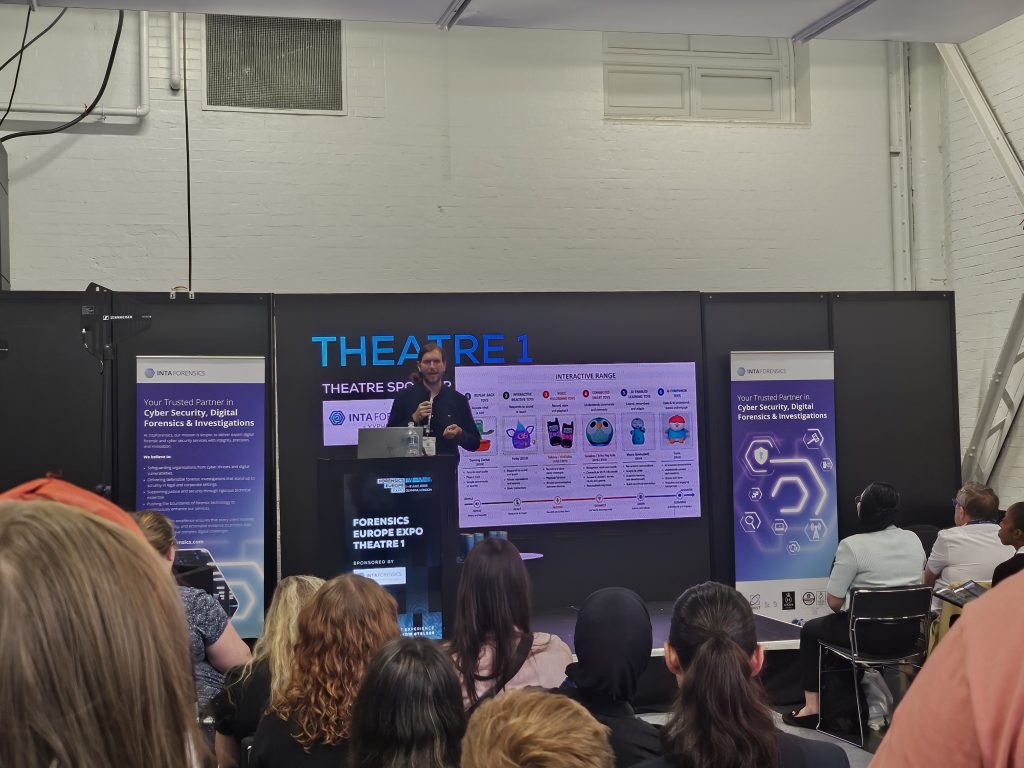
“The Curious Case of the Singing Cactus” – Adam Newberry
That idea found its sharpest expression in MSAB’s “Are You Playing Nintendo Forensics?”, delivered by the double act of Alex Coley and Beth Morgan. Their premise cut right to a professional anxiety many in the room will recognise: investigators lean heavily on automated tools, but what happens when the critical evidence is not parsed, not flagged, or not even recognised by the tool in the first place? They made a compelling case for the “unknown unknowns” that live beyond standard tool output — the artefacts that only a well-trained, genuinely curious practitioner will think to go looking for.
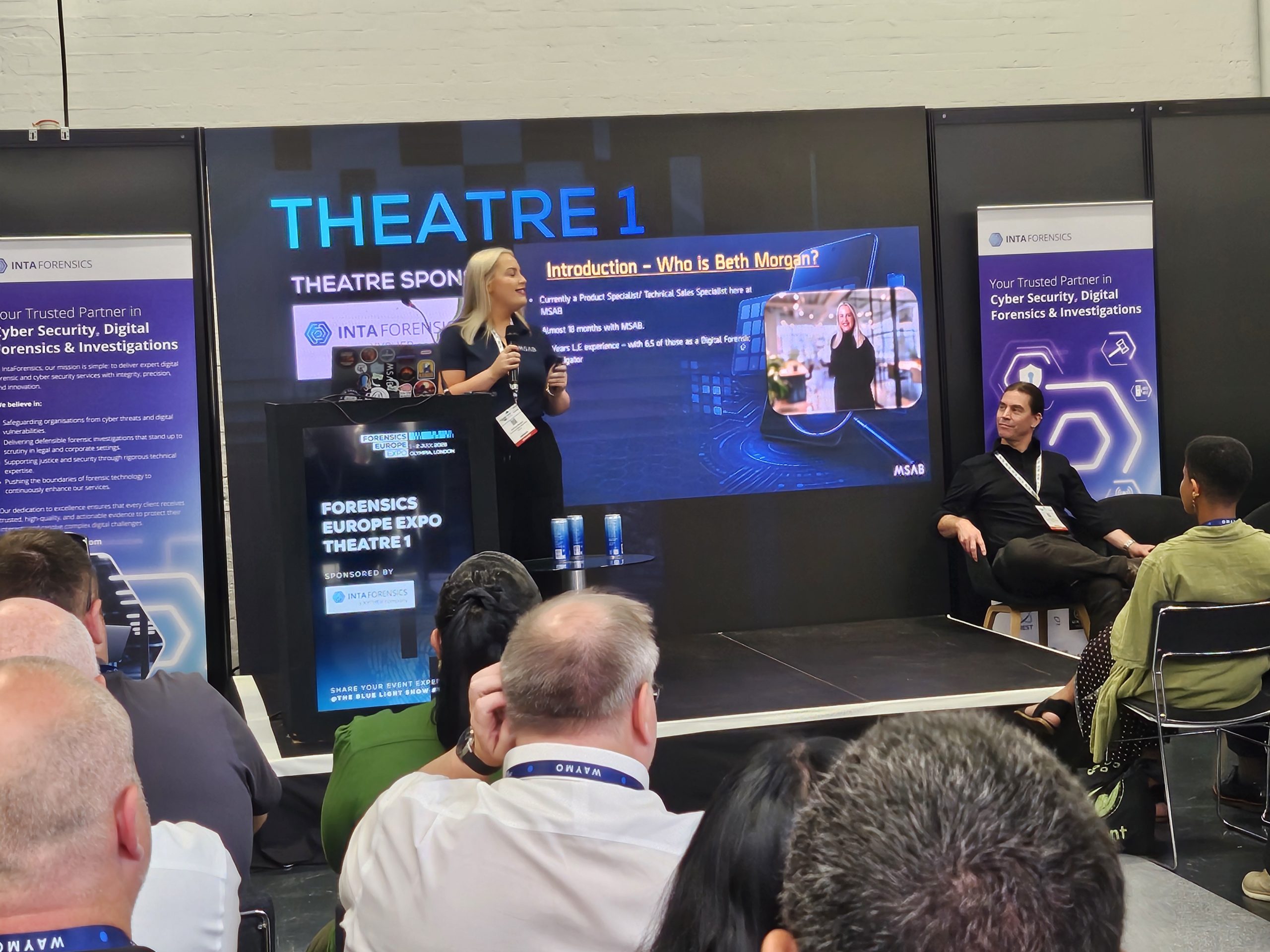
“Are You Playing Nintendo Forensics?” – Alex Coley and Beth Morgan
Deepfakes and the Crisis of Trust
If everyday devices were one dominant thread, AI-generated media was unquestionably the other — and here the mood was more urgent.
Alexander Fehrmann of Amped Software tackled the problem head-on in “New and Old Methods to Detect Deepfakes Before They Enter the Courtroom.” The same generative techniques that make synthetic media so convincing are, he explained, becoming a real burden on the criminal justice system. Fehrmann took the audience through how deepfakes are actually created — beyond the familiar shorthand of generative adversarial networks and text-to-image diffusion — before turning to detection. Part of his answer involves training neural networks to spot the tell-tale signs of manipulation. But one of the most reassuring takeaways was that the old skills still matter: analysing shadows, reflections and perspective can still expose AI tampering, and the provenance of a piece of evidence remains central to establishing whether it can be trusted at all.
Clair Tan of Sensity AI picked up the same anxiety and named it directly in “Crisis of Trust — The Impact of Deepfakes on Forensic Investigations.” Her framing was stark: digital forensics is facing a genuine crisis of confidence, as AI-generated media threatens to outpace the detection methods currently available. When public and judicial faith in digital evidence can be undermined by a convincing fake, and when law enforcement is increasingly meeting cases where synthetic media is not incidental but central to the crime, the question becomes how to use AI to close that gap without sacrificing forensic validity. It is a problem the field will be wrestling with for years, and it was valuable to hear it articulated so plainly.
Capturing the Scene and Looking Ahead
Away from the AI conversation, Marcus Rowe of Leica Geosystems offered a different kind of forward look in “Harvesting, Preserving and Presenting the Scene: Using the Forensic Digital Twin to Reduce Conscious Bias.” His subject was the “forensic digital twin” — using advanced 3D capture and spatial data to preserve a crime scene with a level of accuracy that lets investigators revisit it long after the physical scene is gone. The benefits he set out went beyond convenience: a faithful digital record helps reduce conscious bias, strengthens how evidence is presented in court, and protects the integrity of that evidence from the scene all the way through to the courtroom.
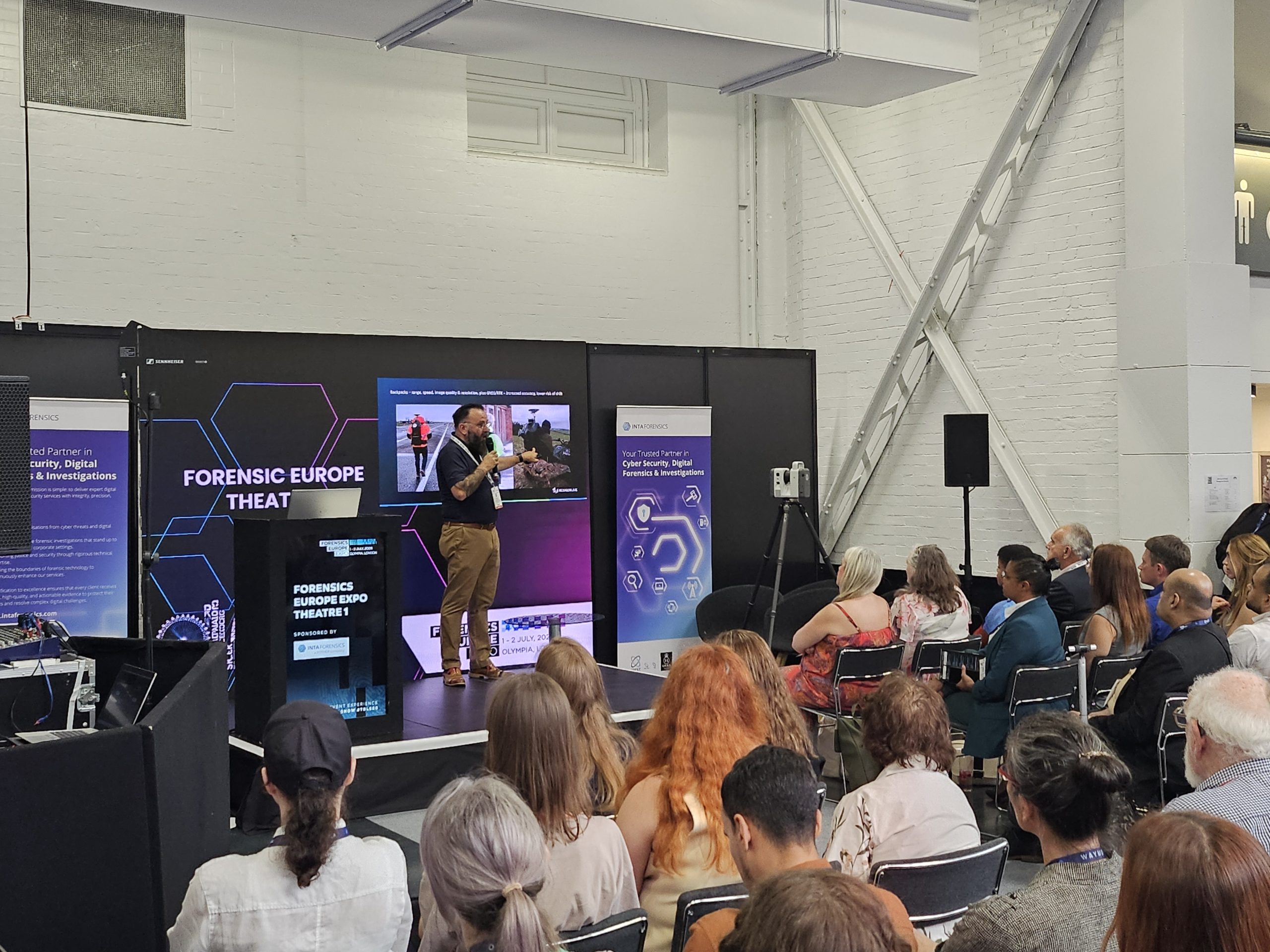
“Harvesting, Preserving and Presenting the Scene: Using the Forensic Digital Twin to Reduce Conscious Bias” – Marcus Rowe
Taking a wider view, a panel chaired by Bob Gallagher MBE, “Inside the Digital Forensics Toolkit: New Technologies Transforming Investigations,” brought several of the sector’s leading companies together to discuss where the tools are heading. With the volume and complexity of digital evidence still climbing, the conversation ranged across device extraction, cloud data analysis, AI-assisted investigation and large-scale data processing — and kept returning to the constants that underpin all of it: evidential integrity, legal compliance, and the ability to adapt as digital ecosystems keep shifting under everyone’s feet.
Closing Thoughts
Step back from the individual sessions and a couple of clear themes emerge. The first is that AI now cuts both ways in this field: it is at once the source of one of forensics’ fastest-growing threats and, handled carefully, part of the response to it. The second is that the evidential attack surface has quietly expanded to take in almost anything with a chip in it — doorbells, toys and games consoles included.
Running underneath much of the digital programme was a related point, made most directly in the doorbell, singing cactus and Nintendo sessions: powerful tools are no substitute for a trained, curious examiner who knows when to keep digging. In an age of automation and synthetic media, that is perhaps the most reassuring observation of all.
Thanks to everyone who stopped by the Forensic Focus stand over two busy days. We look forward to seeing you again at Forensics Europe Expo 2027, taking place at ExCeL London on 22–23 June 2027.