Why A US Ruling On AI Child Abuse Images Would Not Survive In Britain
How is AI reshaping child abuse laws and digital forensic investigations? Paul Gullon-Scott explores the US–UK legal divide and its implications for investigators.
Share
About this article
Articles 16 November 2026 13 min read 3,098 words
By Paul Gullon-Scott BSc, MA, MSc, MSc, FMBPsS, Forensic Mental Health & Well-being Lead, Spectrum Specialist Consultancy Ltd
When Judge John Z. Lee of the US Court of Appeals for the 7th Circuit ruled last month that the First Amendment protects a person’s right to privately possess AI-generated child sexual abuse images at home, provided the images depict no real person and never leave the house, he was working within a constitutional architecture that has no real counterpart in the United Kingdom. The ruling in United States v. Anderegg is narrow by design, and Lee himself seemed uneasy with where the law forced him to land, inviting the Supreme Court to revisit precedents set in 1969 and 2002 that were written decades before anyone could type a sentence into a diffusion model and generate a photorealistic image of an abused child in seconds. But set against UK law, the ruling is a useful mirror. It shows, more than anything, how differently two legal systems can respond to the same technological problem when one starts from a near-absolute free speech guarantee and the other starts from a Parliament willing to legislate directly and repeatedly in response to harm.
Why the UK Never Needed a Stanley v Georgia Moment
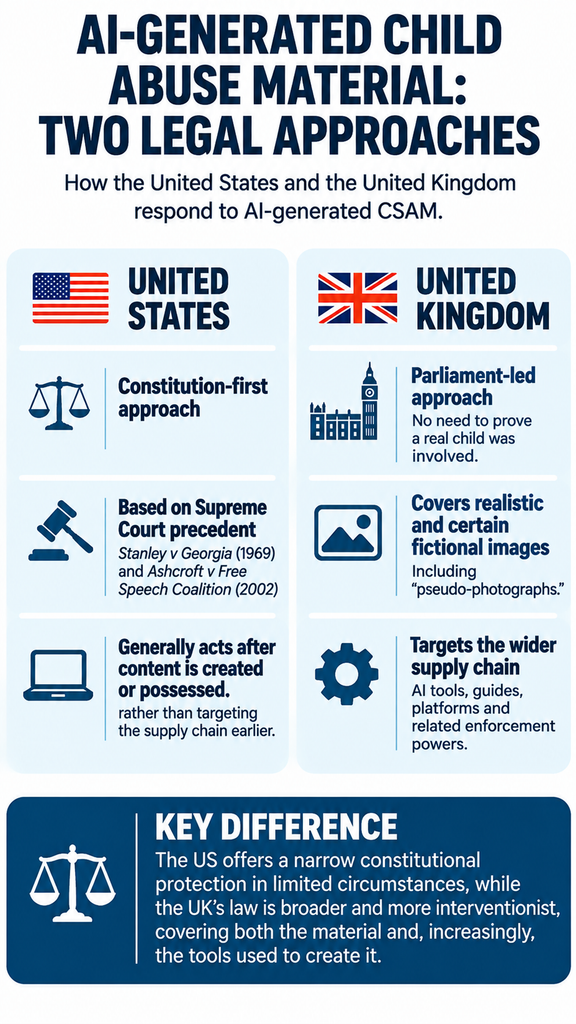
The 7th Circuit’s reasoning rested on two US Supreme Court cases: Stanley v Georgia (1969), which held that the government cannot criminalise the private possession of obscene material inside a person’s own home, and Ashcroft v Free Speech Coalition (2002), which struck down a federal law banning “virtual” child pornography that did not depict any real child, on the basis that the harm justifying CSAM laws is the abuse of an actual, identifiable minor. Put those two together and you get the narrow protection Anderegg received: an entirely fictional, AI-generated image, kept privately at home, sits in a gap the First Amendment still guards.
The UK has never had that gap, because it never adopted the underlying premise. English and Welsh law treats the realism of the image, not the reality of the child, as the trigger for liability. The Protection of Children Act 1978, amended in 1994 to cover computer-generated imagery, criminalises both indecent photographs of children and “pseudo-photographs” – images that appear to be photographs, regardless of how they were created. An AI output that looks like a real child does not need to be traceable to an actual victim to be illegal; it only needs to look real. Simple possession is a separate offence under section 160 of the Criminal Justice Act 1988, with no exception for private, domestic possession.
There is no British equivalent of Stanley v Georgia because the rights to privacy and freedom of expression under the Human Rights Act (Articles 8 and 10 of the European Convention on Human Rights) are not absolute. They can be restricted where necessary and proportionate to protect health, morals or the rights of others. UK courts have consistently accepted such restrictions to protect children. Parliament is responsible for setting these boundaries and has taken a broad approach.
Even when AI-generated images are clearly fictional, such as cartoons, manga or CGI that does not resemble a photograph, they can still be covered by a separate law in England and Wales.
Sections 62 to 68 of the Coroners and Justice Act 2009 make it an offence to possess a “prohibited image of a child”. This includes fictional pornographic material that is grossly offensive, disgusting or obscene and depicts specific sexual acts or focuses on a child’s genital or anal region.
Introduced more than a decade before generative AI became a mainstream concern, the law was designed to close the loophole that allowed offenders to argue that an image was not illegal because it did not depict a real child. This is the same distinction that later led American courts to reach a different conclusion.
Legislating Upstream: The AI-Specific Offences of 2025–2026
The UK has long criminalised the possession of child sexual abuse material, but recent legislation goes further by targeting the tools and technology used to create it.
In February 2025, then Home Secretary Yvette Cooper announced plans to make Britain the first country to introduce offences specifically targeting AI models designed or adapted to generate child sexual abuse imagery. The announcement followed a sustained campaign by the Internet Watch Foundation (IWF), which had recorded a fourfold increase in confirmed reports of AI-generated child sexual abuse material in a single year.
These measures were subsequently included in the Crime and Policing Bill and are now part of the Crime and Policing Act 2026.
The Act introduces several measures:
- AI image generators: It creates an offence, carrying up to five years’ imprisonment, for possessing, adapting or supplying an image generator that has been optimised to produce hyper-realistic child abuse material, targeting the tool itself, not only what someone does with it.
- Instruction manuals: It expands the existing “paedophile manual” offence under section 69 of the Serious Crime Act 2015 to cover guides that teach people how to manipulate otherwise lawful, general-purpose AI models into producing illegal content.
- Websites and forums: It introduces a new offence for administrators and moderators of websites and forums that facilitate the sharing of abuse imagery.
- Border Force powers: It gives Border Force new powers to compel travellers to unlock devices at UK entry and exit points where officers reasonably suspect the presence of digital CSAM, with scanning restricted to matching against the existing Child Abuse Image Database.
Where the American approach, constrained by the First Amendment’s deep suspicion of prior restraint and its protection of dual-use technology, can really only reach a person after they have generated or possessed unlawful content, the UK approach is explicitly designed to intervene earlier, against the supply chain of tools, manuals and platforms.
What This Means for Investigations
The practical implications for UK investigators are significant, and not entirely favourable. The disappearance of any “private possession” defence removes one legal headache the US system now has to live with, but it does not remove the operational one. Traditional CSAM detection has relied heavily on hash-matching: comparing files against a database of digital fingerprints of already-known illegal images, a system the IWF and its US counterpart, the National Center for Missing and Exploited Children, have run for decades. Generative AI defeats that system almost by design; because every output can be unique, there is no known file to match against.
The scale involved is difficult to overstate. The IWF’s most recent full-year analysis found:
- 8,029 AI-generated images and videos in 2025 realistic enough to meet the legal threshold for child sexual abuse material.
- 3,443 individual videos, up from just 13 the year before, an increase the organisation describes as 260-fold.
- 65% of those AI videos were graded at Category A, the most severe classification under UK sentencing guidelines, compared with 43% of criminal videos generally.
- 312,030 reports of child sexual abuse material actioned by the IWF in 2025, its busiest year in three decades.
The AI surge is therefore not simply adding volume but skewing toward the most severe and most distressing end of the spectrum.
Kerry Smith, the IWF’s chief executive, has warned that offenders “essentially can have their own child sexual abuse machines to make whatever they want to see.”
The IWF’s chief technology officer, Dan Sexton, raised further concerns when giving evidence to the Crime and Policing Bill Committee. He told MPs that analysts had identified 128 AI models, each trained to reproduce the likeness of a specific real child victim. These models effectively give offenders “a DIY child sexual abuse generation tool”, allowing them to create unlimited new material depicting children who may have been abused years earlier. As Sexton put it, “their abuse is not finished.”
That volume is now arriving faster than human moderators and forensic examiners can classify it. In the UK, classification carries significant legal weight, influencing both the offence charged and the likely sentence. Investigators and prosecutors increasingly need expert evidence not just on what an image shows, but on how it was made and how convincingly it mimics reality.
The new AI-model offence also creates a challenge for UK investigators that has no obvious equivalent in the US. To prove that software has been specifically “optimised” to produce abuse imagery, rather than being a general-purpose AI model that has been misused, investigators must examine its training data, modifications and behaviour. Most police digital forensics units do not yet have the resources to carry out this level of technical analysis at scale.
Enforcement is further complicated by the international nature of AI development. Tools such as the open-source Stable Diffusion model used by Anderegg are developed and hosted outside the UK. This makes it difficult to enforce British law against developers or distributors based overseas who are unlikely to face prosecution in UK courts.
The Online Safety Act 2023 partly addresses this problem by requiring platforms, wherever they are based, to proactively detect and remove child sexual abuse material. Ofcom can impose fines of up to 10% of global turnover for breaches. The US has no direct equivalent to this regulatory approach, largely because of its First Amendment protections and laws governing platform liability.
The Human Cost: Judgement, Trauma and the Sentencing Stakes
Behind the statistics sits a workforce carrying a rapidly growing burden, and UK research on that burden long predates the AI surge but is increasingly relevant to it.
A longitudinal study by Duran and Woodhams, published in the Journal of Police and Criminal Psychology, followed 21 civilian analysts and investigators working on serious crime in UK law enforcement, including child exploitation cases. After six months in their roles, participants reported little distress and a strong sense of purpose. However, by twelve to eighteen months, symptoms consistent with PTSD, depression and burnout had increased sharply.
Among the 21 participants:
- 11 had developed sleep disturbance, including daily nightmares.
- 10 reported intrusive thoughts about cases during their personal time.
- 14 described hypervigilance about their own safety outside work.
- 20 felt under pressure to meet monthly case-processing targets.
- 8 said they intended to leave the role within a year.
“Even when I’m trying to relax,” one participant told the researchers, “my mind drifts back to cases I’ve worked on.”
A separate qualitative study of digital forensics analysts in a UK police force, published in Frontiers in Psychology, found the same pattern of hypervigilance, difficulty decompressing, and a creeping, unwanted shift in how analysts viewed the world around them: one described being unable to “unsee the darker side of life”; another described becoming “increasingly desensitised to it.”
What the arrival of AI-generated material adds to that picture is not just more images to view, but a second, distinct judgement layered on top of the first.
Under UK sentencing law, images are not simply illegal or not. They are graded, under the Sentencing Council’s guideline, into three categories:
- Category A: Penetrative activity, sadism or bestiality.
- Category B: Non-penetrative sexual activity.
- Category C: Erotic posing and other content.
This classification directly influences the sentence a court imposes. Police forces record the categories in the national Child Abuse Image Database, but a classification is only considered final when three separate police forces have independently agreed on it. This safeguard reflects how difficult and open to interpretation the process can be.
AI-generated images add a further, prior question the guideline was never written to answer: is this realistic enough to be a “pseudo-photograph” at all, or does it fall instead under the separate, generally lower-tariff prohibited-images regime? The 2024 prosecution of Hugh Nelson in Greater Manchester supplied the first real answer: the courts held that an AI image needs demonstrable “provenance”, a traceable link back to a real source photograph, before it can be charged and sentenced as a pseudo-photograph under the main guideline. An image without that link is prosecuted differently, and typically less severely, regardless of how convincing it looks. Nelson himself was sentenced to eighteen years, but the precedent he set means an analyst’s judgement about whether an image is “real enough” now sits directly upstream of which law applies and how long a defendant may spend in prison.
It is that combination – the existing, well-documented psychological toll of years spent viewing this material, now paired with a classification task whose outcome the courts rely on – that investigators and researchers increasingly describe as a distinct and compounding strain. However, no study has yet isolated this strain from the general burden of exposure, so the claim remains an emerging practitioner observation rather than a tested research finding.
The IWF frames the difficulty in its own terms: analysts face what it calls a “needle-in-a-haystack” problem, in which content is now sometimes deliberately made to look imperfect, like amateur photography, specifically to make it harder to tell apart from the real thing.
Getting the call wrong carries a cost in both directions: treating a real child’s abuse as synthetic risks leaving that child unprotected, while treating synthetic content as real diverts scarce safeguarding resources towards a child who does not exist.
Conclusion
Seen together, the two countries have arrived at a telling asymmetry. In the United States, a federal appeals judge who plainly finds the current law inadequate for the AI era has had to ask the Supreme Court to reconsider the constitutional limits, which only it can change. In the United Kingdom, Parliament has already moved the line twice – first in 2009, for obviously fictional images, and again in 2025–2026, for the tools that generate them – without waiting for a court case to force the question.
That is not a guarantee the British framework is better calibrated. The Crime and Policing Act’s new offences are recent, largely untested in the higher courts, and Lords have already raised concerns in debate about definitional gaps and the practicalities of proving an AI model was built for illegal purposes. But it does mean the specific scenario at the heart of the American ruling – a defendant successfully arguing that a wholly fictional, privately kept AI image is constitutionally protected – is not one the UK’s courts are likely to face, because Parliament closed that door before it was ever tested.
Paul Gullon-Scott BSc MA MSc MSc FMBPSS is a former Digital Forensic Investigator with nearly 30 years of service at Northumbria Police in the UK, specializing in child abuse cases. As a recognized expert on the mental health impacts of digital forensic work, Paul now works as a Higher Assistant Psychologist within the NHS and is the developer of a pioneering well-being framework to support digital forensics investigators facing job-related stress. He recently published the research paper “UK-based Digital Forensic Investigators and the Impact of Exposure to Traumatic Material” and has chosen to collaborate with Forensic Focus in order to raise awareness of the mental health effects associated with digital forensics. Paul can be contacted in confidence via LinkedIn.
References
News reports
Nitasha Tiku, “Federal judge warns law is being left behind by AI child sex abuse images,” The Washington Post, 26 August 2026. https://www.washingtonpost.com/technology/2026/08/26/federal-judge-warns-law-is-being-left-behind-by-ai-sex-abuse-images/
“Home Possession of AI-Generated Porn Depicting Fake Children Remains Constitutionally Protected, Seventh Circuit Rules,” Reason (The Volokh Conspiracy), 27 August 2026. https://reason.com/volokh/2026/08/27/home-possession-of-ai-generated-porn-depicting-fake-children-remains-constitutionally-protected-seventh-circuit-rules/
US case law
United States v. Anderegg, US Court of Appeals for the Seventh Circuit, decided 25 August 2026 (opinion of Judge John Z. Lee, joined by Judges Doris Pryor and Joshua Kolar).
Stanley v. Georgia, 394 U.S. 557 (1969).
Ashcroft v. Free Speech Coalition, 535 U.S. 234 (2002).
UK legislation
Protection of Children Act 1978 (as amended by the Criminal Justice and Public Order Act 1994). https://www.legislation.gov.uk/ukpga/1978/37
Criminal Justice Act 1988, s.160. https://www.legislation.gov.uk/ukpga/1988/33
Coroners and Justice Act 2009, ss.62–68 (“prohibited images of children”). https://www.legislation.gov.uk/ukpga/2009/25/part/2/chapter/2/crossheading/prohibited-images
Serious Crime Act 2015, s.69 (the “paedophile manual” offence).
Online Safety Act 2023.
“Crime and Policing Act 2026: child sexual abuse material factsheet,” GOV.UK. https://www.gov.uk/government/publications/crime-and-policing-act-2026-factsheets/crime-and-policing-act-2026-child-sexual-abuse-material-factsheet
“New AI child sexual abuse laws announced following IWF campaign,” Internet Watch Foundation, February 2025. https://www.iwf.org.uk/news-media/news/new-ai-child-sexual-abuse-laws-announced-following-iwf-campaign
“AI-Generated Indecent Images and UK Criminal Law,” Reeds Solicitors. https://reeds.co.uk/insights/ai-generated-indecent-images-and-uk-criminal-law/
Parliamentary sources
House of Lords, “AI: Child Sexual Abuse Material,” Hansard, 30 April 2025. https://hansard.parliament.uk/lords/2025-04-30/debates/A33CA2D2-0435-4204-AE1C-153D13758BB0/AIChildSexualAbuseMaterial
Dan Sexton (IWF Chief Technology Officer), evidence to the Crime and Policing Bill Committee, 27 March 2025, reported in “AI giving offenders ‘DIY’ child sexual abuse tool as dozens of child victims used in AI models, IWF warns MPs,” Internet Watch Foundation. https://www.iwf.org.uk/news-media/news/ai-giving-offenders-diy-child-sexual-abuse-tool-as-dozens-of-child-victims-used-in-ai-models-iwf-warns-mps/
IWF data and reports
Internet Watch Foundation, AI CSAM Report 2026: Harm Without Limits. https://www.iwf.org.uk/media/hl1nvdti/iwf-ai-csam-report-2026.pdf
“AI becoming ‘child sexual abuse machine’, warns IWF,” Internet Watch Foundation. https://www.iwf.org.uk/news-media/news/ai-becoming-child-sexual-abuse-machine-adding-to-dangerous-record-levels-of-online-abuse-iwf-warns
“AI child abuse at record high as public backs action on unsafe tools,” Internet Watch Foundation. https://www.iwf.org.uk/news-media/news/dangerous-ai-child-sexual-abuse-reaches-record-high-as-public-backs-clampdown-on-uncensored-tools/
Academic and occupational health research
F. Duran and J. Woodhams, “Ongoing exposure to distressing material is associated with worsening mental health in UK law enforcement staff: a longitudinal interview study,” Journal of Police and Criminal Psychology (Springer). https://link.springer.com/article/10.1007/s11896-026-09809-2
J. Woodhams and F. Duran, “A model for secondary traumatic stress following workplace exposure to traumatic material in analytical staff,” Communications Psychology (Nature), 2024. https://www.nature.com/articles/s44271-024-00060-1
H. Strickland, J. Kloess and M. Larkin, “An exploration of the personal experiences of digital forensics analysts who work with child sexual abuse material on a daily basis: ‘you cannot unsee the darker side of life’,” Frontiers in Psychology, 2023. https://www.frontiersin.org/journals/psychology/articles/10.3389/fpsyg.2023.1142106/full
Sentencing and case law
Sentencing Council, Indecent Images of Children definitive guideline. https://consult.justice.gov.uk/sentencing-council/indecent-images-children/supporting_documents/sexual%20offences_Indecent%20images%20of%20children.pdf
Crown Prosecution Service, “Indecent and Prohibited Images of Children,” legal guidance. https://www.cps.gov.uk/prosecution-guidance/indecent-and-prohibited-images-children
R v Hugh Nelson (Bolton Crown Court, 2024). Greater Manchester Police press release: https://www.gmp.police.uk/news/greater-manchester/news/news/2024/august/man-pleads-guilty-to-creating-computer-generated-indecent-images-in-landmark-case-for-gmp/ ; sentencing reported in Courthouse News, https://www.courthousenews.com/british-man-sentenced-to-18-years-for-using-ai-to-make-child-sexual-abuse-imagery/
“Evolution of AI in child sexual abuse material,” College of Policing. https://www.college.police.uk/article/evolution-ai-child-sexual-abuse-material