by Guocai Wang, Technical Support Lead for China at THIRD ENGINE SL
1. Introduction: “Blurred” Is Not a Diagnosis
In low-quality vehicle imagery, describing a licence plate as “blurred” is common, but that description alone is rarely sufficient to determine how the material should be processed.
Two plates that appear equally unreadable may be limited by very different factors. Character-to-background contrast may be poor; the target may occupy very few pixels; motion may spread character edges spatially; parts of the plate may be obscured; and scale or perspective may change from frame to frame. In real casework, several of these factors often occur together.
“Blurred” is therefore better treated as a description of visual appearance than as a technical diagnosis.
In practice, the first question should not be which filter or algorithm to use. More important questions are:
What information remains in the material, where is it distributed, and how far can that information reasonably support an interpretation?
Video also provides something that a single image does not: a temporal dimension. The same weak structure may be recorded repeatedly across many frames. Conversely, when occlusion, viewpoint or target position changes over time, different frames may record different parts of the target.
For this reason, “using multiple frames” is not, by itself, a complete processing strategy. Different cases may benefit from the temporal sequence for very different reasons.
Nor does the end result necessarily need to be a single, complete registration number. Some imagery may support only part of the plate, several plausible character candidates, or positions that remain unresolved. Forcing those uncertainties into a complete reading may produce a conclusion that goes beyond what the source material can support.
This article does not compare software performance, nor does it propose a fixed workflow for all low-quality licence plates [1].
Instead, several real casework examples are used to examine three linked questions:
What information remains?
How can that information be used without exceeding what the source material supports?
Where should the interpretation stop?
2. Case Materials and Selection
All examples in this article are drawn from real image-analysis casework.
The cases were selected purposively rather than randomly. They were not chosen because they produced the “best” results, nor are they intended to estimate an overall success rate for low-quality licence-plate enhancement. Each case illustrates a different type of practical decision-making problem.
The selected material includes:
- Extremely weak character information in individual frames;
- Changing occlusion and potentially complementary observations across frames;
- Target localisation under extremely low illumination;
- Reassessment of processing order; and
- Candidate-level interpretation where the imagery does not support a unique plate reading.
All cases were analysed from source video. At the image-processing and initial character-interpretation stages, the registration number later established during the investigation was not known to the analyst.
| Case | Video resolution | Approximate plate size | Frame rate |
| Case 1: Weak information and multi-frame registration | 1280 × 720 | ≈76×28 px | 30 fps |
| Case 2: Changing occlusion and complementary observations | 1920 × 1080 | ≈27×20 px* | 25 fps |
| Practical aside: Target localisation under extremely low illumination | 1600 × 1200 | ≈79×25 px | 25 fps |
| Case 3: Reconsidering the processing order | 1920 × 1080 | ≈137×58 px | 12 fps |
| Case 4: Candidate-level character interpretation | 1920 × 1088 | ≈123×40 px | 25 fps |
* The target changed in scale during motion. Contemporaneous records described the plate as ranging approximately from 22 × 28 to 30 × 20 pixels.
These dimensions are included only to help describe the original imaging conditions. They should not be used to rank the cases by difficulty. The amount of usable information also depends on contrast, motion, occlusion, perspective change, noise and the number of useful frames available.
All material prepared for publication has been anonymised where necessary. Complete registration numbers, precise dates, locations, source organisations, camera locations and other information capable of identifying individual cases are not disclosed.
The original analytical material remains unchanged. Figures prepared for publication are limited to necessary cropping, annotation and anonymisation.
Grey blocks shown in some figures are publication anonymisation masks and are not part of the analytical processing.
The meaningful differences between these cases become apparent only when the processing decisions are considered in context.
3. Casework Examples
3.1 Case 1: Can the Temporal Sequence Still Be Useful When a Single Frame Contains Very Little Information?
This case involved handheld video recorded through glass. Dust on the glass, reflections and poor character-to-background contrast all contributed to very weak plate information.
The source video was 1280 × 720 at 30 fps, with the plate region of interest (ROI) occupying approximately 76 × 28 pixels. In an individual source frame, only very weak intensity structure was visible, and no stable character reading could be formed.
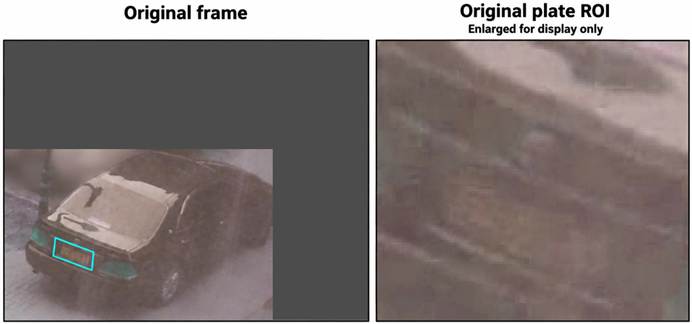
Local histogram equalisation made some of the previously weak intensity variations easier to observe, but it also enhanced noise and non-character structure.
The purpose of this step was therefore not to “read the plate”, but to answer a more basic question:
Does the plate region still contain repeated structure that may be worth exploiting?
The vehicle was largely stationary, while the recording device exhibited handheld movement. The analysis therefore shifted away from trying to enhance a single frame further and towards examining how the same target behaved across the temporal sequence.
A total of 237 frames were selected for subsequent processing. Selection favoured frames with relatively limited camera movement, relatively small frame-to-frame target displacement, and visible intensity structure remaining within the plate region after local enhancement.
The number 237 was not, in itself, the reason for the result. What mattered was that the frames entering the multi-frame process still contained information relevant to the task.
Automatic stabilisation did not produce a satisfactory result.
Because the plate itself had very low contrast and lacked sufficiently stable local features, registration was instead performed manually using physical vehicle features that could be matched between frames.
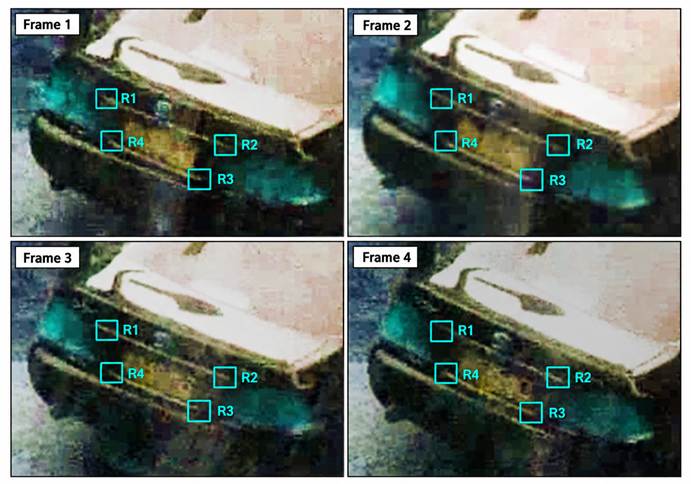
Contemporaneous working notes also recorded that low contrast and other image degradations limited registration accuracy.
This is important because frame averaging is most useful when corresponding target structures can be aligned with sufficient accuracy. If registration error approaches the spatial scale of the character detail itself, adding more frames may weaken rather than strengthen the available structure [3,4].
After registration, the selected frames were averaged.
Frame averaging should not be described here as “recovering characters”. More accurately:
Where spatial correspondence is sufficiently good, frame averaging can make repeated stable structure easier to observe.
The averaged result remained visibly soft, so a further restoration stage was applied.
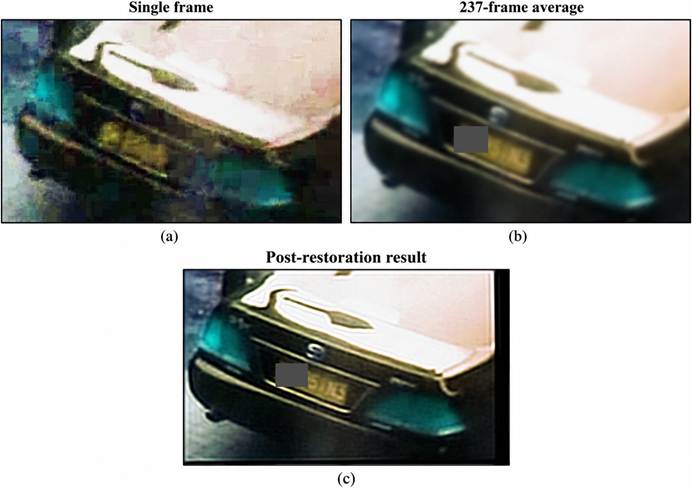
Although restoration tools were used, the fact that a particular treatment produced a visible improvement does not justify working backwards from the tool and assigning a specific physical blur model to the original imagery.
The article therefore describes what processing was performed and what changes became observable, without inferring the original degradation mechanism from the name of the tool used.
The contemporaneous working notes recorded all character positions as readable after processing.
The broader conclusion supported by this case is more limited:
Very weak character information in a single frame does not necessarily mean that the video sequence as a whole contains no usable information. Whether that information can be combined effectively depends first on frame selection and the reliability of frame-to-frame spatial correspondence.
3.2 Case 2: Can Changing Occlusion Provide Complementary Observations?
This case came from video recorded by a fixed camera.
The source video was 1920 × 1080 at 25 fps. As the vehicle moved, the plate changed in image size from approximately 22 × 28 to 30 × 20 pixels. The plate was also viewed at a pronounced downward angle and was partially obscured by a moving, flexible object.
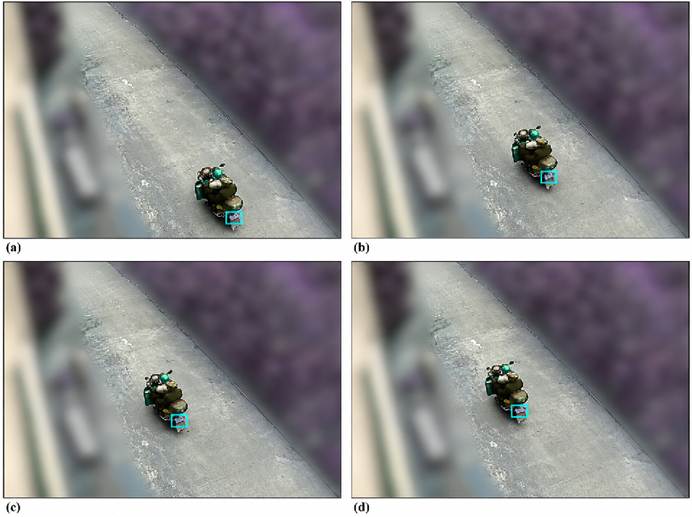
Unlike Case 1, the temporal sequence here did not merely repeat the same weak observation.
Successive frames showed that the position of the occluding material changed relative to the plate.
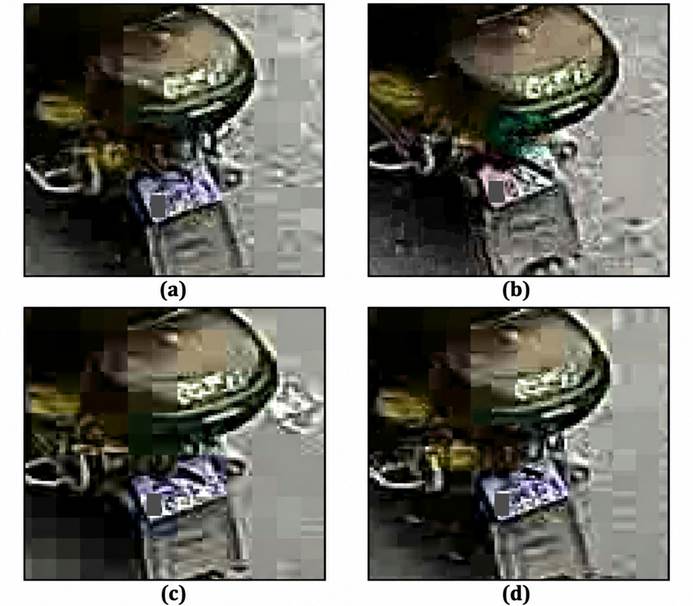
The frames directly show that:
Different areas of the plate were not equally visible at every point in time.
A local region that was heavily obscured in one frame could therefore be more exposed in another.
Multi-frame processing cannot recover content that remained fully hidden in every frame and was never recorded by the camera. It can only use information that actually entered the camera’s field of view at some point in the sequence.
In that sense, the temporal sequence offered the potential for complementary observations, rather than merely repeated sampling for noise reduction.
Before those frames could be combined, however, geometric consistency had to be addressed.
Vehicle motion produced changes in position, scale and perspective, so the frames could not simply be averaged directly. The original workflow involved selecting usable frames, followed by perspective registration and stabilisation before multi-frame processing.
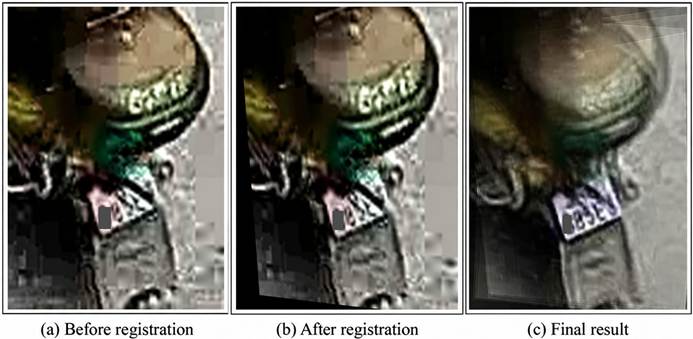
Registration does not add new plate information. Its purpose is to map corresponding target structures recorded at different times into a sufficiently consistent spatial relationship.
The contemporaneous working notes recorded the final five character positions as readable after processing.
This does not prove that each readable character in the final result came from a newly exposed region in a particular frame.
A more defensible interpretation is:
As the occlusion changed over time, different frames provided different observation conditions across the plate. After the necessary geometric correction and multi-frame processing, information distributed across the temporal sequence could be used more effectively.
Practical Aside: Exploratory Enhancement Is Not the Final Processing Chain
Not every processing step serves the same purpose.
In this example, the original video was extremely dark and the plate could not initially be located with confidence. The source video was 1600 × 1200 at 25 fps, with the plate region measuring approximately 79 × 25 pixels.
During the exploratory stage, exposure adjustment and preliminary multi-frame processing were used to improve the visibility of dark regions. At this point the objective was not to interpret plate characters, but simply to answer:
Where is the target?
Once the plate ROI had been identified, those exploratory steps were not carried forward into the final analytical processing chain. The final processing chain was rebuilt from the original source data specifically for the identified ROI.
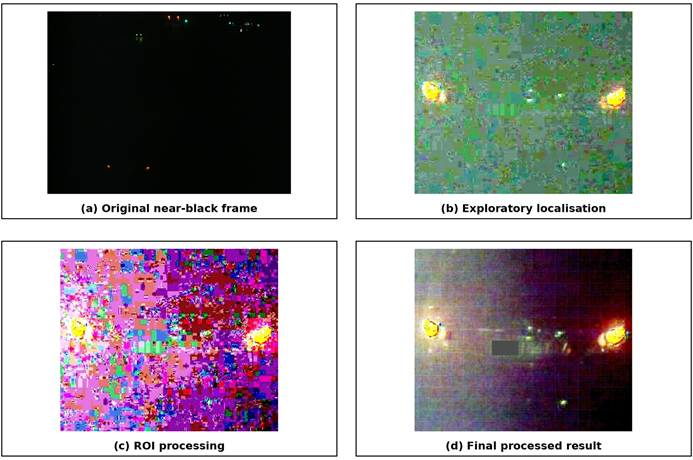
The point of this example is not that one enhancement method was better than another. It illustrates a practical principle:
Processing used to find a target may be exploratory; processing used to interpret that target should return to the source material and be rebuilt for the final analytical purpose.
3.3 Case 3: Should the Processing Order Be Reconsidered When the First Route Is Not Enough?
This case involved vehicle video recorded at 1920 × 1080 and 12 fps. In the selected frames, the plate occupied approximately 137 × 58 pixels.
Six frames were ultimately used, covering the period from when the complete plate became visible until strong illumination produced extensive local overexposure across the plate region.
The registration number later established during the investigation was not known when the analysis began.
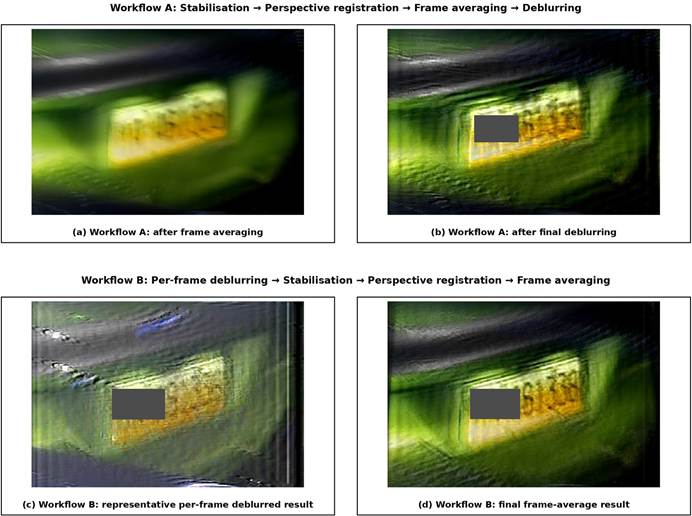
The first processing route was:
Stabilisation → Perspective registration → Frame averaging → Deblurring
In other words, frame-to-frame spatial correspondence was established first, the frames were averaged, and deblurring was then applied to the combined result.
The resulting character structure was still insufficient for a stable reading. Contemporaneous working notes record that, without prior knowledge of the ultimately established registration number, individual characters remained difficult to interpret reliably.
At that point, the focus shifted away from further adjusting the final deblurring stage and back towards the input frames themselves.
Re-examination of the six frames showed visible differences in viewpoint, scale and brightness.
These were observable differences in the input conditions, but they were not sufficient to prove that each frame was governed by a separate, precisely estimable motion-blur model.
The second processing approach therefore changed the strategy rather than simply intensifying the first one:
Per-frame deblurring → Stabilisation → Perspective registration → Frame averaging
Each frame was treated individually before the six processed frames were reassembled into a sequence for stabilisation, perspective registration and averaging.
This was not a controlled experiment.
The two routes differed in more than processing order. In the second approach, frames were treated individually, and processing parameters may also have varied according to the condition of each frame. The difference in results therefore cannot be attributed solely to the decision to perform per-frame deblurring first.
Accordingly, this case does not demonstrate that per-frame deblurring followed by frame averaging is generally superior to frame averaging followed by subsequent deblurring.
What it does support is a more limited, but more practical, lesson:
When one processing route fails to produce a sufficiently interpretable result, the assumptions underlying the workflow should be reconsidered rather than continuing to adjust parameters within the same processing chain.
The final result was not forced into a single complete registration number. Instead, several closely related candidate readings were recorded.
3.4 Case 4: When the Image Supports Candidates Rather Than a Unique Reading
This case involved night-time vehicle video.
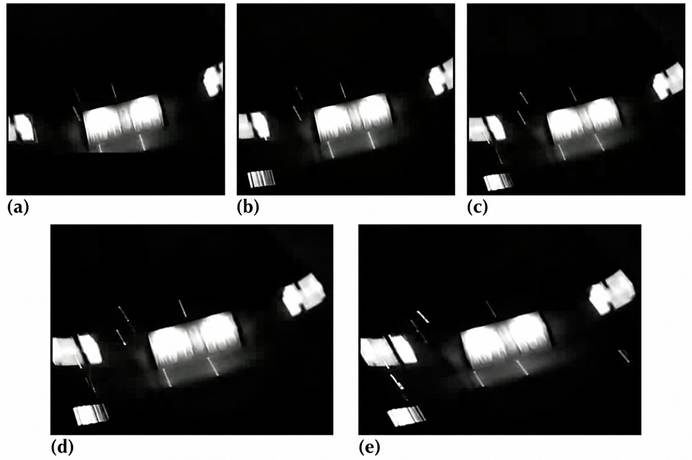
The source video was 1920 × 1088 at 25 fps, with a plate region of approximately 123 × 40 pixels. The imagery showed both motion blur and severe local overexposure. In some character positions, only incomplete residual structure remained, preventing a stable, complete reading from being formed directly from the source frames.
The central question in this case was therefore no longer simply:
How can the structure be made easier to see?
It became:
How far can those structures reasonably be interpreted?
Processing included frame selection, stabilisation, perspective registration, brightness and contrast adjustment, frame averaging and motion deblurring.
These steps made some character structure more visible, but they did not provide the same level of image support at every character position.
Some positions still contained only partial strokes or edges. Some supported more than one plausible character interpretation. Others still lacked sufficiently stable structure.
It would therefore be misleading to describe the result as:
Blurred source image → enhancement → complete plate recovered
A more accurate description is:
Enhancement improved the observability of some residual structures, while different character positions remained subject to different levels of uncertainty.
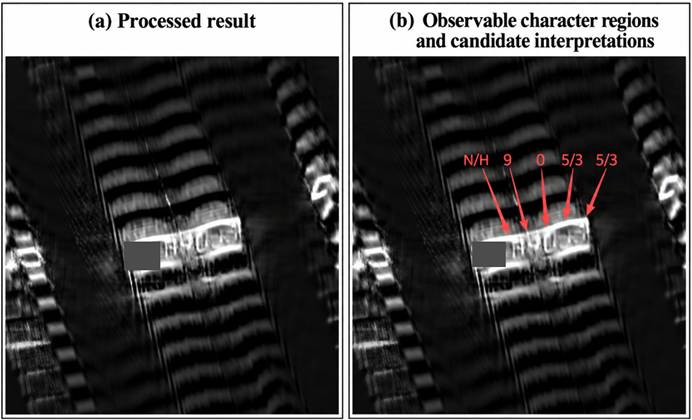
The purpose of Figure 5B is not to tell the reader what the final plate number was. It is to show which positions contained observable structure and where more than one interpretation remained plausible.
A more appropriate output can distinguish between:
- Relatively well-supported character positions;
- Candidate-level character positions; and
- Unresolved positions.
This is not an attempt to avoid a conclusion. It is a way of keeping the strength of the conclusion proportionate to the source material.
The objective of low-quality licence-plate analysis is not necessarily to eliminate all uncertainty. In some cases, the more defensible technical result is to state clearly: which characters are supported, which remain candidate-level interpretations, and which positions cannot be determined reliably.
In other words:
Preserving uncertainty can itself be part of the analytical result.
4. What the Cases Show
The degradation conditions and processing strategies differed between the cases, so they should not be reduced to a single fixed workflow.
Instead, they illustrate four related but distinct practical principles.
4.1 “Blurred” Is Not a Diagnosis
All of the plates were difficult to read, but not for the same reasons.
“Blurred” therefore describes an appearance; it does not determine the correct processing method.
The more useful question is:
What is limiting the current imagery, and what usable information still remains in the source material?
4.2 Multi-Frame Processing Is Not a Single Mechanism
Both Case 1 and Case 2 used information from multiple frames, but for different reasons.
Case 1 primarily exploited repeated weak structure across many frames. Case 2 showed that, when occlusion changes over time, different frames may offer different observation conditions.
Therefore:
More frames do not automatically mean more useful information [3,4].
The value of multi-frame processing depends on what was actually recorded and whether sufficiently reliable spatial correspondence can be established between frames.
4.3 The Processing Chain Should Follow the Material
Case 3 shows that the processing workflow itself should be treated as a technical assumption that may need to be tested and reconsidered.
When the first route does not produce a sufficiently interpretable result, the appropriate response is not always to apply increasingly aggressive parameter settings. It may be necessary to reassess differences between the input frames and reconsider the relationship between processing stages.
This case does not establish the universal superiority of one processing order over another.
What it supports is simpler:
A fixed workflow cannot substitute for judgement about the material in front of the analyst [1].
4.4 A Useful Result Does Not Have to Be a Unique Plate Reading
Case 4 shows that, even after reasonable processing, the source imagery may support only partial characters, several candidates or unresolved positions.
Therefore:
Partial information is not the same as no information.
What should be avoided is not uncertainty itself, but presenting uncertainty as a unique answer.
Taken together, the cases can be reduced to two practical principles:
Let the processing strategy follow the material.
Let the strength of interpretation follow the evidence.
5. Validation and Evidential Interpretation
5.1 Tracing Interpretations Back to the Source
One of the central risks in low-quality licence-plate processing is that, once the final image becomes easier to inspect, every newly visible structure is treated as genuine character information.
Enhancement can improve the observability of information already present in the imagery, but deblurring, contrast enhancement, registration and frame averaging can also alter the appearance of noise, edges and artefacts [2].
The key validation question is therefore not:
“Does the final image look like a particular character?”
but:
“Can that interpretation be reasonably supported by the source material and the intermediate processing stages?”
In the principal cases discussed here, the ultimately established registration number was not known when processing began. This helps reduce obvious hindsight bias, but it does not eliminate subjectivity in frame selection, parameter adjustment or low-quality character interpretation [6].
Important character structures in the final result should therefore be traced back, where possible, through the source frames, other relevant frames, images before and after registration, and intermediate processing results.
Ideally, a feature ultimately interpreted as part of a character should not appear only in the most heavily processed final image. There should be a reasonable, traceable relationship between that interpretation and the source data or intermediate stages.
A structure becoming more visible does not automatically increase its evidential weight.
Particular care is required because:
- Deblurring can produce ringing, double edges and spurious line structure; [2,5]
- Strong contrast enhancement can amplify noise, texture and compression artefacts;
- Registration error can create ghosting, broaden edges or introduce false stroke-like features; and
- Frame averaging can accumulate not only stable target structure but also some systematic artefacts.
Accordingly:
“Clearer” and “more reliable” are not the same judgement.
A structure observed repeatedly across several relevant frames may provide stronger support than one visible only in a single heavily processed result, although repeated observations from the same video source are not independent.
Adjacent video frames may share the same optical limitations, similar motion blur, the same encoding or compression characteristics and similar occlusion.
For that reason:
Cross-frame repetition can increase support, but it should not be treated as independent confirmation.
5.2 Observation Versus Interpretation
Low-quality character analysis requires a clear separation between observation and interpretation.
The first level is:
Observable image evidence
For example:
- A vertical structure;
- A curved edge;
- A stable local intensity transition; or
- The absence of sufficiently reliable structure in part of a character position.
Only at the second level does the analyst move to:
Candidate interpretation
That is, which characters might reasonably be consistent with those observed structures.
For example:
“This position may be 3 or 5”
is more faithful to the imagery than:
“This character is 5”
when the source material does not uniquely support the latter.
5.3 Later Corroboration Must Not Rewrite Earlier Image Evidence
Later records may eventually support one of those candidates, but they should not be allowed to rewrite the evidential strength of the earlier low-quality image.
For example, if the early imagery supports 5/3 and later information supports 5, the appropriate wording remains: “The earlier imagery supported 5 or 3; later information was consistent with 5.” It should not be rewritten as: “The earlier imagery clearly showed 5.”
The analytical process should therefore maintain three distinct levels:
Observable image evidence → Candidate interpretation → Investigative corroboration / case-level conclusion
This article is concerned with casework-level validation and corroboration rather than algorithm performance validation.
An image that looks clearer after processing does not automatically justify a more certain conclusion.
6. From Enhancement to Investigative Use
6.1 From Candidate Readings to Search Criteria
Image processing does not necessarily end with a single, complete licence-plate number.
In low-quality material, some character positions may be relatively well supported, others may have two or more plausible candidates, and some may remain unresolved.
The transition from image analysis to investigation should therefore not be:
Enhanced image → identified vehicle
A more defensible sequence is:
Observable image evidence
→ Candidate character interpretations
→ Candidate plate patterns
→ Authorised query
→ Candidate vehicle records
→ Cross-source checks
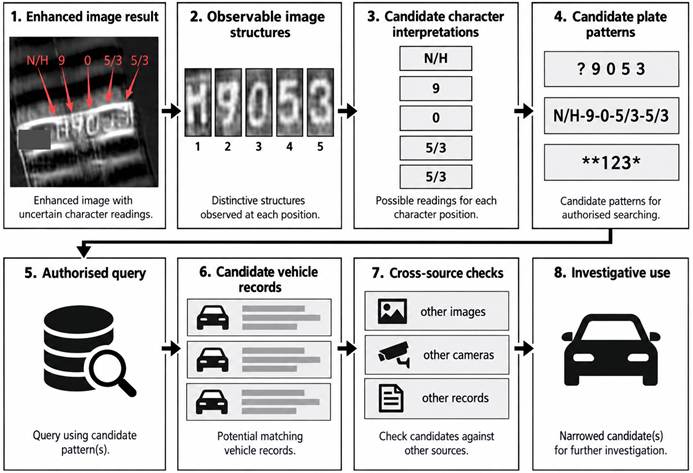
The purpose of this workflow is to convert the limited information supported by the image into bounded search criteria, rather than prematurely elevating a candidate interpretation into an identity conclusion.
A vehicle analytics platform may automatically analyse video or other vehicle imagery and generate structured information such as plate-reading results, vehicle type, body characteristics, time and location.
Within the appropriate authorised scope, candidate numbers or partial plate patterns can be queried together with relevant time ranges and accessible data sources.
At this stage, the principal function of the query is to reduce the search space rather than to identify a vehicle from the image alone.
6.2 Platform-Generated Data Versus Independent Corroboration
A vehicle analytics platform may independently run its own algorithms and generate its own structured outputs. However, if the platform is analysing the same underlying video used for the manual image examination, the two analytical processes still share the same source data.
Therefore platform-generated structured data should not automatically be described as independent corroboration.
Stronger cross-source corroboration arises when a candidate is supported by independently acquired material, such as:
- Imagery from another camera or checkpoint;
- Other independently sourced images; or
- Separate vehicle records.
A different time point should be treated as independent corroboration only where it comes from an independent acquisition source, rather than merely another frame or event within the same underlying recording.
Later information can increase certainty at the case level, but it cannot retrospectively increase the level of certainty that the original low-quality image itself was capable of supporting.
The more accurate role of low-quality plate enhancement in this wider process is therefore to provide investigative screening criteria with clearly defined evidential boundaries.
The value of an enhancement result is not limited to producing a complete plate number. It may also lie in narrowing the search space reliably without overstating what the imagery itself can support.
7. Limitations
This article is based on several real casework examples and is intended to discuss decision-making in complex low-quality licence-plate analysis, not to evaluate the performance of a particular algorithm or fixed workflow.
First, the cases were purposively selected rather than randomly sampled. They cannot be used to estimate an overall success rate for low-quality licence-plate processing, nor to determine how frequently these particular problem types occur in routine practice.
Second, the imaging conditions varied between cases. Resolution, frame rate, target size, illumination, motion, occlusion, perspective change and the number of usable frames were not consistent, and the processing strategies also differed. The final outcomes therefore cannot be used to compare algorithm performance or to establish a universally optimal workflow.
Case 3, in particular, should not be interpreted as a controlled experiment. The two processing routes differed not only in order; individual frames in the second approach may also have received different parameter settings according to their image condition. The difference in results therefore cannot be attributed solely to processing order, nor can it demonstrate that per-frame processing followed by frame averaging is generally superior to frame averaging followed by subsequent deblurring.
Multi-frame results also depend on frame selection and registration quality. Low-quality character interpretation continues to involve human judgement. Not knowing the ultimately established registration number when processing begins can reduce obvious hindsight bias, but it cannot remove subjectivity from frame selection, parameter adjustment or candidate-character interpretation.
The evidential strength of subsequent database queries and platform results also depends on their underlying data sources. A vehicle analytics platform may generate its own structured analysis, but if that analysis is derived from the same source video used for manual examination, it should not be treated as fully independent external corroboration.
In addition, not every case retained equally complete historical records of the candidate readings generated during the original examination. Some cases are therefore useful for illustrating real casework practice but should not be presented as strict blinded candidate-validation experiments.
Finally, all published material has been anonymised where necessary. Full registration numbers, dates, locations, source details and other case-identifying information are not disclosed. The published figures are therefore intended to illustrate technical phenomena rather than to reproduce the complete case context.
Within those limitations, this article can support discussion of:
how analysts assess remaining information, select and adapt processing strategies, and control the strength of interpretation in complex real-world material.
It cannot establish that one algorithm is universally superior, that one processing workflow applies to all low-quality plates, or that every blurred plate can be reliably recovered.
8. Conclusion
Complex low-quality licence-plate analysis cannot be reduced simply to selecting a “stronger” enhancement method.
In real casework, the more important questions are:
What information remains in the source material, can that information be used reliably, and how far can the resulting interpretation reasonably go?
The cases presented here used different processing strategies and produced results with different levels of interpretive certainty. Those differences do not support a single optimal workflow.
Instead, they point to a simpler principle:
Let the processing strategy follow the material.
Likewise, an image becoming easier to inspect does not mean that the conclusion should automatically become more certain. Partial characters, multiple candidates and explicitly unresolved positions may all be more defensible technical outcomes than an overconfident complete plate reading.
Therefore:
Let the strength of interpretation follow the evidence.
From this perspective, the purpose of forensic image enhancement is not simply to produce an image that looks clearer. It is:
to make information that genuinely remains in the source material easier to observe, interpret and examine without exceeding what that material can support, while preserving uncertainty where reliable determination is not possible.
For complex low-quality licence plates, retaining uncertainty is not a failure of analysis. It is part of sound technical judgement.
Guocai Wang is the Technical Support Lead for China at THIRD ENGINE SL, based in Barcelona, Spain. He has over a decade of experience in forensic imaging and image processing. His areas of specialisation include image processing, image-based identity examination, image authenticity examination, and image-based event reconstruction. His work focuses on providing practical image-analysis support for forensic image examination in criminal investigations. He also has extensive experience in technical support, case-oriented image examination, and forensic image-processing workflows.
References
1. Scientific Working Group on Digital Evidence (SWGDE). Guidelines for Forensic Image Analysis. SWGDE 16-I-002-2.0, Version 2.0, 18 March 2025.
2. Scientific Working Group on Digital Evidence (SWGDE). Image Processing Guidelines. SWGDE 15-M-002-1.0, Version 1.0, 8 February 2016.
3. Hardie, R. C., Barnard, K. J., & Armstrong, E. E. Joint MAP registration and high-resolution image estimation using a sequence of undersampled images. IEEE Transactions on Image Processing, 6(12), 1621–1633, 1997. https://doi.org/10.1109/83.650116
4. Farsiu, S., Robinson, M. D., Elad, M., & Milanfar, P. Fast and robust multiframe super resolution. IEEE Transactions on Image Processing, 13(10), 1327–1344, 2004. https://doi.org/10.1109/TIP.2004.834669
5. Liu, R., & Jia, J. Reducing boundary artifacts in image deconvolution. Proceedings of the 2008 IEEE International Conference on Image Processing (ICIP), 505–508, 2008. https://doi.org/10.1109/ICIP.2008.4711802
6. Dror, I. E. Cognitive and human factors in expert decision making: Six fallacies and the eight sources of bias. Analytical Chemistry, 92(12), 7998–8004, 2020. https://doi.org/10.1021/acs.analchem.0c00704