Neurodivergence, Trauma And Well-Being: A New Study For Investigators
Dr Fazeelat Duran joins the Forensic Focus Podcast to discuss the impact of traumatic material on investigators’ well-being and her new study exploring neurodiversity, resilience and workplace support.
Share
About this article
Podcast 23 November 2026 25 min read 5,840 words
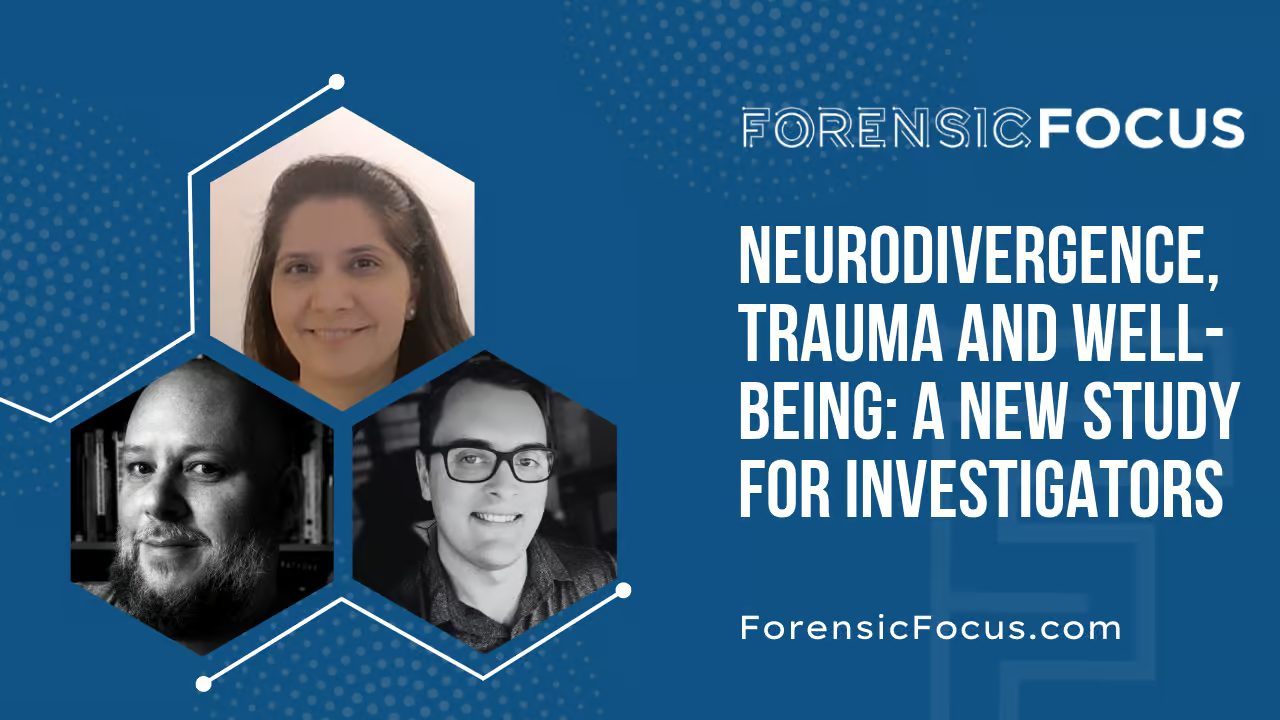










Interested in taking part in Dr Fazeelat Duran’s research on well-being and neurodiversity in forensic and investigative roles? Download the documents below to learn more and get involved:
The following transcript was generated by AI and may contain inaccuracies.
A quick word before we get into the episode. The Forensic Focus State of DFIR Survey is open now, and we’d love to hear from you. It covers caseloads, AI, tools and careers. It takes about eight minutes, and it’s anonymous. Everyone who completes it can get early access to the report, and you can enter our prize draw too. Take it at forensicfocus.com/survey. It closes on the thirtieth of November.
Paul: Hello and welcome to the Forensic Focus Podcast. Somewhere right now, someone is sitting at a screen looking at the worst things human beings can possibly do to one another, so the rest of us don’t have to. They’re not the officer at the door.
They are analysts, digital forensic investigators, the translators, the typists. We rarely name them, and we never ask how they’re doing. Today we’re going to ask that.
Hello and welcome to my guest today. She has spent over 10 years working with police and law enforcement organisations on exactly this problem: protecting the mental health and wellbeing of staff. She is an occupational psychologist at the University of Birmingham and is leading a new study that I think could change how our sector looks after people.
Dr Fazeelat Duran, welcome to the podcast. Before we get into the study itself, I want people to know who you are and why you’ve spent a decade on this. Tell us a bit about yourself. How does an occupational psychologist end up spending 10 years inside policing and law enforcement?
Fazeelat: Hello, Paul. Thank you once again for inviting me back. It’s really nice to be here again. When I started working in this area, I don’t think I ever imagined that I would be spending 10 years working alongside policing and law enforcement organisations.
My interest has always been people at work: how people experience their work, what affects their wellbeing, and how organisations create healthy working environments. During my doctoral research, when I was conducting research with frontline officers, I realised that there was this whole workforce behind the scenes that we don’t talk about.
People analysing intelligence, working in digital forensics, translating material, supporting investigations, and examining evidence. Some of these individuals are repeatedly exposed to incredibly distressing material as part of their normal working day. I became really interested in what they actually experience when they work with this kind of material.
They’re often sitting behind a screen doing highly skilled and important work, but potentially seeing things that most of us would find extremely difficult to see even once. That led me to a whole series of questions. What makes some people more vulnerable? What protects people? What does good organisational support look like?
And more recently, after having conversations with a group of people over these many years: how does neurodivergence change any of that? So I didn’t plan to spend 10 years researching policing and law enforcement. I stayed because I became fascinated by the people behind the work. How do they do this work? And there were so many questions we don’t have answers to as well.
Paul: What first pulled you towards the wellbeing of staff rather than the operational side of the work?
Fazeelat: When you’re working in policing, it’s very easy to become focused on the operational side: the investigations, the intelligence, the evidence, the technology, and the outcome. Obviously all of that is incredibly important. I’m not saying it’s not.
But as a psychologist and researcher working alongside these organisations, I kept coming back to the person doing the work. I remember thinking, we can have the best technology, the best systems, and the best practices in the world, but if we are not looking after the people who are doing this work, we are missing something really important.
What particularly struck me was that some of the people I was researching with were dealing with things that most of us would find extremely difficult, like I said before, to even see once. But for them, exposure to this material could be part of their working day.
Besides that, they have meetings to attend, deadlines to meet, reports to write, colleagues to support, and then they go home and have their own duties supporting their family members. That human side of the work really stayed with me.
So my question gradually shifted from “How do we help people perform this job?” to “How do we make sure people can do this important work without it coming at an unnecessary cost to their own wellbeing?” I think that question has stayed with me throughout my work in this area over these many years.
Paul: It’s quite obvious to me that you’re really drawn to the human element here, the human cost of doing this work.
Fazeelat: Because humans are so important. At the end of the day, we are all human. If we want a good quality of life, if we want success at every point, we want to be good humans, and at the same time we need to make society better for other humans as well. So it’s all about humans for me.
Paul: I think you touched on a really important point there. Because we are all human, we are all vulnerable to the stressors that this job brings.
Fazeelat: Of course. If I was supposed to do this job for a day, I wouldn’t be able to do it, and these people are doing it for a long time. On top of that, like I said, they have to look after their colleagues, they have to meet deadlines, and then they have to go back home, get back to normal, and support their family.
So it’s not a simple and straightforward journey for them. At the end of the day, they’re protecting us, so how can we protect them? How can we look after their mental health?
Paul: Absolutely. When you talk about distressing or traumatic material, what does that actually mean day to day for the people that you study?
Fazeelat: I think this definition is really important, Paul, because people do get confused when I say that we are working with professionals who work with distressing or traumatic material. It can sound quite abstract.
For the people I have conducted research with, it can mean being exposed to the distressing or traumatic experiences of other people through different modes of exposure. That might be through photographs, videos, audio recordings, written material, or other digital evidence relating to serious offences.
Their role might involve reviewing, translating, categorising, or processing the material as part of an investigation. What can be difficult to appreciate from the outside is that this can happen while they’re simply sitting at a computer going through their normal working day.
There is nothing dramatic about the working environment itself. They might be at their desk, having a meeting, answering emails, but at the same time they have to go back to reviewing the difficult material they are working on.
So when I talk about exposure, I’m not necessarily talking about someone being physically present at a traumatic incident. I’m talking about being exposed to material relating to extremely distressing events through the course of their work.
I think that distinction is really important, because these are highly skilled professionals doing essential work, but the nature of what they have to engage with as part of their work can be very difficult.
Paul: Yeah, you’re right. It is a really important distinction to make, isn’t it? A lot of people think about post-traumatic stress or secondary traumatic stress as something that happens when you are present at an event, when it happens in front of you.
But what a lot of people don’t realise is that you can actually become susceptible to both of those things by being exposed to the content that digital forensic investigators deal with every single day.
Fazeelat: Yes, and you might have noticed as well that secondary traumatic stress now falls under the DSM criteria for PTSD, so it’s part of it now. It’s not considered a disorder on its own. That means that if an individual is exposed to trauma indirectly, they are at risk of developing PTSD symptoms as well.
Paul: That’s a really important point to make, because historically, secondary traumatic stress and PTSD were treated as separate things.
Fazeelat: Yes.
Paul: But within DSM-5, secondary traumatic stress now comes under the umbrella of post-traumatic stress, doesn’t it?
Fazeelat: Yes.
Paul: I think that’s a very important point to make. So let’s name the roles, because some listeners won’t have a word for the group that we’re talking about. The study calls them secondary investigators and analysts. They work with the material, but they aren’t frontline responders. So who exactly are we talking about?
Fazeelat: That’s a difficult question to answer, Paul, because we have been trying for three or four years to come up with an umbrella term for this group of professionals, and eventually we decided to go with “secondary investigators and analysts.”
But like I said before, there is nothing secondary about their roles. It’s just to separate them from the officers who are working in frontline roles. They could be working in varied roles, but what connects them is that they may be required to engage with distressing material as part of their work.
For example, someone working in digital forensics might have to examine digital devices and identify relevant material, and analysts might be reviewing information across a large investigation. A translator may be required to work through recordings or written material, while someone in an investigative support role might be exposed to material while helping to understand a case.
So one of the important things is that we shouldn’t think of this as one particular profession or type of worker. It relates to a much wider workforce supporting policing and the criminal justice system. And because many of these people aren’t necessarily visible to the public, their experiences can easily be overlooked.
That is why we describe them as professionals who are working with distressing material, whether investigators or analysts, because different units call them different things as well.
Paul: Exactly. I was just going to say, someone can do the same job in a different country, and it’s often referred to with a very different label, isn’t it?
Fazeelat: Exactly. Some just call them officers. I was working with one organisation, and they call them officers, and I thought, “Okay, that’s more challenging to differentiate between the two.” If you at least have “investigators and analysts,” you can call them secondary investigators.
But they call them officers because they want to treat them in the same way as frontline officers, and make sure they are treated equally in terms of the support that’s provided to them.
Paul: So the term used in the study, secondary investigators, is an overarching term to capture everyone who does that work.
Fazeelat: Exactly. Yes.
Paul: So why do you think repeated exposure to this kind of material carries its own particular risk, different from ordinary job stress?
Fazeelat: I think the key word here is “repeated.” There is a difference between encountering a distressing event once and having repeated exposure to difficult material.
For some people who are exposed to trauma, it could be just a one-off event. It can be part of the task they’re employed to do, and they may encounter a distressing event. But there is a group of people who are repeatedly exposed to it. That’s part of their job, and they have to do it.
That’s important, because you’re not able to simply walk away from it. You have to do the job. You may need to review the material carefully, make decisions about it, record the information, communicate with your colleagues about it, and then move on to the next piece of work.
You don’t stop at one case. You have to start working on another case. So there can be this combination of repeated exposure and the demands of continuing to work professionally.
It’s also different from ordinary workplace stress. Most jobs involve deadlines, workload, difficult colleagues, or pressure. Based on my research with them, they have these demands as well, but on top of that, they also have this repeated exposure.
I would like to flag here that it doesn’t mean everyone who is exposed to this material will experience psychological difficulties. People respond very differently, and that’s actually one of the things that interests me most as a researcher.
Paul: I think you’ve just touched on a very interesting thing there, because some of the research that’s already been done internationally suggests that how a person perceives what they’re viewing will affect their reported feelings of PTSD, for example, or stress or anxiety. So it’s a very interesting subject to study.
Fazeelat: Yes. When we conducted a study with newly recruited investigators and analysts, we found that some people were showing symptoms of depression while others were not. So what is happening? How is this individual different from that individual?
We were conducting interviews with them at the same time, and we were trying to understand what was having an impact, and why one individual was less at risk of distress compared to another.
That’s interesting, because once we understand those factors, we can support people in a better way. For example, we identified mental imagery, like we discussed before. We also identified belief in a just world. There are many factors that make one individual more at risk of distress compared to others.
Paul: That discussion is definitely open for argument across the research, because some will find in favour and some will find against. It’s a really interesting area.
Now, one of the myths that gets spoken about around digital forensic investigators and the evidence that they deal with is that you get used to it. What’s your view on that?
Fazeelat: I’ve heard that as well. There is a myth that if you do this work for long enough, you will get used to it. In reality, I think it’s much more complicated.
I remember speaking to some of the DFIs in one of my studies, and one said, “I think I can work with this material because, I don’t know why, but I can easily compartmentalise the information. I have been working for this long, I’m desensitised towards the material.” But at the same time, that person also said, “I don’t know how long this is going to last, or whether it’s going to be the same when I leave this role.”
So there is a myth that it doesn’t impact you, or that you’ll get used to it, but it is very complicated. People can develop coping strategies and learn how to manage repeated exposure, but that doesn’t necessarily mean that the material stops having an impact.
For some, the effects can build gradually, affecting their sleep, mood, relationships, their ability to switch off, or how they feel about their work. And because many people continue to function very well professionally, it isn’t always obvious when they’re struggling.
I think that’s also part of why this workforce has been overlooked. When people come to work and perform, others start thinking, “Oh, everything is fine. They do the job perfectly.” And when we think about trauma in policing, we often think about officers attending traumatic incidents. We don’t think about the people behind the scenes who are repeatedly exposed.
So we need to recognise that exposure can take different forms, and make sure people have appropriate support, rather than assuming that because someone is functioning well and coming to work from 9:00 to 5:00, they’re fine. I don’t think that’s the story.
I do think there has been a shift, although I wouldn’t describe it as a major one. Since I started, I can see there has been some shift. There is more awareness now of the experience of staff and the impact of repeated exposure to distressing material, and more willingness to have conversations as well.
But there is a long way to go. We’re seeing a shift in awareness, but we need to translate that into better understanding and better support.
Paul: I think you mentioned a couple of interesting things there. One was coping strategies, and we both know through research that we’ve done that coping strategies aren’t necessarily proactive.
Fazeelat: Yes.
Paul: Some can be quite destructive as well, can’t they?
Fazeelat: Yes.
Paul: And you also mentioned that when someone’s turning up and performing at work, that doesn’t necessarily mean they’re all clear, does it?
Fazeelat: No. And I think that is the thing, isn’t it? People come to work, they smile and go home, and that’s taken to mean they can perform their job well. That then feeds into the myth you asked me about, that you get used to it.
They start getting used to it, even if they know there is no support for them. They get used to it by doing a typical 9-to-5 job. That’s why I was saying it’s more complex. It’s not straightforward.
Paul: It is. So the main purpose of today’s podcast is to launch your new study, and that’s why neurodivergence is at the heart of this episode. Your study is especially interested in secondary investigators and analysts who are neurodivergent, and importantly, that includes people with a formal diagnosis and people who identify as neurodivergent.
You’re also gathering information from neurotypical professionals in the same area. So tell us why that framing matters. Why does it matter that you’re gathering data from both neurodivergent and neurotypical individuals?
Fazeelat: First, I’ll tell you where this idea came from. I was sharing my findings from the neurotypical study, on how people are exposed to distressing material and what impact it has. I started sharing these findings at conferences, with different organisations and different police forces, and one question kept coming up consistently: “What about neurodivergent staff? Our brains don’t work the same way.”
That really made me stop and think. If we are trying to understand how people experience repeated exposure to distressing material, can we really assume that the same factors will affect everyone in the same way? That was the starting point for this study.
We wanted to look at neurodivergence more directly and understand whether there might be different experiences of risk, resilience, and support. When we use the term “neurodivergent,” we are talking about people whose cognitive or neurological functioning differs from what is typically expected, including, for example, autism, ADHD, dyslexia, and other forms of neurodivergence.
So we’re not focusing on one specific form of neurodivergence. We are making it quite broad. And we are not requiring a formal diagnosis, because a formal diagnosis can take time. We all know that. It can take ages. If you know that you are neurodivergent but you don’t have a formal diagnosis, we want you to take part in the study. We didn’t want that to be a barrier to taking part.
We were really interested in the experiences of people who are diagnosed and people who are not diagnosed, rather than simply saying that if you’re diagnosed you can take part, and if you’re not diagnosed you cannot. That’s the reason we want to include both.
Then comes the question of why we are comparing them to neurotypical people. What we heard from people was, “Our brains don’t work the way neurotypical people’s brains work,” so we wanted to understand what is happening behind the scenes.
That means looking at factors like workplace support, the working environment, coping strategies, and how people switch off, which may affect people differently. We need to understand how they differ from neurotypical people in terms of their risk, the support they need, and their resilience.
Paul: I have to say I wholeheartedly agree with the approach you’ve taken, where you’re considering neurodivergent individuals with a diagnosis and neurodivergent individuals who don’t have a diagnosis. Because, as you touched on, the waiting list for people to get diagnosed in the NHS currently is unbelievable. It’s really, really long. Some people are waiting for years.
Fazeelat: It’s very long. A number of people approached us when we were doing an RCT study and said, “We are not diagnosed, but we know we are neurodivergent. Can we participate in the study?”
From those conversations, we decided that when we designed a neurodivergent study, we would include both people who are self-diagnosed and people who are diagnosed. We’ll compare them with neurotypical participants, but we’ll also measure traits as well.
Some people might have clinical-level traits of autism or ADHD that they’re not aware of, so we’ll also look at how those traits relate to their risk of distress compared to others.
Paul: That actually runs into my next question: why put neurodivergence at the centre of a study about trauma exposure and wellbeing? It’s to understand what their reaction might be, isn’t it?
Fazeelat: Yes, to understand.
Paul: And of course, that would lead to a better understanding of the support that neurodivergent DFIs may actually require to do the job well.
Fazeelat: Yes, because we are aiming to provide more tailored support. We are asking whether support needs to be more tailored, rather than having a one-size-fits-all approach. If we want the support or resources to be tailored towards this group of professionals, then we need to capture everyone, irrespective of their diagnosis.
Paul: So there’s a strengths side to this too, isn’t there? Because many of these roles are done exceptionally well by neurodivergent people. How do you hold the strengths and the risks at the same time?
Fazeelat: Based on the literature I have read, I wouldn’t want to frame neurodivergence purely in terms of risk or vulnerability. Neurodivergent people can bring real strengths to the role as well, like attention to detail, pattern recognition, and sustained focus.
Someone can be exceptionally good at their job and still experience particular challenges. There might be a group of people who are really fantastic at their job, and who might say, “We are not getting emotionally distressed by the material, because we don’t have that emotional element, so it doesn’t impact us.” But at the same time, they might have other challenges.
So those things can coexist. We are trying to understand the whole picture: what might create challenges, but also what enables neurodivergent staff to thrive. That would help us understand the factors that help them thrive, and the factors that could be challenging, which can coexist at the same time.
Paul: Indeed. So what do you hope to learn by comparing the two groups, neurodivergent and neurotypical?
Fazeelat: I think comparison is important because it helps us understand what’s specific to neurodivergence and what’s more generally part of the job they are doing. Because it’s not an easy job that they do.
Paul: No, it isn’t.
Fazeelat: If we only studied neurodivergent staff, it would be much harder to know whether particular experiences were different or similar across the forces. By looking at both groups, we can identify where experiences are similar and where they are different, and that can help us support them in a much better way.
Ultimately, we are trying to move beyond assumptions and understand what actually matters for people’s wellbeing, to be very honest. That’s our focus.
Paul: That’s really interesting. And I suppose by using the psychometrics within the survey, you’ll be able to identify whether certain stressors affect each group in the same way, or whether they differ.
Fazeelat: That would be an interesting finding. I’m hoping that we have a good number of participants in each group to make the comparisons, because then we will be able to say quite explicitly: these are the challenges this group has, these are the strengths of this group, these are the distress levels of this group. It will be really useful to have those kinds of conversations.
Paul: Exactly, because that goes towards the support that can be given to neurodivergent individuals to do the job to the best of their ability.
Fazeelat: Yes.
Paul: So let’s get practical, because this is the bit I really want people to act on. There are two parts to the study, and you can do one or both parts. Isn’t that right?
Fazeelat: Yes.
Paul: So tell us about the survey. Who is it open to?
Fazeelat: The online survey is going to take approximately 35 minutes. We have pilot tested it, and based on that, we’ve identified that it takes about 35 minutes.
The online survey is open to people working in policing, law enforcement, and defence who are exposed to the distressing or traumatic experiences of other people, or who are exposed to trauma indirectly.
We are interested in a wide range of roles. Like I said before, this could be analysts, digital forensic staff, intelligence professionals, behavioural investigative advisers, translators: anyone who regularly engages with this type of material.
For the survey, we are interested in neurotypical people, neurodivergent people who are diagnosed, and neurodivergent people who are not diagnosed, so that we can make comparisons across different factors.
We are measuring emotional and cognitive difficulties, occupational and social factors, and distress levels and wellbeing as well. So it’s quite a comprehensive set of psychometric measures. The aim is to understand the different factors that may influence how people experience this type of work and their overall wellbeing.
It’s an online survey, and it also allows you to take breaks. If you think you won’t be able to sit for 35 minutes, there are complete guidelines on how we can support you. You can take a break and then come back to complete the survey.
Paul: Excellent. And of course, it’s a two-part study, isn’t it? The second part is interviews and focus groups for those who wish to take part. So who are those for?
Fazeelat: For the interviews and focus groups, we are specifically focusing on neurodivergent investigators and analysts. And please don’t forget that “secondary investigators and analysts” is an umbrella term. That doesn’t mean you can’t participate if your job title isn’t investigator or analyst.
For the interviews and focus groups, we are recruiting neurodivergent people who are self-diagnosed or diagnosed. You can’t participate in both the interviews and the focus groups; you can participate in one of those elements.
Let me give you a bit of background. As part of this study, we co-designed the research with experts in the subject area, with Paul and others, and one of the suggestions was to include focus groups alongside individual interviews because of the needs that neurodivergent people might have.
So based on that, we give participants the option of taking part in an interview or a focus group. The interview is one-to-one. The focus groups will be conducted with five to eight people, but we are trying to keep it to around five so that people can share as many experiences as possible.
We are also giving people the option, if they can’t speak in a big group and they can’t speak one-to-one, to share their experiences in the chat during the focus group, and we can keep that recorded as well and use it in our analysis.
So we are trying to be as adjustable as possible. At the start of the interviews and focus groups, we are trying to accommodate people as much as possible. We can provide instructions or guidelines beforehand on how we can support you during the focus group or interview.
Paul: I think something you just said there is really important. You are obviously making this as accessible as possible for neurodivergent individuals, because they do encounter accessibility problems. I think it’s important to point out that you’ve built this into the study, haven’t you?
Fazeelat: Yes. We are trying, as much as possible, to meet their needs and to make it as flexible as possible for them, so that they feel included. It’s not just for the sake of ticking boxes. We value what they say.
We have also had feedback that in some instances we can share the questions with them beforehand, so they can have a look before the interview. I know that with some groups of people, they can’t bring their thoughts together immediately. This way they can think about it beforehand, bring those points to the meeting, and we can discuss them in the focus group or interview.
So that’s what we are trying to do, to make sure that they feel heard and valued.
Paul: I think that’s a really great approach, actually, being able to supply the questions to those who want to take part before they actually take part. Because, as you’ve just said, it gives them the time they need to process the information that they want to share.
Fazeelat: Yes. We have heard that some of them might have difficulty answering questions immediately. They like some time to think about it, to process the question, and then respond.
So we are giving them a certain amount of time to think about it and come prepared, so that they don’t feel like, “Okay, we can’t answer these questions, the thoughts are not coming to mind.” That should help them.
Paul: I think a great deal of thought has been put into making it that accessible.
Fazeelat: Thank you, Paul.
Paul: And it’s really nice to hear that, I have to say. If this study goes the way you hope it does, what are the changes that could come from it?
Fazeelat: I’m excited about that bit. I would hope the study contributes to a better understanding of what these staff need to stay well while doing their work.
I would like to see more tailored support for them, better awareness of the challenges associated with repeated exposure, and also of the things that help them thrive. And organisations thinking about their wellbeing proactively, rather than only responding when people are struggling.
We want the findings to reach the people closest to the workforce, such as team leaders. We’ll be sharing the findings with wellbeing leads, senior leaders, policymakers where possible, and the wider community as well.
Some of the changes may need to happen at an organisational level. I’m not saying that all the changes are supposed to happen at the individual level. Some of the changes might need to happen at the organisational level, so we’re trying to reach as many people as possible.
Paul: For the individual analysts or examiners who are listening and contemplating taking part, what’s in it for them? Why is their voice worth 35 minutes of their time?
Fazeelat: I think the biggest thing is that their experience matters. The study isn’t just about producing a research paper. We want to use what we learn to develop practical resources.
We are planning to create videos that could be used in training. We are producing infographics for senior leaders on how best to support their team if they have a neurodivergent staff member, and eventually a recommendations report for organisations as well.
But those resources will only be genuinely useful if they’re informed by the experiences of the people actually doing this work. So by giving us around 35 to 60 minutes of their time, they’re helping us understand what the challenges really are, what support is helpful, and what might need to change.
Ultimately, we want those experiences to help shape better support for neurodivergent staff in the future.
Paul: I think it’s that collaborative, trauma-informed approach you’ve taken that’s going to get the most out of people, especially in the focus groups, isn’t it? And it’s so important to work collaboratively, because the participants are the experts in their own field and the experts in their own emotions.
Fazeelat: Yes. And if any participant would like to be part of the co-creation process, they’re more than welcome to reach out and let us know. When we are creating videos, we can take feedback from them. If they would like to give feedback on the infographics, we are happy to take that on board, to make sure the resources we create are relevant to what they’re asking for.
So please feel free to reach out if you would like to be part of that co-creation side of the study. I’m more than willing to take your feedback on board, discuss it with the expert team, and see what we can do with it.
Paul: And this is bigger than one study, isn’t it? It’s about a culture shift in how we treat people who do this work. Do you think this will assist in shifting that culture? Where do you see that heading?
Fazeelat: That’s what I’m hoping. I hope there is some shift in culture towards thinking about neurodivergence not as a disability, but rather thinking, “Okay, if you’re neurodivergent, you have certain strengths and certain challenges, and how can we support you in a better way?”
And when senior managers have a member of their team who is neurodivergent, they know how to support them in a better way.
Paul: Ladies and gentlemen, if you take one thing from this episode, take this. If you are a secondary investigator, an analyst, a digital forensic investigator, an intelligence officer, a translator, a typist, a behavioural investigator, this study wants to hear from you.
Neurodivergent or neurotypical, diagnosed or not, it’s voluntary. You’ll get all the details in writing first, and it could genuinely improve how this sector looks after people.
Do the survey. We will supply the link with this podcast. If you’re neurodivergent and want to go further, you can email Dr Tia Bennett, whose details we will also include with this podcast, to join either the interviews or the focus groups.
And the third thing you can do is share this episode with at least one colleague who needs to hear it.
Dr Duran, it’s been an absolute pleasure. I am a big fan of what you’re doing, and I hope to talk to you in the future about the results of this, if that’s okay.
Fazeelat: Thank you, Paul. I think this would not have been possible without you. You are one of the expert members sitting on the committee supporting us. I’m looking forward to the findings, and I’m more than happy to share them as well. Thank you, everyone, for listening.
Paul: Amazing. Thanks very much for joining us again.
Fazeelat: Thank you.
Featured videos Sponsored
All videos
Related articles
All articlesInterviews
Andrew O’Malley, Developer of Veilio