








The following transcript was generated by AI and may contain inaccuracies.
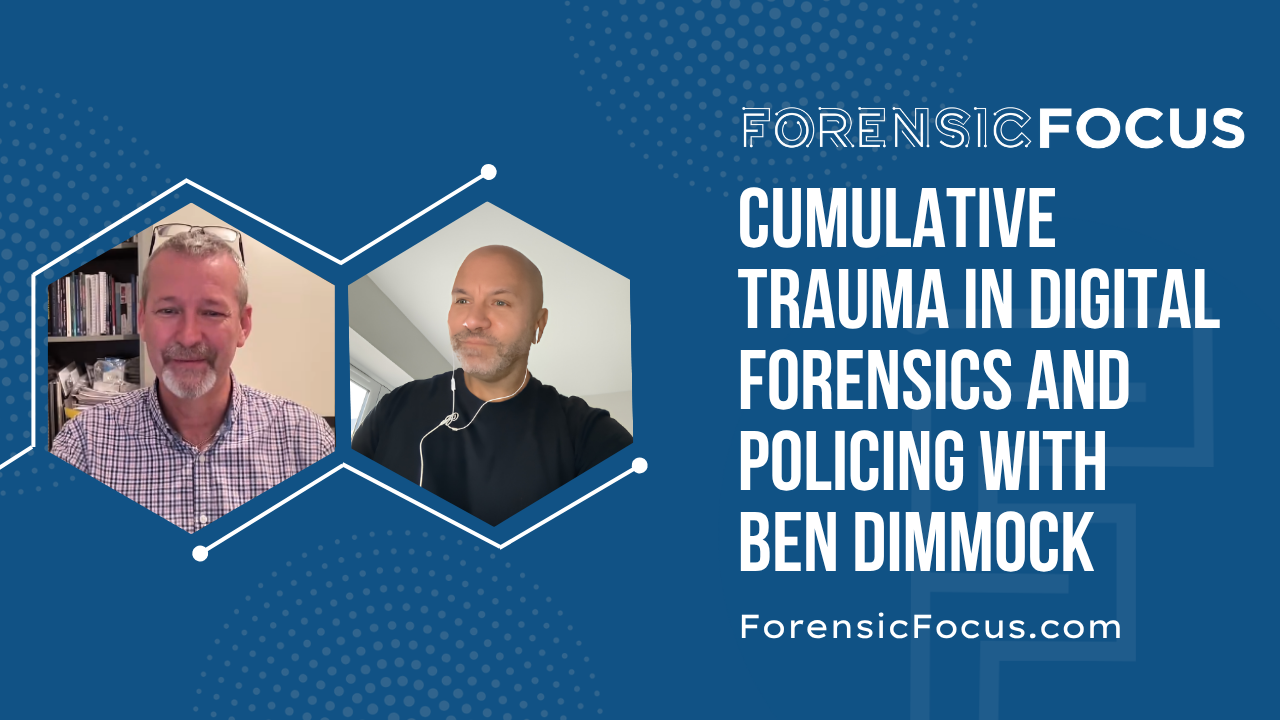
Paul: Hello everyone, and welcome back to the Forensic Focus Podcast. Today’s episode is one I have genuinely been looking forward to for quite some time, because we’re going to be talking about something that affects almost every area of policing and digital forensic investigations, yet still often remains difficult to openly discuss. We’re talking about psychological safety, trauma exposure, organisational culture, and the long-term emotional impact of working in high-pressure investigative environments.
Joining me today is Ben Dimmock. Ben is a police inspector, hostage and crisis negotiator, and someone who has become an increasingly important voice in the conversations around officer welfare, trauma-informed leadership, and psychological safety within policing cultures. Ben has spoken openly and honestly about issues including trauma exposure, suicide prevention, misconduct investigations, organisational harm, and the responsibility institutions hold when it comes to protecting the people doing these incredibly difficult jobs.
Ben, thanks so much for joining me today.
Ben: Oh, it’s a pleasure. It’s lovely to see you, and thanks so much for having me on the podcast. Really appreciate it.
Paul: I think a really good place to start is simply by hearing a little bit about your journey, because people listening may know your recent well-being work, but perhaps not the path that brought you here. Can you tell us a bit about your policing background and how your perspective on psychological well-being evolved over time?
Ben: Yeah. I’ve been in policing 24 years now. I’ve done a variety of different roles — operational policing, frontline. I was a detective. I’ve been in community policing, covert policing, intelligence, and then I was promoted to sergeant. I did community safety, I did offender management, and then inspector. I’ve done various roles, which has led me to this.
Just to put some context on it, about 12 years ago I was really poorly with depression. It hit me incredibly hard, and back then in policing there was a stigma, there’s no doubt about it. We didn’t talk about mental ill health like we do now, and it was something I felt I had to hide. Because I hid it, I became a lot poorlier than I would have done if I’d opened up and sought help earlier. I didn’t want anybody to know, because I was a sergeant at the time, I was a dad, I was a husband.
I thought it was weak, and I thought I would be punished by an organisation if I opened up and showed vulnerabilities — what I then perceived as weaknesses. I thought that would destroy my career. I got through that, and what happened on my journey to recovery was that I started to open up and started to do presentations to various departments and teams around mental health, which was never even spoken about at that point.
What it did was incredible. The emails I would get from officers and staff saying, “Wow, I can’t believe your story. You gave me the courage to open up and talk about how I’m feeling now.” That’s all I ever wanted — if I could save one person through that conversation, I would.
Then, fast-forward, four years ago we set up a full-time well-being team in policing — again, something that when I joined we would never have had. I was lucky to become the lead for it, and now, 24 years in, I’m the Force Well-being Lead and inspector for the well-being team. I remember people saying to me, when I opened up my story, “That’s career suicide.” But look where I am now. That’s how far we’ve moved on in the organisation around psychological safety, which we’ll hopefully talk about later. Having a full-time well-being team where I’m at now — that’s our aim, that’s our mission, to make an organisation that’s psychologically safe.
Paul: I have to say, it’s really refreshing to hear such a senior leader within the police force talk so openly about your own experiences of depression. By doing so, as you said yourself, you had other officers contact you saying, “Thanks for saying that, that’s really validated how I feel.” How did getting those emails make you feel?
Ben: Incredible. I didn’t know how it would land. I created a presentation about my story, and it could have gone completely wrong. All I was, was open and honest about my story, about the thoughts and feelings around why I had to hide it and how it made me feel.
Then watching it land — honestly, it wasn’t just one email, it was two, three, four, five, six. Over a period of a week to a month, probably 20 or 30 emails from people saying, “I’m going to go to the GP,” “I’m going to talk to my supervisor.” It was just incredible. I thought, these are people I’ve now enabled to feel safe and have the courage to speak to their supervisor, which they hadn’t previously been able to do. It was wonderful. We still have some way to go, but wow, have we moved on since then in policing.
Paul: As you know, I regularly watch and read the posts you put up on LinkedIn, and for anybody watching this who isn’t connected to Ben’s LinkedIn posts, you really should be. Ben speaks very openly and very bluntly about the problems he encounters in policing, and he’s well worth following.
Ben, was there a particular moment, or perhaps a series of experiences, where you realised well-being was something policing needed to confront more openly and more honestly?
Ben: Yeah, absolutely. For years I’d seen well-being as a token gesture — something that sat on the sidelines, seen as a tick-box exercise. Those in policing who have been in for a number of years have probably seen that. But the result of treating well-being as a tick-box exercise, as something that doesn’t become the norm within operational policing, is that you then start having people leaving the organisation. You start seeing massively increased burnout and sickness. You start seeing suicides, really at-risk situations where, if we’d managed to have those open conversations earlier on, we could have prevented some of these things.
Moving on now, we’ve got 43 forces in England and Wales, and it’s mandatory to have some form of well-being provision. Some forces have hardly got anything. Some forces are very fortunate — Bedfordshire, our force exec and chief constable have invested in a full-time well-being team. I think we’re probably the biggest well-being team in the country. I feel so sorry for the likes of the Met, who have had a lot of their well-being services disbanded. I can’t understand it.
Paul: I’ll never understand that.
Ben: I don’t. It’s a must. I hate the fact that some people still see well-being as a pink and fluffy thing to have. It’s an operational necessity. You can’t not have a well-being function in policing now, and it should be at the forefront of every leader’s mind, whatever they’re doing — whether it’s a basic one-to-one with a member of staff, all the way up to a major operation. Well-being has got to be built into the whole of operational policing, at every rank. Otherwise there are key risks.
Paul: I totally endorse what you just said. Well-being has to stop being a nice to have.
Ben: Absolutely.
Paul: And it must become a must have.
Ben: Yeah, a must have. Time has shown that, with the sickness rates, with officer burnout, with trauma. When I joined, I do a lot of reflecting, and I speak to a lot of people. People say, “Oh, it was different back then.” I don’t know if it was different, but we didn’t have social media like we do, we didn’t have phones recording everything you do. Of course it was traumatic, but there was very much a “just get on with it” culture. When you look back at it now, it’s horrendous really, because that cumulative trauma builds up over time, and we’ve seen people leave — and they probably left because they were absolutely burnt out and with PTSD.
Paul: I think you’ve just touched on something really interesting there, really important actually, because policing historically has often rewarded stoicism, hasn’t it? You keep going, you get the job done, you don’t let things affect you. But the reality is that human beings simply don’t work like that indefinitely, particularly in high-risk roles such as policing.
Ben: Absolutely. You’re spot on. We have rewarded that, and what it’s done is create a culture where people just carry on and carry on until one day they burn out. We see that in various forms — whether people just leave the organisation, and we’ll never know if they’ve done it because they’ve burnt out unless they tell us, or people going off long-term sick. And it doesn’t have to be just mental health. We see a lot of people off with physical symptoms that can be linked to mental ill health.
Paul: That’s something a lot of people don’t think about. They don’t think of the physical manifestation of mental health issues, do they?
Ben: Absolutely. It all interlinks. That’s why I always say to managers, yes, look out for the obvious mental-health-related illness — stress, anxiety, depression — but also those going off with muscular conditions, high blood pressure, bowel conditions. All of these things can be massively affected by the brain, and we forget that. For me it’s a risk point where managers need to go, “Okay, we need to do some serious checking in and make sure they’re okay, because it could be something else.”
Paul: That leads quite naturally into a discussion around psychological safety, doesn’t it? Because it’s a phrase people hear increasingly often now, but I’m not convinced everybody fully understands what it means in practice. So when you talk about psychological safety in policing, what does that actually mean to you?
Ben: For me, psychological safety is creating a culture where people feel safe to say “I’m not okay” and feel they’re not going to be punished for it — but also where there’s no fear that if I make a mistake, I’m going to be punished. It’s okay to have those open and honest conversations and to learn from them without the constant fear of punishment, or of facing professional standards with misconduct or gross misconduct. People are human, and the more they hide and keep things because they fear it’s not safe, the more we lead to all sorts of other risks.
It’s as simple as it says on the tin. It’s creating an environment where people feel safe to say “I’ve made a mistake” or “I’m not okay,” and know they’ve got a trusted, safe space to go to — whether that’s a peer, a supervisor, the well-being team, a leader, whoever. Psychological safety comes right from the top down. But I always say to people, it’s not just your leaders, not just your chief constable and senior leaders, who create psychological safety. It’s all of us, everybody. They set the tone and the culture, absolutely, but we’re all responsible for it.
If I had a colleague on my team and I was worried about them, if I thought they were acting differently to normal, rather than just leave it I’d say, “Are you okay, mate? You don’t seem the same today. You’re really quiet compared to the other day. Should we go for a cup of coffee?” It’s about all of us taking responsibility for looking after each other, and that for me is what creates psychological safety.
Paul: I really like the way you framed that, because psychological safety isn’t about removing accountability or avoiding difficult conversations, is it? It’s about creating an environment where people feel strong enough, safe enough, to say, “I’m struggling, I need support, this work is affecting me” — without fear of ridicule or judgment or career consequences.
Ben: A hundred percent. It means early intervention — visible leadership, peer support, trauma-informed supervision, good well-being structures. That all creates psychological safety. It’s not just about reacting when somebody is already broken, and that’s what I think we’ve previously done in the past. We react when somebody’s broken. We’ve moved on. We can’t let that happen. We’ve got to get early intervention in and prevent that. That’s psychological safety.
Paul: I’m a huge advocate for proactive support when it comes to mental health and well-being. Historically — and I’m not just saying this about police forces, but employers in general — people have often offered a reactive service and not a proactive service. And the damage that can do long-term to someone who is struggling is quite significant.
Ben: Absolutely. I’ve seen over the years so many people now struggling silently, and that’s the sad thing. You hit it on the head when you said we became very good in policing at operational resilience. But I’ve seen experienced officers burn out, experienced officers withdrawing, people becoming more cynical, people carrying years of unresolved trauma. Everybody used to think well-being was this soft, pink and fluffy thing. Now I think it’s almost not too late — we’ve got a lot of catching up to do — but it absolutely has to be operational in everything we do.
Paul: When it comes to catching up, the work you and your team are doing down in Bedfordshire is absolutely first class. If I was asked who could come and take best practice from someone, my recommendation would be to send them to you.
Ben: I appreciate that, Paul. There are some wonderful forces doing some incredible things. I’m just really fortunate that I’ve got a team of six, and we can be more visible. We were really lucky to win at the Oscar Kilo National Well-being Awards last year. We took a number of different awards across different categories, and it was incredible to be recognised for what we’re doing. But we don’t do it for awards.
Paul: No.
Ben: We’ve got a team that genuinely cares. This isn’t a job to me. I’ve been in 24 years, and I’ve got no interest in further promotion. I love what I do — it was almost like a calling. It sounds silly, doesn’t it, but it was a calling to me, and when it came I thought, “This is me.” All I want to do now is look after my team and create this culture where we make people feel safe. As a team we average around 80 to 100 welfare interventions a month with members of staff — that’s people who are simply having a bad day through to people in crisis. We probably manage two to three suicidal high-risk people a month as well. So the team are incredibly busy.
In addition to that, we’re going out delivering training, doing pop-up surgeries, clinics, coffee mornings, team-building days, running walk-and-talks, doing meditation classes, boot camps. We’re trying all sorts of things to be visible and really being there for anybody who needs us.
Paul: You guys must never stop.
Ben: It’s a good point, because I always say I’m very conscious that my team take on a lot of trauma for everybody else. So who looks after the people who look after everyone else? We’re a good team, we look after each other, but I’m very mindful of that, and I ensure they receive psychological supervision as well, because they hear and see everything, and it’s a lot for them to take on. Secondary trauma, vicarious trauma — it’s huge. So I’m very alive to that and make sure they’re looked after and cared for.
Paul: That’s a really important point you’ve just made — who looks after those who look after everyone else. That’s quite often overlooked.
Ben: It is. It’s just taken for granted — “you’ve got a full-time well-being team.” But I still say to this day, yes, we’ve got a full-time well-being team, but we can’t fix everything. Well-being is everyone’s responsibility, right from the chief constable all the way down. We’ve all got to look after each other. Yes, we can help and support, but supervisors and everybody have a duty to look after each other.
Paul: I totally agree. One of the problems policing has historically struggled with is that resilience sometimes becomes interpreted almost as emotional suppression — as if being affected means you’re weak — whereas actually being affected by traumatic material is often a completely normal human response. And it goes back to what we were talking about earlier with stoicism. It became the norm for a very long time. But thankfully, as you’ve just explained, things are changing for the better.
I’ve seen this particularly within digital forensics and online child abuse investigations. You’ll have investigators spending years repeatedly exposed to some of the worst material imaginable, while simultaneously being expected to function at an incredibly high cognitive level. Eventually, for some people, the system between exposure and support just breaks down, doesn’t it? And that will be the same for frontline cops as well.
Something you’ve spoken quite powerfully about is the cumulative nature of trauma. I think that’s especially relevant within policing. Every single day of every single week when you’re on duty, you are exposed to some level of trauma. And eventually that is going to affect you in some way, isn’t it?
Ben: Yeah. This is what worries me the most, and what I try so hard to encourage people to address, because we take it for granted in policing that this is the norm. From your frontline officers going to horrendous jobs, to your investigators dealing with serious complex crime, horrendous child abuse, serious sexual offences — that just becomes the norm, that they’re doing this day in, day out. You get into this mode of professional masking, and you just carry on, because you know the job’s got to be done. We can’t all down tools and leave, otherwise policing would end. We’ve got to do the job, but we’ve got to be mindful that it’s not normal. Some of these jobs are not normal.
So what do we do about that? That’s why it’s so important that supervisors do one-to-ones. We are hounded about one-to-ones, and people go, “Oh, one-to-ones.” It’s not just about checking workload. For me, the top part of the one-to-one has got to be around welfare — are you okay? How are you doing? How’s everything at home? Regular check-ins, looking for signs and symptoms, making sure people are safe and well.
But also, when they have dealt with a traumatic job, what support have we got in place? Do they need to speak to a peer supporter? Do they need to speak to the well-being team? Do they need to do a TRiM? We do TRiM in our force — Trauma Risk Management assessments — to help people process that trauma. I always say trauma sticks. The more jobs you go to, it sticks and sticks, and eventually it’s going to weigh you down, and at some point that next job is going to break you.
So it’s so important now, and not enough people are doing it. My aim is for people to understand cumulative trauma more and actually realise — you need to debrief this, talk about it, have a TRiM, just offload it and process it ready for the next job.
Paul: I’ve just formed a question in my head, but I’ll come to that in a second, because you talked about something really important there — one-to-one supervision with your team. That’s something that simply didn’t happen when I worked in policing. It just wasn’t there. You were expected to just get on with it. I can say now, in the job I do as a psychologist in the NHS, I get that on a weekly basis. My senior supervisor and I will go and have a cup of tea somewhere, and the first words out of his mouth are, “How are you doing?”
Ben: It’s not hard, though, is it? It’s funny you say that, Paul, because when I’ve been asked “How are you doing?” I’d say, “Yeah, I’m fine.” I’m not fine. I relate this back to when I was really poorly — if someone had asked me whether I was fine, what would I have said? “Yeah, I’m fine.” But what it would have done, if I wasn’t ready to talk about it then — like your supervisor asking how you’re doing — it sets a seed in your head that says, “Actually, that person cares. And when I’m ready, I’ll open up.”
We always say, don’t just ask, “Are you fine?” Ask, “Are you really fine? Are you really okay?” Reinforce it, because it’s just that human reaction, isn’t it — they go, “Oh no, actually, I’m not.”
Paul: It is. If you probe that little bit deeper, it will quite often come out. I think it’s partially down to the skill of the supervisor conducting the supervision, but it’s so important and so easy to introduce into any employment, really.
Ben: It is. But people worry. I see this — people think a one-to-one has got to be this long, structured PDR, a performance development review, 45 minutes to an hour. No, it doesn’t. A one-to-one could be five or 10 minutes. “Let’s go have a quick cup of coffee, let me jump in the car with you.” It doesn’t have to be long, because that simple check-in — where, again, we talk about psychological safety — means people feel cared for, trusted, looked after. That makes the world of difference. It gives that person the confidence to be able to say, when they’re not okay, “Actually, that supervisor really cares, and I can trust them to go and tell them something.”
Paul: It creates that safe psychological space.
Ben: Absolutely.
Paul: For you, and someone who can make a difference. I just had a quick —
Ben: It’s so important. But you’re right, they still don’t happen enough.
Paul: No, they don’t. And the research is out there to support the fact that the supervision of a one-to-one — whether it be weekly, bi-weekly, monthly, whenever — has a positive effect. It reduces stress and trauma.
Ben: Absolutely.
Paul: Going back to what we were talking about before, I think cumulative trauma is probably one of the least understood concepts operationally, because people often imagine trauma as one dramatic major incident. But what we frequently see is a gradual psychological erosion — tiny deposits into the stress bucket over the years, until eventually something relatively small just flicks the switch. And I don’t think it’s properly understood within many situations, really.
Ben: You’re absolutely right. It’s not, because, like I said, we just take it for granted. We go to a job and think, “Okay, that was a bit rubbish,” and the trouble is, policing doesn’t stop and pause and give us a chance to have a break. It carries on. By the time you finish one job, you’re straight onto the next, and the next, and the next. Or if you’re a detective or an investigator, you’re on one case, you might be running multiple cases, then you’ve got court cases to deal with. You don’t get time to stop and think, “Oh my God, that was awful, that was a really difficult job,” and ask for help. That’s why these one-to-ones are key. That’s why early check-ins are key.
Self-recognition, too. We rely heavily on supervisors, but actually we’re all responsible for our own well-being as well. If I feel like I’m struggling, it’s my responsibility to say, “I’m struggling” — but only as long as I feel safe to do that. That’s the key thing.
Paul: It comes down to: am I safe? Do I feel like I can say this?
Ben: Absolutely. Key.
Paul: You’ve discussed the psychological impact of prolonged investigations on officers, and I think it’s a really nuanced conversation, because accountability absolutely matters, but equally we can’t ignore the human impact of those processes. So how do we balance those things responsibly?
Ben: Wow. In terms of the long-term effect — for a long-term investigation, you’re going to have pause points during the investigation, and this is key, whether you’ve got an SIO or whoever’s leading and supporting the case. For me, this goes back to right at the beginning of our conversation, where welfare has to be operational in everything we do. Every ongoing case should have a welfare element to it. There should be a welfare officer assigned to that case to make sure they’re checking in on whoever’s involved — whether that be the OIC, the exhibits officer, the statement taker, everyone.
But if you haven’t got that capability, that’s where supervisors and those one-to-one checks throughout are key. This is also where psychological assessments are really key. If it’s been a really traumatic case or investigation, do we look at occupational health referrals to make sure that person is psychologically fit and safe, because of the trauma related to that incident, before they go on to the next case? That, for me, is key — and it’s not done. It’s not done, I don’t think, and it should be. If someone’s had a long, protracted investigation that’s gone on for months and months, even years, the emotional toll that could have taken on that officer or member of staff is huge, and then we expect them to go on to the next case.
Paul: I cannot agree more with what you’ve just said. Speaking from my own personal experience, the biggest workload we had was online child abuse investigations. We would see some horrific images and videos, and quite often those cases would go on, as you’ve just described, for months and months. But as soon as you put that case down, as soon as you’ve got the evidential package together and it goes into the archives ready for being produced at court, you don’t stop, you don’t pause. You just picked up the next case and cracked on. That’s where the damage is done.
Ben: So damaging. But people don’t see it, and that’s the thing. That’s exactly what cumulative trauma is — it just builds and builds without you even knowing it, until that one case you’re given. And it could be a really simple, straightforward one, but because of the build-up over time, you explode.
Paul: So what do you think separates psychologically safe leadership from what might look like performative well-being? What I’m getting at is that some people might see it as a tick-box exercise, as opposed to genuinely psychologically safe leadership, which in my view is what you guys are promoting.
Ben: I think it’s about having trusted, visible leadership. Psychological safety only builds if someone feels safe enough to admit they’re struggling, to admit they can ask for help, and they actually feel that. That comes from visible leadership. It comes from leadership that invests in something like a full-time well-being team — it’s not just a slogan or a poster on the wall. They’ve actually got a dedicated team or welfare provision that’s not just seen as, “Well, we’d better add on a bit of welfare to make it look good.” It’s serious. That’s the difference between having it as a sideline slogan versus, “Actually we mean business here, and we’re going to look after you.” That’s when proper psychological safety matters.
Paul: I think you framed that really well. I also think sometimes leaders underestimate the impact of small behaviours — simple things like what we’ve discussed: checking in properly, allowing people psychological permission to speak honestly, recognising the cumulative workload, and ensuring supervision actually happens, because quite often it doesn’t, because of the workload placed on the shoulders of police officers and investigators. Those things matter enormously.
Ben: Huge. It’s that cultural shift from “who’s broken?” to “how do we keep people well?” That’s why I talk about supervisors checking in routinely, peer support becoming normal, trauma conversations becoming normal, recovery being normal — all of those things being spoken about honestly, and not as some kind of secret that we can’t talk about, if that makes sense.
Paul: Make it an open and honest conversation.
Ben: Absolutely.
Paul: Can you give us some examples of what your team does on a day-to-day basis?
Ben: I’d say probably 60% of their job is doing welfare interventions with members of staff — having that conversation, supporting, signposting. The rest of the time we deliver training to new recruits and post-tutorship students, we do leadership training, department visits, pop-up surgeries, team-building events. We run boot camps and HIIT sessions for physical fitness, meditation and mindfulness classes, walk-and-talks — a wide range of different events.
We also manage our whole peer support network. We’ve got over 160 peer supporters in Bedfordshire that we manage and coordinate, plus TRiM assessors. We run a welfare support officer programme that looks after officers and staff who are under investigation, and we run police family support officers who look after the families of officers and staff who are under investigation, to support them. So there’s a huge breadth of things we can offer as a welfare provision.
Paul: You’ve touched on a couple of things there which I find really interesting. Firstly, the support you offer to officers who are currently under investigation — that is vastly overlooked. And it’s so important, because quite often, more often than not, when officers come under investigation they’re almost isolated and taken away from their natural habitat, if you like. So it’s fantastic to hear that those officers are actually also receiving the help they need, because that is an unbelievably stressful process.
Ben: Yeah. It’s supporting officers and staff at the worst points of their careers. Any of us can find ourselves under investigation for anything. Having someone there to help guide them through the process is key — especially when we look at officer and staff suicide rates nationally that are hitting the headlines recently. Over half of those officer suicide statistics were officers and staff who were under investigation, so it is key. It’s just another service we can offer, so that at the loneliest, most isolating time of your career we can show people we’re going to support them all the way through to the end of the process.
Paul: The other service you mentioned, which I think is really unique, is support to families.
Ben: Yeah, it’s a new thing we ran last year, off the back of a lot of feedback. We forget that behind what we do is a family at home who live and breathe what we do to an extent. They deal with all the fallout — when we get home in a bad mood, when we’re upset, when we’re sad, when we’re elated because we’ve secured a conviction or made the best arrest, or when we’ve been assaulted. Our families live and breathe it and take it home.
When it comes to investigations — the fear around job loss, around financial stability — our families are living and breathing it. Although a police family support officer isn’t there to advise on the investigation, they’re there purely for welfare support, so we can help and support a wife, a husband, a parent, any loved one going through that period. If I’m under investigation for gross misconduct, for example, and I’m in a really dark place with that, the last thing I want to do is talk to my wife about it, because I can barely support myself. So if I know there’s a provision to support my wife through that difficult time, that’s something we can offer.
And there are a lot of partners in the job, too. If you’re under investigation and your partner’s also in the job, all the rumours, all the things you’re going to hear as a partner — it’s horrendous. So having that support for them as a family member is really important.
Paul: It’s super important, and that’s revolutionary, what you’re doing there. I don’t know of another force that actually offers that service.
Ben: I don’t think there is. I think we’re the first force to do it. I’ve spoken to some other forces about it recently, but I don’t think there’s anybody else doing it.
Paul: I think that’s fantastic. Before we wrap up, have you got any final words for anybody listening and watching this right now who may be struggling silently? What would you want them to hear?
Ben: The key is, please don’t struggle in silence. I’ve been there and I’ve done it, and it’s the worst thing I could have done. It might feel like you’ve got to pull some bravery and courage right down from below, but it will be the best thing you’ve done. There’s nothing worse than struggling in silence.
Talk to a trusted family member, talk to a supervisor you trust, talk to a peer supporter. If you’ve got a well-being team, talk to someone you trust. Don’t keep it in silence, because that one conversation can literally be lifesaving and make all the difference. You might not want to talk about it straight away, but just open up, because it will make life-changing differences.
Paul: And in some instances it can actually be lifesaving.
Ben: Absolutely, a hundred percent. You might not think you can solve it, and it might just be that someone is there to listen to you — not there to solve the problem, but just listening. When I talk to people, I say, “Do you want me to listen, or do you want me to help you problem-solve?” Sometimes they just want me to listen. Sometimes they do want me to help problem-solve, and that’s fine. So I’ll always ask which one they want me to do. Some people just want to be listened to, and some people want help through the problem. So it’s about finding the right person you can trust.
Paul: What you just said there is really important, about problem-solving or just listening. Working in the therapeutic environment, which I do now, therapy isn’t always about going through a full-on therapeutic intervention. It’s also about sitting with someone in the moment when they are really struggling, and just validating their feelings and what they’re going through in that moment.
Ben: Absolutely.
Paul: Ben, thank you genuinely. Honestly, this has been such an honest and thoughtful conversation, and I think these discussions are incredibly important — not just for policing, but for everyone working in trauma-exposed professions. Hopefully conversations like this continue pushing forward to change cultures and increase psychological well-being.
Thank you to everybody listening. If this episode resonates with you, please consider sharing it with your colleagues and supervisors. Please look up Ben on LinkedIn — his posts are really interesting, really factual, and he’s very straight to the point. Until next time, everyone, please take care of yourself and each other.