








The following transcript was generated by AI and may contain inaccuracies.
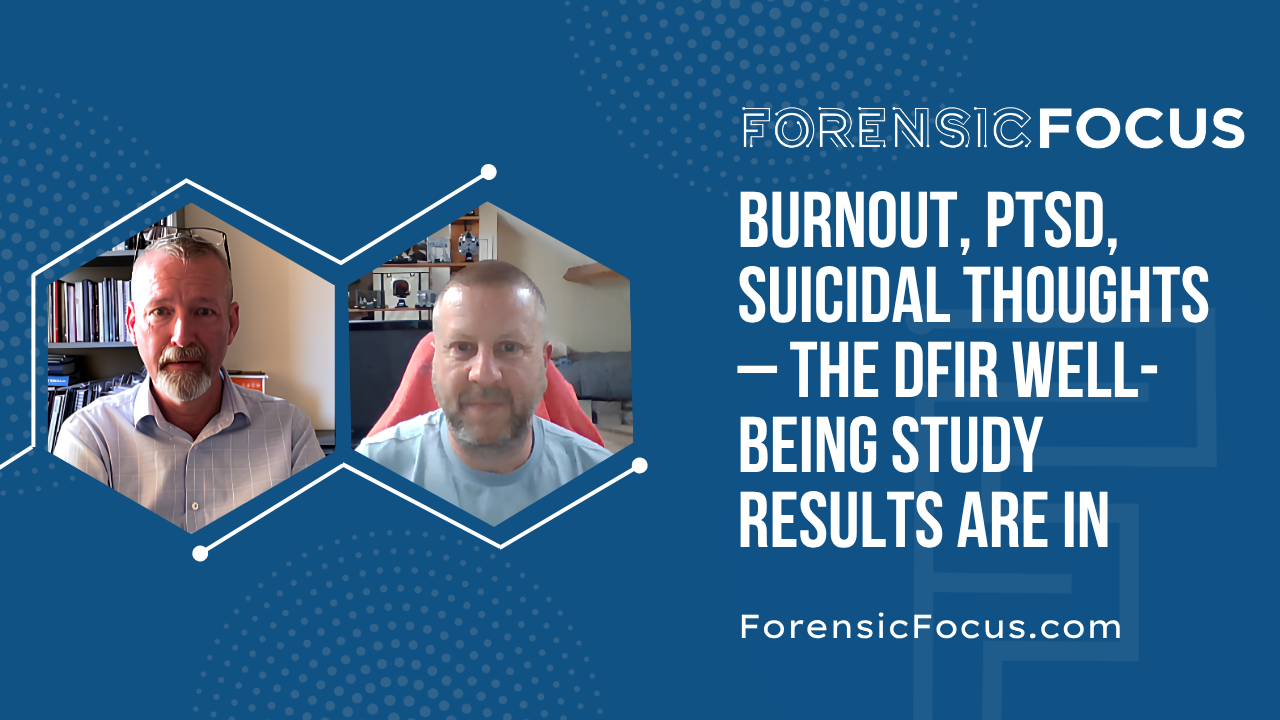
Paul: Hello, and welcome to the Forensic Focus Podcast. I’m Paul Gullon-Scott, the wellbeing lead here at Forensic Focus, and today we are talking about something both Phil Anderson and I have put a great deal of work into, and that is the Forensic Focus International Well-Being Study.
Phil and I came to the study from quite different angles, which I think is one of the reasons it ended up being as strong as it did. I’m going to let Phil introduce himself and explain where he’s coming from.
Phil: Thanks, Paul. From my background, it’s the technical aspect, the investigative elements of digital forensics, where I spent most of my academic career. I did a little bit of different things before within academia, teaching different subjects.
There’s a growing interest, really, in just being a nice human being where you want to make sure everybody’s looked after no matter what they do for work. I know we mentioned this in the previous podcast when we talked about law enforcement and mental health within law enforcement, and I’m not trying to differentiate it.
If you look at your frontline police officers, they have very different roles and responsibilities, but equally, the people that work behind the scenes that make everything tick — because for frontline policing, without the digital forensics investigators, they’re not going to get very far.
Speaking to you about this, you lit something — I’m going to say a bomb under us — but you lit something in me about the whole subject of mental health welfare for digital forensics investigators. And I’ve got a little bit more invested in this because a lot of my graduates over the past six, seven, eight, nine, ten years have gone across the country into UK law enforcement to become digital forensics investigators.
You worry about them a little bit and the kind of stuff they do. And then as we were talking about this Forensic Focus International Wellbeing study, there’s obviously the big stuff around AI, and I kind of convinced you to sneak a little bit in about the AI dimension as well.
Paul: Yeah, you did, and that’s actually thrown up some really interesting results, hasn’t it?
From my side, the psychological piece had been something I’d been watching with increasing concern for quite a long time. As we both know, it’s important to be able to put numbers on what we’re hearing, to take it out of the realms of anecdote and into something that organisations and policymakers can’t ignore.
I think between us, we’ve covered that ground pretty well within the wellbeing survey. So let’s get into what we found. 179 digital forensic investigators from across the world completed the survey. Let’s just pause for a second and appreciate that. Can I just say thank you to each and every individual forensic investigator who took the time to complete the study.
Phil: From a research perspective, when we talk about quantitative and qualitative data, the biggest challenge is often getting enough participants, so you can validate your results. We kept updating each other, didn’t we? You kept texting me, “How many today?” And if I had a figure, I’d have a quick look and I would text you. It’s just brilliant. That is a huge data set to work with.
From 179, you can’t really argue with it — well, people probably will, but statistically it’s got to be very strong.
Paul: You’ve just took the words out of my mouth. From a statistics point of view, from the numbers point of view, it is a massively strong study. We got participants from the UK, the US, Australia, Canada, Germany, South Africa, India, and many more countries across the world. So the results aren’t just generalisable to the UK — they’re generalisable internationally. Globally, really.
Phil: Initially, when we first had the conversation, our focus was potentially just looking at the wellbeing of UK digital forensics investigators. But if you think about it, the problem behind it is a global problem anyway. It’s not unique to any country. The core stuff that causes the mental health issues, or that we believe causes the mental health issues, is a global problem.
Paul: It absolutely is. And that really came home to me last year. I was invited to become part of Project Cyclops, which explored wellbeing in digital forensics in Europe. I was lucky enough to attend a couple of conferences out there and talk to DFIs and get a real feel for what’s going on in Europe.
I have to say, in some countries in Europe, it’s even worse than it is here in the UK. It’s quite chilling.
Phil: When we wrote the survey, in the back of my mind, we knew there’s a thing about survey fatigue. I didn’t want to have to send a survey out and then another survey six months or 12 months later. We were just going to take this as big a bite as we could get to try and answer all of the questions.
We broke it down into different areas. So yes, it was a big questionnaire, but now that we’ve got it, it’s going to tell us so much more. There are years and years of research that we can take out of this, and if we find particular niche things, we can follow up with all sorts as well.
Paul: Totally agree. We have prepared a document for Forensic Focus to put out as quickly as possible, but what follows is going to be a really in-depth analysis of that data set. When we start pulling out the effects and the questions that we’re going to answer, we will publish in a journal, and we’ll let everyone know when that’s been done. That’s a very slow process, but we will keep you updated.
So, 72% of the respondents identified as men, 26% as women, and 46% had more than 10 years of experience in the field. That is the backbone of the profession speaking here.
Phil: It’s important context for everything that’s going to follow. It’s almost like understanding who works within this arena and then linking other issues to that as well. The biggest part of that is people with 10 years of service, but that’s not to say we’re going to ignore the people with six months, 12 months, two years’ service, because they may be going through a completely different experience.
What we want to look at is: those that have got 10 years in, what coping mechanisms have they developed, and what issues have they faced? So 10-year service, six-month service — all the stuff we’re going to find is going to be valuable to learn from.
Paul: Because we’ve got such a wide spread of experience within the data set, we can do comparisons — for example, compare the reported results from the PTSD questionnaire against those young in service against those with 10 years’ service, to see if there’s any significant differences. That will be a really important thing to do. So the spread of the length of service is super important.
I want to say something about the design choices we made before we get to the findings, because Phil and I were deliberate about this. We planned and we talked a lot before we put this together. I was quite insistent on using validated psychometric instruments rather than bespoke questionnaires. A big bit of credibility was brought to the study by doing that.
So the PCL-5 was to measure PTSD symptoms, the GAD-7 for anxiety, the PHQ-9 for depression, and the PHQ-15 for physical health symptoms. What many people may not be aware of is that mental health issues, as they progress, can manifest as physical symptoms — bad back, heart palpitations, that kind of thing. So we wanted to capture it all.
We also included the Brief Resilience Scale, the Brief COPE Scale, and a childhood trauma questionnaire. All of those measures have been tested and normed across clinical and occupational populations, so our findings can be benchmarked and will carry real weight in academic and policy settings.
Phil: On top of those, we’ve also looked at — your background, you did this role for an awful long time, and my background coming from academia rather than practitioner, we kind of knew in the background. And again, this is why you do research: you have an inkling of what some of the stresses are. So we created some bespoke ones as well to try and capture them.
We’re looking at specific pressures that we know for a fact — and again, this is probably not unique to the UK, and our study will probably validate this — the amount of digital forensic work, the caseload work, is just creeping up, and up, and up. It’s only going one way.
Case staffing has increased a little bit as well to try and cope with that, and we’ve written a separate paper on trying to take a different approach in the UK — well, certainly in England, Wales, Northern Ireland — looking at the legislation to try and aid some of the caseloads around that.
We haven’t got an infinite amount of time to work on these cases because we’re not allowed to do that. So you throw in time pressure. I don’t know what the current statistics are — probably should look them up — but the amount of caseload that’s child sexual abuse material, and how that’s managed with individuals, is another factor.
And then, as we just touched on briefly right at the beginning, the fact that AI images are out there, and the fact that they can be replicated and created within seconds — how much of an impact has that had on the CSAM exposure to investigators, and the time pressure to go through it?
Somebody can just download a piece of software or go onto a website, throw some images in, and tell it what they want to get out the other side. The research I was keeping an eye on would suggest investigators were concerned about the increase in workload and caseload due to volume. But what I wanted the survey to pick out was: what’s the impact on the investigator, as well as the caseload?
Paul: From the design perspective, that was the most difficult part of the survey to put together, because it’s so new. Because it is currently emerging, there is no psychometric testing around that yet.
Phil: We were really asking for people’s opinions, weren’t we, with some of the questions. Again, see what comes out of this. There’s going to be loads.
I think this would be a couple of years ago — I don’t know whether it was a white paper or whether I was at a conference — but there was a representative from the government, and to summarise, they were aware of the issues around AI and CSAM, and they were watching this space carefully. That was a couple of years ago.
I’ve heard nothing. I think it’s still status quo. I don’t think anything’s changed, so I don’t know how long they’re still going to watch it for. But what I wanted to do was take this opportunity, this big bite, and find out how it’s impacting individuals that took the survey.
Paul: It’s really important that it gets explored. It’s not going to go away. It’s only going to increase.
So let’s start with the occupational stresses, because the headline finding here challenges quite a lot of assumptions. People often assume that the primary driver of psychological harm in this role is exposure to distressing material. What we found was that 36% of respondents rated CSAM exposure as very or extremely stressful. While that’s a significant number, it’s not top of the table.
Time pressure and deadlines were rated very or extremely stressful by 50% of the respondents. Case volume and backlog, which we’ve just touched on, was 49%. Workload — systemic, structural, organisational workload — is the thing that is causing the most stress. I found that really interesting.
Phil: It’s a challenging environment to work in. If we look at my role as an academic, I would find the amount of work I’ve got to do and the time pressure probably the most stressful as well. I almost thought, well, it’s obviously going to be the CSAM material, but it’s not. It’s the volume of work that they’ve got to get through and the time pressures. It was a bit of an eye-opener that those were the top two.
From a management perspective, are those issues easier to try and resolve, because they can’t stop the CSAM material coming in? Nobody has any control over that. Time pressure’s not so different either, because you’ve got a deadline. But from a workload perspective, case volume and backlog perspective, I think there’s a little bit of wiggle room where management can try and do something to at least ease those issues.
Paul: I would agree. They’re going to have to tackle this from two corners. They’re going to have to do it from the mental health support side, but they’re also going to have to look at the operational and organisational side and make significant changes there, because that’s where the major stresses are coming from.
Phil: Just to quickly quote one of the participants, and I’ll read this verbatim: “The team had no room for anyone to take a break from CSAM cases because everyone was already fully committed to their own backlog.” Which is frightening. People are getting investigated for a very serious crime, so a lot hangs on this. It’s not a sustainable position. Either cases get kicked out because they take too long, or your staff go on the sick because they can’t cope anymore. They’re overwhelmed.
Paul: They’re burnt out. They can’t do it. The investigators who sit behind the screens being exposed to this material and dealing with the backlog, and the organisational stresses that go around that — please remember they’re only human. Not robots.
Phil: That’s one of the reasons why I wanted to do this survey. And not to disrespect — frontline policing is a very stressful job. I was a special for 10 years, so I just got a small flavour of it. But they are a cog in a big machine, and the DFU investigators are a cog in that machine. Without one or the other, they’ve both got to work together to get the job done.
I just wanted this opportunity to work with you and do this survey to shout out to investigators: “We hear you. We know what you’re going through,” and to try and make some changes, even if they’re little changes, just to make it a little bit better for them.
Paul: We’ve got the evidence to do that now. That’s the whole purpose of doing this.
From a psychological standpoint, workload is what removes people’s capacity to cope. You can develop strategies for managing the emotional impact of the difficult imagery, but what you can’t easily manage is being permanently underwater. Chronic overload depletes the very resources — cognitive, emotional, psychological — that people need to process what they’re seeing.
The retention picture that sits beneath this is also quite serious, because we found that 28% of respondents said they were likely or very likely to leave the role within 12 months. And we are talking about experienced people here. So when they go, their knowledge and the resilience they’ve built up over the years goes with them.
And 7% had been off sick for more than 14 days in the preceding six months. Clinically, that is consistent with burnout, work-related PTSD, or significant depressive episodes.
Phil: As you read that out, from an organisational perspective, that’s just not sustainable. New to the DFU role, you don’t just get thrown in the deep end, for obvious reasons. So they invest in training with you — umpteen different training courses. They bring you up to speed. They get you to shadow somebody, and then they drop you in gently.
To lose somebody — yes, people do move on, people change careers, people get promoted, so you can accept those — but organisations are almost shooting themselves in the foot by not dealing with this problem. They just think, “Oh well, in 12 months’ time, if somebody leaves or somebody goes long-term sick, we’ll just have to find somebody to replace them, so we’ll have to advertise again.”
Say there’s 10 in a team — one goes long-term sick, the nine will have to pick the work up for 10.
Paul: Therein lies the problem. But you’ve also got the additional problem that when you bring someone new in, it’s going to take them 18 months to get trained up to use the tools, to be able to do the job solo. The team isn’t just temporarily picking up the slack.
Phil: A lot of it’s down to volume. As I’ve been teaching this arena in undergraduate programmes — I first started teaching this in 2007, 2008, and the first set of students graduated in 2010 — you could see the job adverts coming out on LinkedIn and on Forensic Focus and all the digital forums.
I look on LinkedIn now, and I would say there are at least two or three police forces, obviously different every month, but each month there are two or three police forces advertising for DFU roles. It’s a constant churn. They want more people in to help with the caseload, the workload, which is great. But under that staff turnover — staff leaving, staff moving sideways because they can’t do the role anymore — that’s still significant. It’s causing them to constantly recruit.
Paul: Just to give you some idea — and this is a real-world example, I won’t obviously name the force — I was talking to a digital forensic investigator in a force in this country, and they were telling me that at the beginning of the year, between September and January, they lost 11 staff from their unit.
Phil: Out of how many? It doesn’t really matter, does it? It’s a daft question.
Paul: It was about half. About half the staff had left, gone.
Phil: How do you recover from that? That’s a huge hit. And it goes back to my argument about management — not just DFU management, but senior management within the police, because it goes up the chain. Whoever runs your DFU has got to go up the chain of command to get resources, to beg for resources, to plead for resources.
This is some of the concrete evidence I want out of this study. I’m not saying they’re sleepwalking their way through this, but from what I’ve seen and what I’ve researched, and what we’ve seen from this survey, it’s frightening that it’s just become an accepted norm.
Paul: It has to stop being the accepted norm.
One of the things that you were very strong about including in this study was having a look at, delving into the world of AI, and seeing what’s happened.
Phil: I was really interested. We obviously work for Northumbria University, and we’ve got a centre for AI that looks at the ethics and all the stuff around organisations and the use of AI.
We all know about AI, we know about ChatGPT, and some people use it on a personal level. The audience listening to this will have seen a real-world impact of people using AI to generate CSAM. It’s just frightening. It’s the world we live in, but I scratch my head — who would write a piece of software in the first place and then willfully share it that can do such a thing?
Off the back of those different pieces of software, and we talk about child sexual abuse material, I’ve been keeping an eye on some other research around AI — nudification, violence against women and girls, that kind of stuff as well. It kind of goes hand in hand.
One of the things that came out of the survey was that 60% of the investigators said they found AI-generated CSAM slightly more distressing than the real material. This still sticks in my mind: one of the responses was that it wasn’t necessarily the images that disturbed them, it was the recovered logs or the input from one of the apps — whatever the user had been typing in, describing to the AI platform to generate the images.
You almost sit back and think, “Look, we’ve got enough to do. We don’t need this on top.” But it’s technology, it’s the world we live in. We know AI can be used for good. Unfortunately, people will use AI and they will do horrible things with it.
I just thought, where this AI CSAM stuff is just floating to the surface and starting to bubble a little bit, if we could stick that in. I said to you, “Can we do this, please? Pretty please. I would like to do it, please.” It was just an opportunity to get in while we were looking at the other things, just to see if it did have a huge issue.
Paul: I’m really pleased we did, because those figures really surprised me too. When we first looked at those numbers, my initial psychological frame and thoughts around it were that knowing no real children were being directly harmed in the creation of the material might offer some protective distance.
Phil: I’ve done some reading and research around this. The same argument could be made about generating nude images of girls and women. It doesn’t wash with me, Paul, because the way AI works is that AI’s got to have a reference point from somewhere to create these images in the first place. AI doesn’t magic the data. You put a request into AI, it’s got to understand your request and have something to build on to deliver what you ask it to do.
So it’s had to have learnt that before, which goes back to first contact, or the CSAM material that’s already in circulation out there anyway. I don’t think you can separate the two. I just see AI as a different conduit to the same material, if that makes sense. It just means it’s easier for the end user to churn out.
You could argue potentially that they don’t go and commit first contact CSAM offences, but I think we’ve got to make it clear that AI-generated CSAM is still harmful. It’s got to have come from somewhere. You’re not giving a crying baby a dummy to soothe them. You’re back to the same problem — using the data that’s already in circulation. So yeah, it’s still a big issue.
Paul: It’s massive. And I think with such a vast influx of AI-generated CSAM material, it also brings in a new problem. Because AI is becoming so capable of producing such realistic images, the whole system of victim identification starts to break down. As one investigator described, that is a vicious circle, and I think that’s exactly what it is.
Phil: This is one of the things I was interested in — the victim identification. Interestingly, some of the results have opened my eyes, because I never saw it this particular way. A couple of the responses suggested they were concerned that they identified an image as AI when it could obviously then be a real one.
I was thinking on the flip side — they would misidentify real as AI. It opened my eyes. You did this role for an awful long time, so you’re looking at trying to create images in victim identification, and then all of a sudden you’ve got this software that can just create any kind of AI-generated material that you want.
Paul: It’s really frightening from the identification perspective, because as an investigator myself historically, the weight that is put on you is enormous. The decisions you’re making are going to have a profound effect on someone’s life. That cannot be understated. The psychological weight of AI is absolutely enormous, and we haven’t even begun to scrape the top of what happens.
Phil: Not just in this, but in any walk of life, we are in uncharted territory. I generally think that. It’ll be the old scenario as it often is with technology — the horse has bolted and then we try and close the stable door behind it, and it’s far too late.
If you look at the analogy — and I know this is a slight tangent, but you’ll know me by now, I do like my tangents — how long has social media been out? And we are still, as not just here currently but all the countries in the world, wrestling with the challenges and the problems that it’s causing. We are on 15-whatever years since Facebook first came out, and we are still wrestling with that.
AI is very much in its infancy — two, three, four years old. So there’s a long road ahead.
Paul: There’s one comment from one of the investigators that absolutely sticks in my mind after reading it. This is in regards to AI and identification of images. They wrote: “Massive stress. Imagine if I missed a victim and that victim came to harm. I would struggle to live with myself. It’s a genuine concern.”
That comment just radiates the impact that AI is having on investigators.
Phil: We’ve talked about the different ways it goes, but we know where it’s going. It’s more volume. Victim classification’s going to be harder. How are courts going to deal with all this? Is it AI-generated? Probabilities and things like that. What’s the defence going to make of it?
Like you said, what that investigator’s just come back with is the victims not getting identified as a result. Everybody’s finding their feet in this.
Paul: Everybody’s starting from the bottom. And of course, because technology advances so quickly, we are constantly going to be chasing it.
Phil: From law enforcement, I think we’re always going to be chasing it. Nobody saw AI coming. I can remember it was almost like an overnight phenomenon when ChatGPT got released to the public. Even back then, nobody foresaw what it was going to potentially lead to. Here we are, two or three years down the line, and we’re stuck with something that’s not going to go away.
From a, “How can we legislate against it?” perspective — back to the social media element — it’s very difficult.
Paul: It’s going to be incredibly difficult to do that.
So let’s jump into my territory. Mental health and wellbeing — that is absolutely my territory now. It has been for a very, very long time. I want to go through this carefully because several of the findings are really serious, and I think they deserve more than just a headline.
Starting with PTSD symptoms, measured by the PCL-5, the most prevalent presentations were hypervigilance, with 47% reporting that at a moderate level or above. Difficulty sleeping was 45%, difficulty concentrating came in at 44%, and emotional detachment also at 44%. Intrusive memories came in at 43% — and intrusive memories here means flashbacks.
These are not marginal findings. Across a sample of 179 people, nearly half are reporting hypervigilance and sleep disturbance at clinically meaningful levels. They are meeting the clinical cut-offs for these presentations.
Phil: Hence why we wanted to use those tried and tested methods, because nobody can argue. We talk about vicious circles. You’ve got the hypervigilance, the difficulty concentrating, the flashbacks. That can only go on for so much.
You then turn around to the investigator and say, “Right, let’s get on with your work.” The work itself is about — based on what you see, you have to make a judgement. Investigators see what’s in front of them and they make a judgement. Going back to victim identification, the investigator makes a judgement call on that.
Let’s just say they’ve got lack of sleep, they’ve got difficulty concentrating, they get flashbacks. How do you make an accurate judgement with all that going on? The machine is forcing people to do that, though.
We’re in the status quo of, “Oh, we’ll just keep going. We’ll just keep doing what we’re doing. We’ll just keep churning.” It’s an awful analogy, but it’s the meat grinder. And it’s not just for law enforcement — you could use that terminology for a lot of businesses. But it’s the principle and the approach that’s going on.
Obviously, we can’t just say, “Look, put the brakes on this. Everybody stop and let’s think about it.” But this study, this work that we’re going to do, is maybe just to get organisations to take a breath and think, “Right, this is what we are currently doing now, and have done for X number of years. Can we do it slightly differently? Is there one or two things we can introduce? Can we change a few things?” We’re not asking for massive things, because we know they’re probably not possible right now. But just for little changes that would try and reduce some of these obvious things.
Paul: I’m going to spend a little bit of time talking about this, because it’s what I consider the most clinically significant finding in the entire study, and I was genuinely bowled over when I saw these numbers.
So the PHQ-9, item 9 result. You saw these numbers when we first ran the analysis, didn’t you? And I want people to understand what we are looking at here.
Phil: When we were doing the survey and we released it and I was watching responses come through, there were always certain questions I was interested in just to see, as we got 20, 30, 40, 50 or 100s in. This was one of the questions I was watching carefully, because you started to blink out of one eye and grimace at the same time. You knew where it was going, but you were hoping it wouldn’t go there. You had a hope upon a hope. But it went there.
We shouldn’t be surprised, which is a horrible thing to say in these circumstances.
Paul: When I read the results, I was genuinely moved. Let me explain. Item 9 in the PHQ-9 asks about thoughts of being better off dead or of hurting oneself. In the general working population, endorsement of that item at any frequency above “not at all” typically sits at around 5%. Please remember that as I’m talking.
In our sample, 13% — that is 24 investigators — reported these thoughts on several days in the past two weeks. 5%, nine people, on more than half of those days. And 2%, which represents three people, almost every day.
In total, that equates to 20% of respondents — so that’s one in five digital forensic investigators experiencing active suicidal or self-harm ideation at a clinically significant frequency. That is four times the general population. That is a horrific finding.
Phil: Investigators get up every morning and go do the job because they know they want to make a difference. They want to protect the children. But that’s what the job’s doing to them.
With any survey — okay, it was anonymous and it was voluntary — but going back to the figures, the respondents were predominantly male. There’s a lot of work going on now, and has been for a good few years, and it’s going in the right direction about male mental health, opening up and people talking about it.
But if you think about it — you’ve got a job, there’s a lot riding on you having a job. You may be married, you may have children, so you’ve got the pressure of wanting to look after your family and earn, and then having to go to work and deal with that on a daily basis.
You know, some people think enough’s enough and they get out, but at what point — going back to your PHQ-9 — at what point do they think enough’s enough? With frontline policing, we talk about violence against police officers. Yes, we know they’re police officers, but violence against them is still completely unacceptable. Nobody, no matter what job, should have to go to work in fear of violence.
If you look at the DFU, nobody should have to go to work and worry about what they’re going to be dealing with and the effect it’s going to have on them. But it’s one of these things where, unfortunately, we’re back to the world we live in. We can’t avoid it, but we need to look at how we manage it, how we work with it to try and reduce the effect of this as low as we possibly can.
Paul: I totally agree. Those numbers are what makes access to support so important. Which I’m going to mention next, because those two findings sit alongside each other, in my opinion, in a way that should be deeply troubling to every organisation.
20% of our people are having thoughts of suicide or self-harm. 61% of the respondents reported not having access to a good quality of support services. How can those two numbers… I mean, that represents a crisis, doesn’t it?
Phil: It’s unbelievable. And I think you’re right in saying “good quality.” It’s not just about a support service. It’s got to be well thought out. It’s got to be able to provide that help to individuals. It doesn’t have to be done piecemeal. It doesn’t have to be, “Oh look, this is what we’ve got. We said we’re going to do this, we’ve got this thing.” But it’s got to be fit for purpose as well.
Paul: The physical health picture adds another layer.
Phil: When you first designed the survey, I’d never contemplated the physical health.
Paul: In digital forensics, it’s never been looked at in respect of mental health. It’s one of the reasons why I wanted to throw it in there. I was actually made aware of it by a great presentation given when I was in Europe, and that really made me start thinking about it.
The PHQ-15 collected the physical health data, and that showed 41% of respondents were bothered a lot by fatigue, 26% had trouble sleeping, 23% reported back pain. Some of the presentations suggested quite acute psychological stress responses. One investigator who’d been signed off for a month was still experiencing chest pains and racing heart at the time they completed the survey.
The body doesn’t separate psychological distress from physical consequences. They are one and the same.
Phil: Absolutely. If that particular individual who was complaining of chest pains and racing heart — he can’t go back to work until all that’s resolved.
It’s not just the flashbacks and things like that. Yes, those are key, but one of the things is sleep. I think sleep, both physically and mentally, is so important, just generally for your wellbeing. If you start messing about with that, it’s got a significant impact. And then if you’re expecting somebody to go through and try and do a job — it’s almost like, well, we’ll just put one hand up your back and you can keep going.
Paul: Without a decent night’s sleep, you’re operating on fumes. It’s as simple as that.
Phil: And it probably puts more pressure on you to get things right. If you have a bad night’s sleep, you get up, you’re exhausted, you go into work, and you’re probably then thinking, “God, I better get this right. I know I’m tired.” It’s just feeding the problem.
Paul: It really is. I don’t think we’re going to have time to talk about all of the results.
Phil: We’ll have a part two. We knew this would happen. I think we should have a part two, actually.
Paul: Are you advertising this as a 15-minute podcast, by the way? Because we’re about an hour in.
One of the things that I do want to mention before we bring the podcast to a close is the fact that Forensic Focus are taking the results of this survey so seriously, they are going to send it directly to the Home Office.
Phil: It’s brilliant and it’s perfect. I don’t know how many supporters we’ve got on board, because in my career in digital forensics, I can remember finding them very early on and using them as a resource, using the forums and all sorts. So it’s absolutely fantastic that we’ve got somebody like that, with that reach. It’ll be knocking on the Home Office door sometime soon.
Paul: I think it’s important for the DFIs who actually took part in the survey, who spent the time to fill it in. Again, we really, really genuinely thank you for doing that. It’s important for them to know that.
Phil: They’ve taken the time and effort to answer all the questions, and both of us would like them to see results from the work they’ve put in. Yes, we’re doing the work to analyse the results and pick it apart and present the information in a constructive manner, but without that data, without them, we’ve got nothing. Absolutely nothing. We’ve got assumptions, and we know what assumptions are.
Paul: For the benefit of the viewers, there is a whole lot more information in there. We haven’t talked about neurodiversity, we haven’t talked about the impact of job stresses in any great detail. There are some suggestions around coping in there. Please go to Forensic Focus, look for the full report. Download it, read it, share it. Give it to your managers. Let them see it.
Phil: And reach out to us as well, via LinkedIn. Everything will be treated anonymously. If you read the report, if you agree with it, if you disagree with it, reach out to us. We’d still love to hear from you. Obviously, 179 of you filled it in, and you’ll then see what all the other 178 people who filled it in have said as well. It’s going to be interesting to see what you think of the results — are they a surprise or not?
I would like to say, if you want to reach out either to you or to me and just tell us what you think about the results — did we get it right? Did we get it wrong? It’s all learning for us.
Paul: That was a really good point, actually, Phil. We’d really be interested in what you think after you’ve read the report. If you do feel like reaching out, message us — either of us on LinkedIn — and let us know.
Phil, before bringing it to a close, have you got any other points?
Phil: Other than I feel grateful, I suppose. I’m not going to end on a soppy note, but it probably will be. I’m grateful to be involved in this because I’m hoping we can make a difference. I really do hope we can make a difference.
Paul: I’m really, really glad you’re on board. I think people watching will see how well we actually gel together. Although we can’t show you, we work extremely well together behind the scenes. We spend many, many hours of our own time working on this. We are working in the background. We are going to do more in-depth data analysis on the set. There is more to come from this data. There is much, much more to come. Like I said right at the beginning, we will let you know when that gets published.
Phil: Just quickly, if anybody is struggling, obviously reach out. You’ve listed support services in various places. If you are struggling — if you are reading this and you are struggling — reach out. Please just reach out. Don’t do this alone.
Paul: Don’t do this alone. Phil, again, thanks for joining the podcast. We have got an awful lot of work to continue with in this. I genuinely look forward to it.
Ladies and gents, thanks again for watching the podcast. I’m sure Phil and I will come back and report on the findings as and when we analyse the data.
Phil: Podcast part 472, probably.
Paul: Take care, everyone. Thank you.