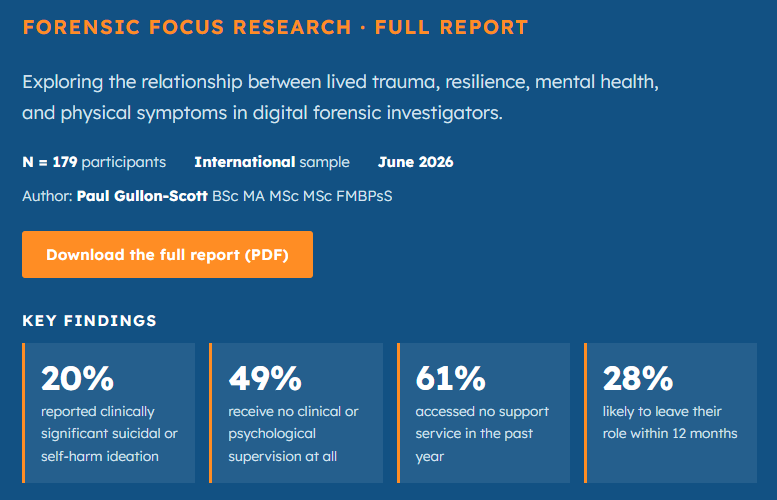
Exploring the relationship between lived trauma, resilience, mental health, and physical symptoms in digital forensic investigators.
Key findings
1. Executive Summary
The Forensic Focus International Well-Being Study surveyed 179 digital forensic investigators across multiple countries to examine the psychological, physical, and occupational impacts of their work. Participants completed a comprehensive battery of validated psychometric measures alongside bespoke questions on AI-generated child sexual abuse material (CSAM), supervision, and coping strategies.
The majority of respondents report meaningful levels of anxiety, depressive symptoms, and somatic complaints — yet nearly half receive no clinical or psychological supervision whatsoever.
At a glance
| Domain | Headline finding |
|---|---|
| Workload & exposure | 49% find case-volume backlog ‘very’ or ‘extremely’ stressful; 36% rate CSAM exposure at those levels. Workload and systemic factors often eclipse the distress of the material itself. |
| Mental health | 27% feel nervous or on edge more than half the days or nearly every day (GAD-7). 20% of respondents (n=36) reported thoughts of being better off dead or of hurting themselves at a clinically significant frequency (PHQ-9). |
| Physical symptoms | 41% are ‘bothered a lot’ by fatigue, 26% by trouble sleeping, 23% by back pain (PHQ-15). |
| PTSD indicators | Intrusive memories, avoidance behaviours and hyperarousal are prevalent across the sample (PCL-5). |
| Resilience | Despite significant stressors, the majority demonstrate moderate-to-high resilience: 66% agree they bounce back quickly after hard times. |
| Support access | 49% receive no clinical supervision; 61% accessed none of the listed support services in the past 12 months. Lack of time (48%) and fear of career impact (34%) were the most-cited barriers. |
| AI-generated CSAM | 60% found AI-generated CSAM about as distressing as — or more distressing than — real material, and 63% worry at least occasionally about misidentifying real victims. |
| Neurodivergence | ADHD (17%) and autism (10%) rates are approximately 4–6 times higher than general-population estimates — and no research exists on how this role’s stressors differentially affect neurodivergent practitioners. |
2. Methodology
2.1 Study design
This study employed a cross-sectional, anonymous online survey design. The survey was hosted on a secure platform and disseminated through Forensic Focus, an international community for digital forensic practitioners. Participation was entirely voluntary, and informed consent was obtained via an explicit opt-in statement prior to the commencement of questions.
2.2 Participants
A total of 179 individuals consented to participate. The sample represents practitioners from a wide range of countries including the United Kingdom, United States, Australia, Canada, Germany, South Africa and India, reflecting the global reach of the forensic community.
2.3 Validated measures
| Instrument | Abbreviation | Domain assessed |
|---|---|---|
| Post-traumatic Stress Disorder Checklist | PCL-5 | PTSD symptom severity (20 items) |
| Generalised Anxiety Disorder Scale | GAD-7 | Anxiety symptoms (7 items) |
| Patient Health Questionnaire — Depression | PHQ-9 | Depressive symptoms (9 items) |
| Patient Health Questionnaire — Physical | PHQ-15 | Somatic / physical symptoms (15 items) |
| Brief Resilience Scale | BRS | Resilience (6 items) |
| Brief COPE Scale | Brief COPE | Coping strategies (28 items) |
| Childhood Trauma Questionnaire | CTQ-SF | Childhood adversity (28 items) |
| Bespoke Occupational Stressor Scale | — | Job-specific stressors (9 domains) |
| Bespoke AI-CSAM Module | — | Reactions to AI-generated material |
| Supervision & Support Module | — | Access to and quality of support |
2.4 Ethical considerations
The study was conducted in accordance with ethical research principles. Participation was anonymous and voluntary, with the right to withdraw at any point. Sensitive sections were preceded by explicit content warnings and opportunities to skip. Signposting to well-being and crisis support services was embedded throughout. Data were used exclusively for academic research purposes.
2.5 Analytical approach
Descriptive statistics are reported as frequencies and percentages for categorical variables. Qualitative responses from open-text fields were also collected; representative participant quotes are presented throughout this report to contextualise and deepen the quantitative findings.
3.1 Sample Demographics
The sample comprised 179 digital forensic investigators. Gender identity was reported by 178 respondents: 72% (n=128) identified as men (including trans men), 26% (n=46) as women (including trans women), and 2% preferred not to say. Ages ranged from mid-twenties to early seventies.
Years of experience in digital forensics
Nearly half of respondents (46%) reported more than ten years of experience, indicating a sample with substantial professional exposure to the demands of digital forensics.
Average weekly exposure to distressing material
of participants are exposed to distressing material for more than 10 hours weekly, with 17% exceeding 20 hours — a substantial occupational hazard with potential cumulative psychological effects.
Neurodivergence & disability
73% (n=130) identified as neither neurodivergent nor disabled. Among those who did: ADHD was most commonly reported (17%, n=30), followed by autism (10%, n=18), dyslexia (5%, n=9), and dyspraxia (1%, n=1). Additional disclosures included PTSD, depression, anxiety, epilepsy, MS, and physical disabilities.
Elevated neurodivergence prevalence. ADHD (17%) and autism (10%) rates in this sample are substantially higher than general-population estimates (ADHD ~2.5–4%; autism ~1–2%) — a finding of considerable significance for understanding who enters this profession and how they are supported.
This elevated prevalence is unlikely to be coincidental. Digital forensic investigation demands a cognitive profile that closely aligns with known neurodivergent strengths: exceptional attention to detail, capacity to sustain hyperfocus during lengthy and complex case reviews, systematic and pattern-based thinking, high tolerance for repetitive technical processes, and an ability to compartmentalise emotionally charged material in service of methodical analysis. These traits — frequently associated with ADHD and autism — may actively draw neurodivergent individuals toward the profession or confer a meaningful professional advantage within it.
However, this finding carries an equally important cautionary dimension. Despite the growing body of research on occupational stress and trauma in digital forensics, there is currently no published research examining how the known stressors of this role — chronic exposure to distressing material, high workload, lack of supervision, and moral distress around victim identification — may differentially affect neurodivergent investigators. This is a critical and urgent gap in the literature.
Neurodivergent individuals may face compounded vulnerabilities in this context. Sensory sensitivities associated with autism may intensify the psychological impact of exposure to disturbing visual content. Difficulties with emotional regulation — common in both ADHD and autism — may affect the ability to disengage after distressing case exposure. Rejection sensitivity, social communication differences, and challenges navigating organisational hierarchies may make it harder to recognise when support is needed or to seek it when it is. Many neurodivergent professionals also report masking — suppressing neurodivergent traits at significant psychological cost — which in an already high-stress environment may substantially accelerate burnout.
Of the 22% of respondents who reported having workplace adjustments in place, the helpfulness ratings tell their own story. Only 10% (n=4) rated their adjustments as ‘extremely helpful’ and 28% as ‘very helpful’ — meaning a combined 38% found adjustments genuinely beneficial. By contrast, 13% rated them ‘not helpful’ and 23% only ‘slightly helpful’, with a further 26% rating them ‘moderately helpful’. Taken together, 62% of those with adjustments found them no better than moderately helpful — suggesting that existing provision is not adequately tailored to the specific demands of the role or the diverse needs of those within it.
3.2 Occupational Stressors
Respondents rated nine occupational domains using a 1–5 Likert scale (1 = not stressful, 5 = extremely stressful). The results reveal a profession under significant and multifaceted strain, with workload and systemic factors often eclipsing the distress of direct exposure to harmful material.
| Stressor domain | Very / extremely stressful | Not / slightly stressful |
|---|---|---|
| Time pressures and deadlines | 50% (n=88) | 17% (n=31) |
| Volume of casework / backlog | 49% (n=87) | 20% (n=36) |
| Lack of recognition / career progression | 49% (n=86) | 28% (n=49) |
| Management support | 45% (n=81) | 31% (n=55) |
| Technical failures / outdated technology | 44% (n=79) | 25% (n=45) |
| Work-life balance | 40% (n=72) | 43% (n=77) |
| Ethical dilemmas (AI, automation) | 39% (n=70) | 57% (n=101) |
| Exposure to distressing material (CSAM) | 36% (n=65) | 30% (n=54) |
| Vicarious trauma from colleagues’ cases | 15% (n=28) | 63% (n=111) |
Workload-related pressures (backlog and deadlines) and systemic factors (management support, career progression) emerged as the greatest occupational stressors — sometimes exceeding distress from exposure to harmful material itself.
Qualitative responses vividly illustrate the cumulative strain of working in under-resourced environments:
“I am concerned that the better AI gets, the sheer volume of CSAM available on the internet will greatly increase which undoubtedly will lead to bigger caseloads. Our team is already struggling with the amount of CSAM jobs we do, and there is not room for anyone to ‘take a break’ from the case type as everyone is dealing with their own CSAM jobs. In the last year I have seen staff members seeming quite fatigued whenever the caseload is talked about. The CSAM jobs are relentless.”Digital forensic investigator
“Workload will go up massively as there will be much more CAID unknown images. That will drive down morale and welfare, especially if the expectation is still to generate big counts for the prosecution to take to court.”Digital forensic investigator
Likelihood of leaving current role
Workforce retention is a pressing concern. Within 6 months, 17% (n=29) considered leaving likely or very likely. This rises over a 12-month horizon, with 28% indicating they were likely or very likely to leave.
Sickness absence (past 6 months)
While 41% reported no sickness absence, nearly one in five (19%) took six or more days off in a six-month period — a rate already suggestive of significant occupational health impact. The 7% (n=12) taking more than 15 days off in a single six-month period is particularly striking: extended, potentially recurrent absence that in clinical terms may indicate acute burnout, work-related PTSD, or serious depressive episodes requiring sustained intervention. These figures are likely an underestimate, given the well-documented culture of presenteeism in forensic and law-enforcement contexts, where attending work while unwell is normalised and disclosure of mental health difficulties carries career risk.
3.3 Experiences with AI-Generated Material
A dedicated module explored the growing challenge of AI-generated CSAM, examining emotional impact, trauma reactions, psychological processing, emotional investment under uncertainty, and anxiety arising from AI ambiguity. Responses reveal a nuanced and evolving psychological landscape as technology outpaces both professional guidance and investigators’ established coping strategies.
Emotional impact: AI-generated vs real CSAM (n=176)
The finding that 60% found AI-generated CSAM slightly more distressing than real material is striking and counter-intuitive. Qualitative responses clarify the mechanism: it is not the images themselves, but the deliberate human intent required to generate them, and the growing anxiety about AI’s trajectory, that drives this heightened distress:
“To be honest, the prompts used to create the images can disgust me more than the actual images.”Digital forensic investigator
“With AI CSAM someone has had to physically describe what they want to see and what they want to see happen. This is far beyond just viewing the material.”Digital forensic investigator
A contrasting perspective was also expressed by some investigators, who drew psychological comfort from the knowledge that no real child was directly harmed in AI-generated content — though most acknowledged this comfort is fragile:
“Knowing that there isn’t a real victim out there takes some of the trauma and worry away, but the images themselves are normally mixed in with real CSAM, so the line is blurred.”Digital forensic investigator
Trauma-related reactions to AI material (n=176)
Open-text accounts from those who do experience differential reactions make for sobering reading. The persistence of trauma symptoms regardless of whether content is AI-generated or real emerges as a consistent theme:
“I find the trauma reactions to be the same… I can still remember the AI generated CSAM that I saw, it still pops into my brain at odd times, it bothers me.”Digital forensic investigator
“Nightmares don’t care about AI.”Digital forensic investigator
Anxiety from AI-related uncertainty (n=175)
“Grading material is subjective and with the more realistic AI becomes the harder it is to determine if something is real or AI. The most worrying is what if I miss something, or I can’t grade the image due to not being 100% certain, to stand up in court and argue why I believe it to be illegal.”Digital forensic investigator
Concern about misidentifying real vs AI material (n=175)
of respondents worry at least occasionally about accidentally misidentifying real victims as AI-generated. The moral weight of this concern — that a real child may go unidentified — was described as one of the most psychologically taxing aspects of the role.
“Massive stress. Imagine if I missed a victim and that victim came to harm. I’d struggle to live with myself and it’s a genuine concern.”Digital forensic investigator
“Are we wasting police resources trying to victim ID a child that doesn’t exist?”Digital forensic investigator
Asked how increasing AI sophistication will affect investigator workload, morale, and well-being, responses were largely pessimistic — centred on volume, erosion of professional confidence, and the risk of systemic collapse in victim identification:
“As the inability to easily distinguish artificial from real imagery increases, I think it’s possible that lingering doubts might lead to an erosion of confidence in one’s own abilities.”Digital forensic investigator
“Weirdly, I would feel better about what I do if I knew at the end of every case was just a piece of code, rather than a living, breathing child.”Digital forensic investigator
3.4 Mental Health Outcomes
PCL-5: post-traumatic stress symptoms
The PCL-5 assessed 20 PTSD symptoms across intrusion, avoidance, negative cognitions/mood, and hyperarousal clusters. Key findings:
| PCL-5 symptom | Not at all | A little bit | Moderately+ |
|---|---|---|---|
| Intrusive memories of stressful experience | 24% | 33% | 43% |
| Disturbing dreams | 47% | 25% | 28% |
| Flashbacks / reliving experience | 52% | 25% | 23% |
| Upset by reminders | 30% | 34% | 36% |
| Physical reactions to reminders | 49% | 21% | 30% |
| Avoiding memories/thoughts | 33% | 28% | 39% |
| Avoiding external reminders | 46% | 22% | 32% |
| Loss of interest in activities | 40% | 27% | 33% |
| Feeling distant from others | 28% | 28% | 44% |
| Difficulty experiencing positive feelings | 42% | 21% | 37% |
| Irritable behaviour / angry outbursts | 36% | 28% | 36% |
| Hypervigilance / on guard | 30% | 23% | 47% |
| Easily startled / jumpy | 53% | 20% | 27% |
| Difficulty concentrating | 32% | 24% | 44% |
| Trouble sleeping | 34% | 21% | 45% |
Hypervigilance (47%), difficulty sleeping (45%), difficulty concentrating (44%), and emotional detachment (44%) were the most prevalent symptom clusters. The spillover of these symptoms into home and personal life is a recurring theme in qualitative accounts:
“Things that are seen that have a traumatizing effect on you once seen can’t be unseen, the thought can’t be unthought, and it stays with you.”Digital forensic investigator
GAD-7: generalised anxiety
GAD-7 responses indicate prevalent anxiety symptomatology across all seven items. Feeling nervous or on edge was endorsed as occurring ‘more than half the days’ or ‘nearly every day’ by 27% of respondents. Trouble relaxing (35%), worrying too much (34%), and becoming easily annoyed (33%) were further common presentations. Feeling afraid something awful might happen was reported at clinically relevant frequencies by 21% of the sample.
PHQ-9: depressive symptoms
PHQ-9 results reveal a meaningful burden of depressive symptomatology across the sample. Fatigue or low energy was the most prevalent symptom, with 47% reporting this on more than several days. Trouble sleeping (55% on several days or more), poor appetite or overeating (58%), and difficulty concentrating (61%) were widespread. These patterns, considered together, are consistent with subsyndromal or clinical depression in a significant proportion of the workforce.
PHQ-9 Item 9 asked about thoughts of being better off dead, or of hurting yourself in some way.
- 13% (n=24) reported these thoughts on several days in the past two weeks
- 5% (n=9) on more than half the days
- 2% (n=3) nearly every day
In total, 20% of respondents (n=36) are experiencing active suicidal or self-harm ideation at a clinically significant frequency — one in five professionals currently working in digital forensics. In the general working population, endorsement of this item at any frequency above ‘not at all’ typically falls below 5%; the rate observed here is therefore around four times higher than general workforce norms.
PHQ-9 Item 9 captures only those willing to disclose such thoughts in a survey. The true prevalence may be higher still, given well-documented stigma around mental-health disclosure in forensic and law-enforcement contexts, and the specific fear — evidenced elsewhere in this study — that disclosure may damage careers.
These figures demand an immediate organisational response: regular, proactive well-being screening with genuine follow-through and confidential referral pathways. Annual questionnaires or ad hoc check-ins are wholly insufficient given the scale of risk this data reveals.
“There was only one time in my career that a supervisor asked if I was okay after a particularly gruesome case. One. Time. No counselling services were ever made available until after I retired.”Digital forensic investigator (retired)
3.5 Physical Health Outcomes (PHQ-15)
The PHQ-15 assessed somatic symptoms over the preceding 7 days. Results suggest significant physical health burden, consistent with occupational stress and the body’s response to chronic psychological strain.
| Physical symptom | Not bothered | Bothered a little | Bothered a lot |
|---|---|---|---|
| Fatigue / low energy | 23% | 35% | 41% |
| Trouble sleeping | 39% | 36% | 26% |
| Back pain | 41% | 36% | 23% |
| Pain in arms, legs or joints | 40% | 43% | 17% |
| Headaches | 46% | 40% | 15% |
| Nausea / indigestion | 56% | 30% | 14% |
| Constipation / diarrhoea | 58% | 31% | 11% |
| Stomach pain | 66% | 25% | 10% |
| Heart pounding or racing | 68% | 25% | 7% |
| Dizziness | 70% | 28% | 2% |
| Chest pain | 77% | 20% | 3% |
| Shortness of breath | 76% | 19% | 5% |
The physical toll of the role is not merely a statistical abstraction. Investigators themselves make the connection between their psychological state and its bodily expression — including in ways that signal acute cardiovascular stress:
“Have been signed off for stress for a month 1 year ago due to case load and amount of CSAM to review. Currently have trouble sleeping, feeling stressed daily and get occasional chest pains and high heart rate.”Digital forensic investigator
3.6 Resilience (Brief Resilience Scale)
Despite the significant challenges documented above, the BRS reveals meaningful resilience capacity within this workforce.
| Item | Agree / strongly agree | Disagree / strongly disagree |
|---|---|---|
| I tend to bounce back quickly after hard times | 66% | 13% |
| I usually come through difficult times with little trouble | 43% | 20% |
| It does not take me long to recover from a stressful event | 56% | 22% |
| I have a hard time making it through stressful events * | 20% | 56% |
| It is hard for me to snap back when something wrong happens * | 20% | 59% |
| I tend to take a long time to get over setbacks * | 22% | 60% |
* Reverse-scored items
Resilience in this population appears to be actively cultivated — often through compartmentalisation, professional identity, and finding meaning in victim-centred outcomes — rather than through any formal organisational support:
“Old school. Put it in a box and just get on with it. Never open the box.”Digital forensic investigator
3.7 Coping Strategies (Brief COPE)
The Brief COPE identified the primary strategies investigators employ to manage demands. The workforce predominantly relies on problem-focused and cognitive coping, with limited use of potentially harmful strategies.
The dominance of acceptance and distraction-based coping, alongside low rates of help-seeking, reflects a workforce that has largely internalised stress as ‘part of the job’ — sometimes to their psychological detriment. Peer support stands out as under-utilised but valued when it does occur:
“We work in a very unique field. I feel that a person on the outside might struggle to understand exactly what we do and how it affects us.”Digital forensic investigator
3.8 Supervision and Professional Support
Access to adequate supervision and professional support is a fundamental safeguard for those working in psychologically demanding roles. The findings in this domain are very concerning.
Clinical supervision frequency
of respondents receive no clinical or psychological supervision whatsoever. Just 8% receive structured, regular supervision. Participants described the evolution — and disappearance — of support structures over time:
“We used to have mandatory 6 month check-ups; this then went to questionnaires and now we have nothing.”Digital forensic investigator
“We get an online form to fill once a year…”Digital forensic investigator
Supervision quality (among those receiving any)
The quality data compound the access problem significantly. 38% of those receiving supervision rated it very poor or poor — but the more telling figure is that 74% rated it no better than adequate. Only 27% rated supervision as good or excellent. The issue is therefore not merely one of access; it is equally one of quality, relevance, and fitness for purpose in a highly specialised professional context.
Peer debrief frequency
Peer debriefing represents one of the most accessible and culturally accepted forms of support available to this workforce, yet the data reveal it is overwhelmingly absent. In aggregate, 86% of investigators are either never or only sporadically engaging in peer support — a form of connection that the broader trauma literature consistently identifies as a meaningful protective factor.
Support services accessed (past 12 months)
Barriers to seeking support
The qualitative data reveal that the obstacles to support are not merely logistical but structural, cultural, and — in some organisations — career-threatening. Several participants described witnessing colleagues leave the profession entirely after disclosure of mental-health difficulties:
“Especially for staff in DF if you have an issue with CSAM, organisations tend to then end your career, or the person leaves after significant mental health breaks. I have witnessed this myself. There is little or no support for staff to be able to switch careers if they do not wish to view CSAM anymore.”Digital forensic investigator
“If the service came to me, during work hours, I would be more likely to take part. I am less likely to seek it out if I have to go outside of work hours.”Digital forensic investigator
The leading barriers — lack of time (48%), fear of career impact (34%), and confidentiality concerns (37%) — point to systemic and cultural issues that no amount of individual well-being provision alone can resolve without structural change.
3.9 Childhood Trauma (CTQ-SF)
The Childhood Trauma Questionnaire — Short Form explored early adversity across emotional, physical, and sexual abuse domains, as well as positive family experiences, to examine whether early adversity moderates occupational resilience and vulnerability.
| CTQ domain / item | Never true | Rarely / sometimes | Often / very often |
|---|---|---|---|
| Emotional abuse | |||
| Called stupid, lazy or ugly by family | 46% | 27% | 27% |
| Hurtful or insulting things said by family | 54% | 29% | 17% |
| Believed I was emotionally abused | 61% | 20% | 19% |
| Physical abuse | |||
| Hit hard enough to need a doctor | 90% | 6% | 4% |
| Left with bruises or marks | 76% | 16% | 8% |
| Punished with belt, board or cord | 62% | 25% | 13% |
| Believed I was physically abused | 83% | 8% | 9% |
| Sexual abuse | |||
| Someone tried to touch me sexually | 82% | 13% | 5% |
| Someone threatened me for sexual acts | 93% | 4% | 3% |
| Believed I was sexually abused | 85% | 8% | 7% |
| Positive family experiences | |||
| Family member made me feel important/special | 22% | 25% | 53% |
| I felt loved | 6% | 21% | 73% |
| Family looked out for each other | 8% | 31% | 61% |
| My family was a source of strength/support | 14% | 33% | 53% |
Emotional abuse was most prevalent, with 27% reporting they were often or very often called demeaning names. Importantly, the majority reported positive family experiences — 73% felt loved, and 61% described family as looking out for one another. 52% of participants also reported experiencing trauma outside of the workplace, meaning occupational exposures frequently compound pre-existing adversity.
4. Conclusions & Recommendations
The Forensic Focus International Well-Being Study presents the most comprehensive snapshot to date of the psychological, physical, and occupational health of digital forensic investigators. The findings paint a picture of a dedicated but increasingly strained professional community, facing compounding demands with inadequate support infrastructure. The voices of investigators themselves make the urgency of this picture undeniable:
“How long can I keep seeing this!”Digital forensic investigator
Mandate regular clinical supervision — and ensure its quality
With 49% of investigators receiving no clinical or psychological supervision whatsoever, there is an urgent need to reinstate and formalise regular (minimum monthly) structured supervision for all staff with significant exposure to distressing material. The quality problem is as acute as the access problem: supervision must be delivered by practitioners with specific knowledge of trauma, forensic contexts, and vicarious traumatisation, and its quality must be actively monitored.
Address systemic barriers to support-seeking
The most-cited barriers — lack of time (48%), fear of career impact (34%), and confidentiality concerns (37%) — demand systemic solutions. Organisations must embed support within working hours, provide unambiguous assurances of confidentiality, and actively address the documented culture in which disclosure leads to career termination rather than care.
Develop AI-specific training and guidance
The emerging landscape of AI-generated CSAM is creating novel psychological pressures and investigative challenges for which investigators currently receive minimal preparation. Dedicated training covering psychological impact, classification protocols, courtroom evidentiary standards, and the unique moral distress of misidentification is urgently needed.
Urgently address workload and caseload
Case-volume backlog and time pressure were the highest-rated stressors in the study — often surpassing the stress of exposure to harmful material itself. Resource allocation, staffing levels, and caseload management must be reviewed at a strategic level. The finding that there is ‘not room for anyone to take a break’ from CSAM cases in some units represents an organisational failure that cannot be addressed through individual resilience alone.
Implement urgent crisis response and regular suicide-risk monitoring
With 20% of respondents experiencing active suicidal or self-harm ideation at clinically significant frequencies — four times the estimated general workforce rate — organisations must implement immediate, proactive, and confidential well-being screening with clear crisis referral pathways. Self-referral, annual questionnaires, and EAP signposting alone are wholly inadequate safeguards for this population.
Implement structured peer support programmes
86% of investigators either never or only occasionally access peer debriefs, despite peer connection being a widely evidenced protective factor for trauma-exposed professionals. Structured peer support, delivered by trained supporters who understand the unique demands of digital forensics, may in practice be the most reachable protective intervention available to the greatest number of investigators.
Commission research on neurodivergence in digital forensics — and tailor support accordingly
ADHD (17%) and autism (10%) prevalence in this sample is approximately 4–6 times higher than in the general population, yet no published research examines how this role’s stressors affect neurodivergent investigators differently. Research into this population is overdue; in the interim, organisations should ensure well-being support is explicitly designed to be accessible and appropriate for neurodivergent practitioners — not merely formally available to them.
Commission longitudinal follow-up research
Cross-sectional data cannot establish causality or track change over time. A longitudinal study — tracking the same investigators over multiple years — would enable more robust conclusions about cumulative impact, the effectiveness of interventions, and early identification of those at greatest risk of harm or attrition.
Where this research goes next
The dataset generated from this study will now undergo further, more advanced psychological analysis to explore the relationships between early-life adversity, resilience, mental-health outcomes, and occupational factors within digital forensic investigators. Planned analyses include inferential statistical modelling, correlation, and regression-based approaches; the outcomes will form the basis of a programme of peer-reviewed publications aimed at strengthening the empirical evidence base in this under-researched area.
Forensic Focus intends to repeat this study, so that the field gains the longitudinal evidence base it currently lacks.
Digital forensic investigators serve on one of the most challenging frontlines in law enforcement and the private sector. They carry the psychological weight of what society’s most vulnerable experience, often in isolation and with minimal institutional recognition. This study makes clear that their well-being cannot continue to be treated as an afterthought. The data demand action — and the investigators themselves deserve nothing less.
Gullon-Scott, P. (2026). Forensic Focus International Well-Being Study: Exploring the Relationship Between Lived Trauma, Resilience, Mental Health, and Physical Symptoms in Digital Forensic Investigators. Forensic Focus, June 2026. https://www.forensicfocus.com/well-being/forensic-focus-international-well-being-study-2026-report/
Journalists and researchers: quotation of statistics with attribution is welcomed. For interviews or the underlying methodology, contact Paul Gullon-Scott by email at [email protected]
Support services
If anything in this report affects you, confidential support is available:
| Region | Service | Contact | Notes |
|---|---|---|---|
| UK | Samaritans | 116 123 | Free, 24/7, anyone in distress |
| UK | Shout | Text SHOUT to 85258 | 24/7 confidential text support, including first responders |
| UK | Mind Infoline | 0300 123 3393 | Mon–Fri 9am–6pm, information and signposting |
| UK | Police Care UK | 0300 012 0030 | Welfare and clinical-treatment programme for police staff and families |
| US/Canada | 988 Suicide & Crisis Lifeline | Call or text 988 | Free, 24/7 |
| EU | EU emotional support helplines | 116 123 (many countries) | Availability varies by country |
| Australia | Lifeline | 13 11 14 | 24/7 crisis support |
| New Zealand | Need to Talk? | Call or text 1737 | 24/7 |
If you are in immediate danger, call your local emergency number first.
© Forensic Focus 2026 · Author: Paul Gullon-Scott BSc MA MSc MSc FMBPsS, Well-Being Lead, Forensic Focus · This report may be quoted with attribution.