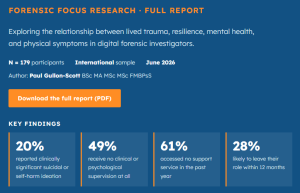
It goes without saying that digital forensics is a high stakes area, and it is therefore crucial for both data and methodology to be as rigorous as possible. Errors in process or in information can be catastrophic – but what
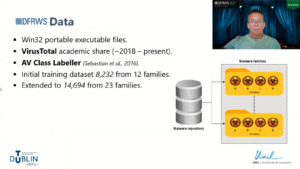
Hello everyone. My name is Steven O’Shaughnessy, and I’m a lecturer from the Technological University in Dublin. And on behalf of my colleague, Frank Breitinger from the University of Lausanne and myself, I am presenting our paper entitled malware family
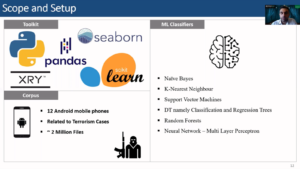
Hi all, thank you for your interest in this presentation that will cover the research work conducted by myself, Cezar Serhal, and Dr An Le-Khac from UCD. Our paper presents a machine learning based approach to triage smartphone content using
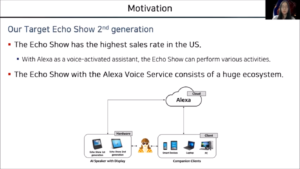
Hello, thank you for attending our talk. My name is Min-A Youn. I’m a member of Digital Forensic Research Center in Korea University. I’m interested in digital forensics, IoT device forensics, and instance analysis. And today, I will give a
Hello everyone. My name’s Wen Qiaokun. It’s my great honour to be here making this presentation about my research topic, and the name is ‘CNN based zero-day malware detection using small binary segments’.Okay, let’s start. Firstly, why I want to
The discussion about how to mitigate human bias in forensic science continued in September. Inclusiveness is a key part of this, not just in terms of racial, gender, ability, or other identity, but also in terms of expertise. This month
Digital forensics research last month fell fairly neatly into two categories, each of which sought to solve bigger problems in the field. In the first category is ensuring quality via frameworks such as service levels, better supporting first responders, reporting,
Our brief roundup this month looks at seven recent papers, which look at improving malware detection and acquisition, analyzing instant messaging apps and the Zoom platform, the future of digital forensics tools and practice, and finally, a framework for forensic
Held virtually once again in response to the COVID-19 pandemic, the Digital Forensics Research Workshop Virtual Europe (DFRWS-EU) embodied its vision of cultivating an inclusive, transdisciplinary approach in both program and activities by featuring 10 of the 29 research paper
February’s research in digital forensics isn’t just about the papers presented at the American Academy of Forensic Sciences (AAFS)’ annual meeting, or those published in the various journals. Last month also saw new research opportunities, either for an impact study
January was a somewhat light month in the way of digital forensics research publication, though the introduction of an Asia-Pacific (APAC) installment of the Digital Forensics Research Workshop (DFRWS) conference more than made up for it. This month we feature
Digital forensics research often depends on casework: specific problems with a device, operating system, app, or artifact that a forensic examiner needs to solve.
That isn’t always the case, though. Sometimes the problem has a broader scope, or the examiner
The end of 2020 could not come fast enough for most of us, and yet, as the year wound down, some things — such as the digital forensics research recapped in this article — were worth slowing down for. This
We Value Your Privacy
We use technologies like cookies to store and/or access device information. We do this to improve browsing experience and to show (non-) personalized ads. Consenting to these technologies will allow us to process data such as browsing behavior or unique IDs on this site. Not consenting or withdrawing consent, may adversely affect certain features and functions.
Functional
Always active
The technical storage or access is strictly necessary for the legitimate purpose of enabling the use of a specific service explicitly requested by the subscriber or user, or for the sole purpose of carrying out the transmission of a communication over an electronic communications network.
Preferences
The technical storage or access is necessary for the legitimate purpose of storing preferences that are not requested by the subscriber or user.
Statistics
The technical storage or access that is used exclusively for statistical purposes.The technical storage or access that is used exclusively for anonymous statistical purposes. Without a subpoena, voluntary compliance on the part of your Internet Service Provider, or additional records from a third party, information stored or retrieved for this purpose alone cannot usually be used to identify you.
Marketing
The technical storage or access is required to create user profiles to send advertising, or to track the user on a website or across several websites for similar marketing purposes.
To provide the best experiences, we use technologies like cookies to store and/or access device information. Consenting to these technologies will allow us to process data such as browsing behavior or unique IDs on this site. Not consenting or withdrawing consent, may adversely affect certain features and functions.
Functional
Always active
The technical storage or access is strictly necessary for the legitimate purpose of enabling the use of a specific service explicitly requested by the subscriber or user, or for the sole purpose of carrying out the transmission of a communication over an electronic communications network.
Preferences
The technical storage or access is necessary for the legitimate purpose of storing preferences that are not requested by the subscriber or user.
Statistics
The technical storage or access that is used exclusively for statistical purposes.The technical storage or access that is used exclusively for anonymous statistical purposes. Without a subpoena, voluntary compliance on the part of your Internet Service Provider, or additional records from a third party, information stored or retrieved for this purpose alone cannot usually be used to identify you.
Marketing
The technical storage or access is required to create user profiles to send advertising, or to track the user on a website or across several websites for similar marketing purposes.