By Paul Gullon-Scott BSc, MA, MSc, MSc, FMBPsS, Forensic Mental Health & Well-being Lead, Spectrum Specialist Consultancy Ltd
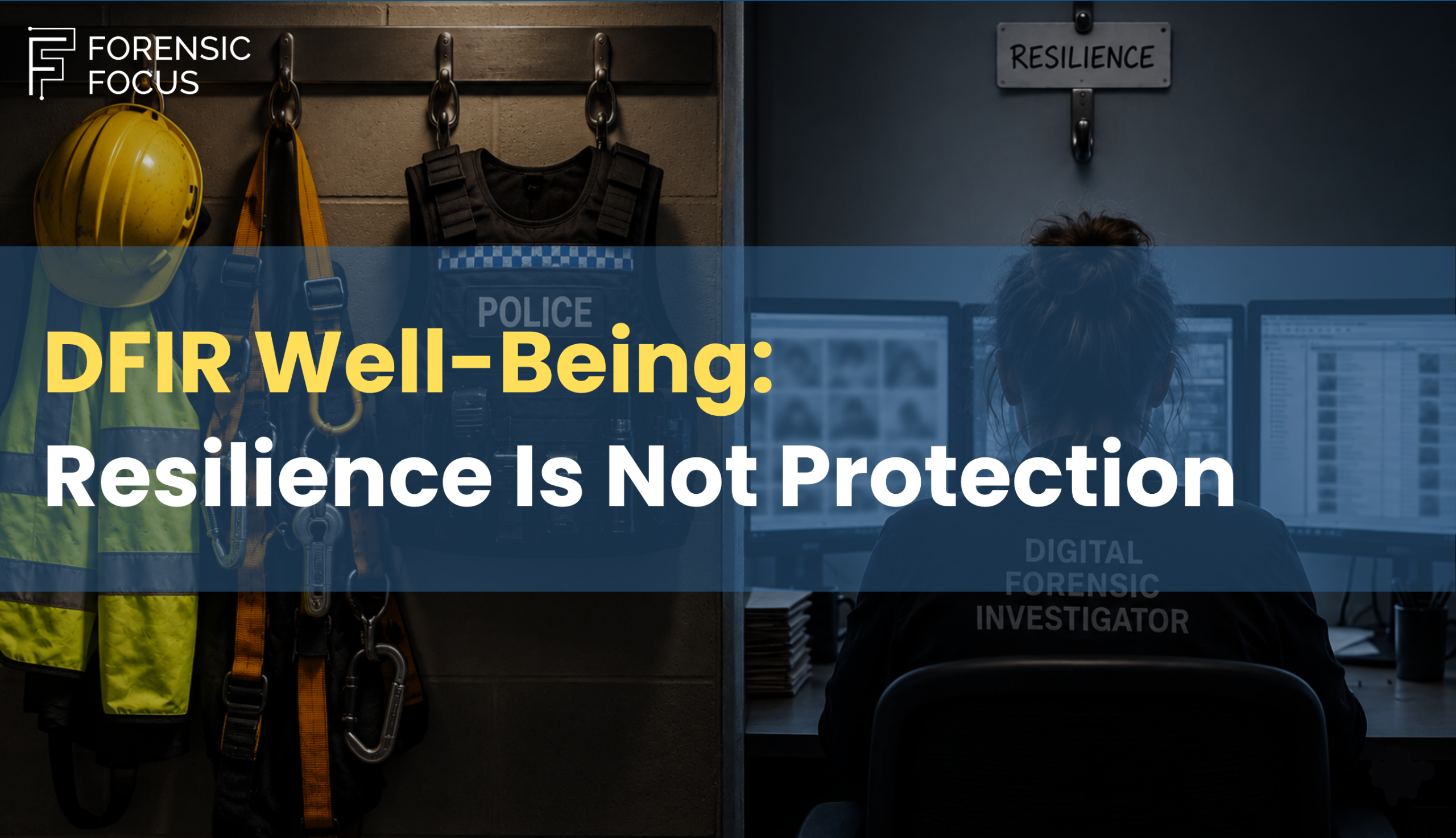
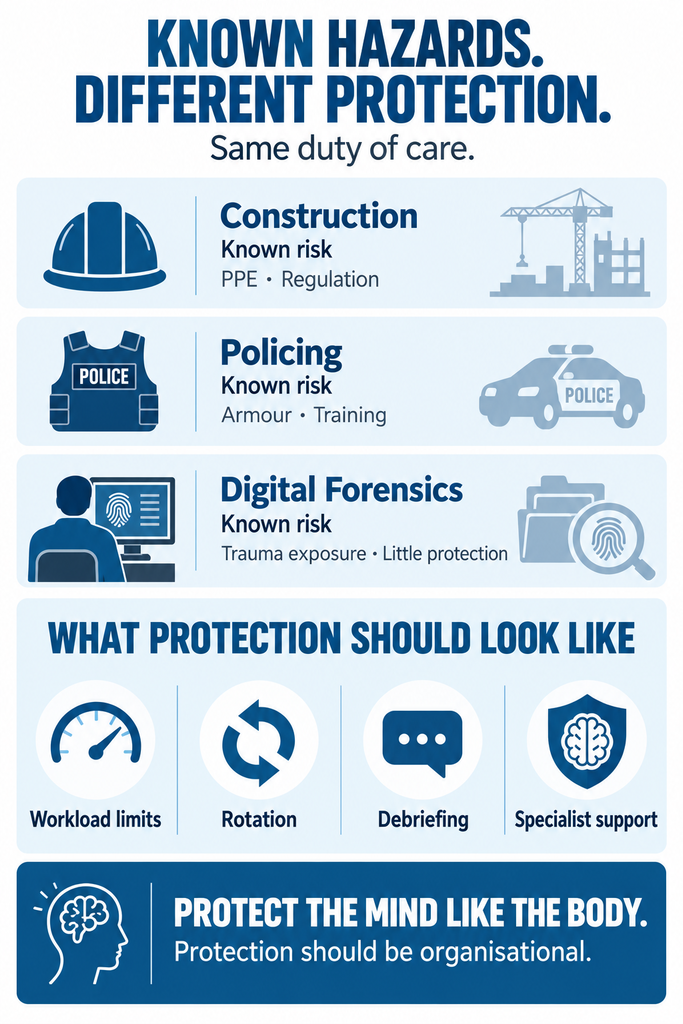
Every job carries hazards. What separates a well-run occupation from a badly-run one is not whether hazards exist, but what the organisation does about them. Nowhere is that clearer than in the two occupations most associated with physical risk in the public imagination: construction and policing. Both have spent decades building formal systems to keep workers’ bodies intact. Hard hats, harnesses, fall-arrest systems and site inductions on a construction site. Stab vests, use-of-force training and risk-assessed deployments in policing. In both cases, protective equipment is not a suggestion, a personality trait, or something you’re expected to supply yourself. It is mandated, funded, inspected and treated as the organisation’s job to provide.
Digital forensic investigators (DFIs) work inside that same policing system, and yet the hazard they are routinely exposed to, repeated, cumulative exposure to child sexual abuse material and other extreme content, gets none of that infrastructure.
Instead, it gets a personality test. “Come and join us if you have the resilience,” as a recent recruitment post for a UK force’s forensics department put it. Nobody treats a hard hat or stab vest as optional because a worker is considered ‘resilient’ enough to cope without one. Yet that is functionally the offer made to DFIs: protection against the psychological hazard of the job is treated as something you bring with you, not something the organisation supplies.
How We Manage Physical Risk
It’s worth being precise about how seriously physical hazard is taken in these two fields, because the contrast is stark.
Construction remains the most dangerous industry in Great Britain by fatality count: 35 workers died on construction sites in 2024/25, and falls from height, the industry’s single largest cause of death, account for over half of all construction fatalities in the last five years, averaging around 21 deaths a year.
In response, the sector has built an extensive system of protection around known physical hazards, including:
- the Work at Height Regulations;
- the PPE at Work Regulations;
- mandatory risk assessments;
- protective equipment such as hard hats, harnesses and fall-arrest systems; and
- continuous enforcement by the Health and Safety Executive (HSE).
Nobody in construction is expected to personally will themselves out of the path of a falling object. The hazard is identified, engineered against, and equipped for as an organisational responsibility, not an individual one.
Policing takes the same approach to physical threat. Under the Health and Safety at Work Act 1974, employers, including police forces, have a legal duty to assess foreseeable risks and provide appropriate protective equipment.
In practice, that means officers are provided with:
- stab vests certified to Home Office standards;
- use-of-force training; and
- risk-assessed deployment.
Knife crime is a real and rising threat to officers; the response to it is not a recruitment poster asking for resilient candidates, it’s body armour.
Where Psychological Protection Falls Short
Now compare that to what happens with psychological hazard, in construction, in policing, and especially for DFIs.
Start with construction, because the numbers are instructive. Despite the industry’s genuinely exemplary record on physical hazard control, an estimated 355 to over 500 people working in construction trades die by suicide in England and Wales each year, roughly ten to fifteen times the number who die from workplace falls. Male construction workers die by suicide at around three times the rate of the general male population, and surveys suggest that as many as 59% of construction workers have experienced a mental health problem, many saying they felt unable to talk about it. The organisational response to this has come almost entirely from third-sector charities, Mates in Mind, the Lighthouse Charity, rather than from anything resembling the statutory, engineered, mandatory infrastructure that governs hard hats and harnesses. Even in the industry that takes physical hazard most seriously, psychological hazard is left to goodwill.
Policing shows the same pattern, and the National Police Workforce and Wellbeing Survey 2026 puts numbers on it. Investigations and investigative support staff, the broad category DFIs sit within, report the second-highest rates of physical and emotional exhaustion of any function in policing (62% and 50% respectively, behind only frontline incident response), the second-highest workload pressure, and some of the lowest scores in the entire survey for psychological safety: only 31% believe they’d be supported by their force if they made a genuine mistake, and just 18% believe their force is genuinely committed to helping them balance work and home life, tied for the worst score of any function surveyed. This is a workforce absorbing a serious, measurable occupational hazard, with almost none of the structural protection given to physical risk.
For DFIs specifically, the research is even more direct. Our own 2024 study of UK-based DFIs found 68.8% reporting secondary traumatic stress to some degree, with 29.9% at high to severe levels. HMICFRS’s inspection of police digital forensics found a national backlog of over 25,000 devices awaiting examination and delays “so egregious that victims were being failed.” Yet the response still relies heavily on individual coping rather than workload controls, staffing, rotation and other structural protections.
Why Resilience Is Not Protection
This is where the “resilience” framing does its quiet damage. It gets talked about as if it were a kind of psychological body armour, something you either arrive with, or fail to, that will reliably absorb the impact of the material and let you carry on unharmed. A stab vest works this way: rated, tested, and reliable within its rating. Resilience does not work that way. It is not a psychological shield that reliably protects investigators from the material they are exposed to, and the research bears this out.
Wortley and colleagues’ major study of internet child exploitation investigators found that a small number of the most resilient-seeming investigators at recruitment went on to develop clinically significant PTSD and depression that worsened over time regardless of how well they started out. Tehrani’s research found that neuroticism, a stable personality trait nobody chooses or trains away, was the strongest predictor of secondary trauma among investigators, not effort or attitude. Duran and Woodhams’ 2026 longitudinal study of UK law enforcement staff found psychological distress reliably worsening over 18 months as cumulative exposure increased, irrespective of how well someone was coping at the outset. And in our own DFI sample, established positive coping strategies, active coping, positive reinterpretation and social support did not significantly reduce secondary traumatic stress at all.
In other words: the vest doesn’t stop the blade every time. Exposure may be too great, too prolonged, or interact with characteristics that were never a choice in the first place. A stab vest that failed this unpredictably would be recalled. Resilience, when it fails, gets read as the individual’s fault.
From Individual Resilience to Organisational Responsibility
The double standard isn’t a legal one. The Health and Safety at Work Act 1974 places the same duty on employers to protect psychological health as physical health. The HSE has been explicit that “health” includes mental health, while the Management of Health and Safety at Work Regulations require organisations to assess psychosocial hazards just as they assess physical ones.
There is no statute that says trauma is the worker’s problem to solve alone.
The separation is cultural, not legal. Physical injury is visible, immediate and relatively easy to attribute. Psychological injury is often invisible, cumulative and delayed, making it much easier to dismiss as a matter of individual constitution.
But saying “you need to be resilient enough to do this job” quietly does the same thing as saying “if it breaks you, that’s on you.” It reclassifies an occupational hazard as a personal deficiency.
If repeated exposure to traumatic material is a foreseeable hazard of digital forensic work, then the organisational response should look like occupational risk management. That means providing:
- workload limits that reduce excessive and prolonged exposure;
- appropriate screening that identifies support needs without simply selecting for supposed “resilience”;
- mandatory debriefing as part of routine working practice, rather than something sought only once somebody is struggling;
- rotation away from sustained high-exposure work to reduce cumulative psychological load;
- access to specialist psychological support from professionals who understand trauma exposure and digital forensic work; and
- a psychologically safe culture in which reporting distress is treated as sensible risk reporting rather than a confession of weakness.
Until that infrastructure exists, the word “resilience” in a job advert isn’t a compliment to the workforce. It’s an admission that the organisation hasn’t built the equipment yet — and has decided that’s the applicant’s problem to solve.
Paul Gullon-Scott BSc MA MSc MSc FMBPSS is a former Digital Forensic Investigator with nearly 30 years of service at Northumbria Police in the UK, specializing in child abuse cases. As a recognized expert on the mental health impacts of digital forensic work, Paul now works as a Higher Assistant Psychologist within the NHS and is the developer of a pioneering well-being framework to support digital forensics investigators facing job-related stress. He recently published the research paper “UK-based Digital Forensic Investigators and the Impact of Exposure to Traumatic Material” and has chosen to collaborate with Forensic Focus in order to raise awareness of the mental health effects associated with digital forensics. Paul can be contacted in confidence via LinkedIn.