By Paul Gullon-Scott BSc, MA, MSc, MSc, FMBPsS, Forensic Mental Health & Well-being Lead, Spectrum Specialist Consultancy Ltd
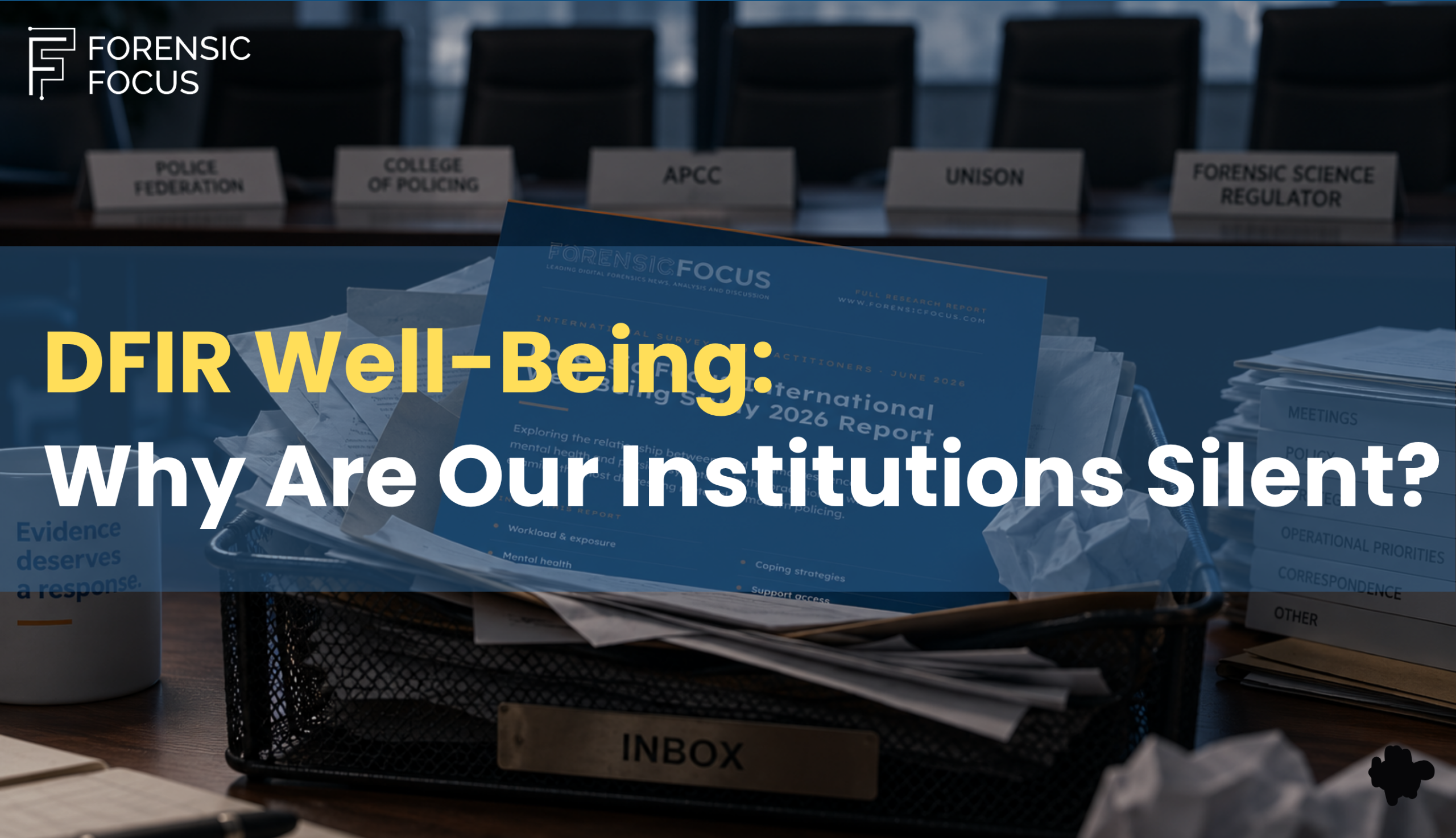
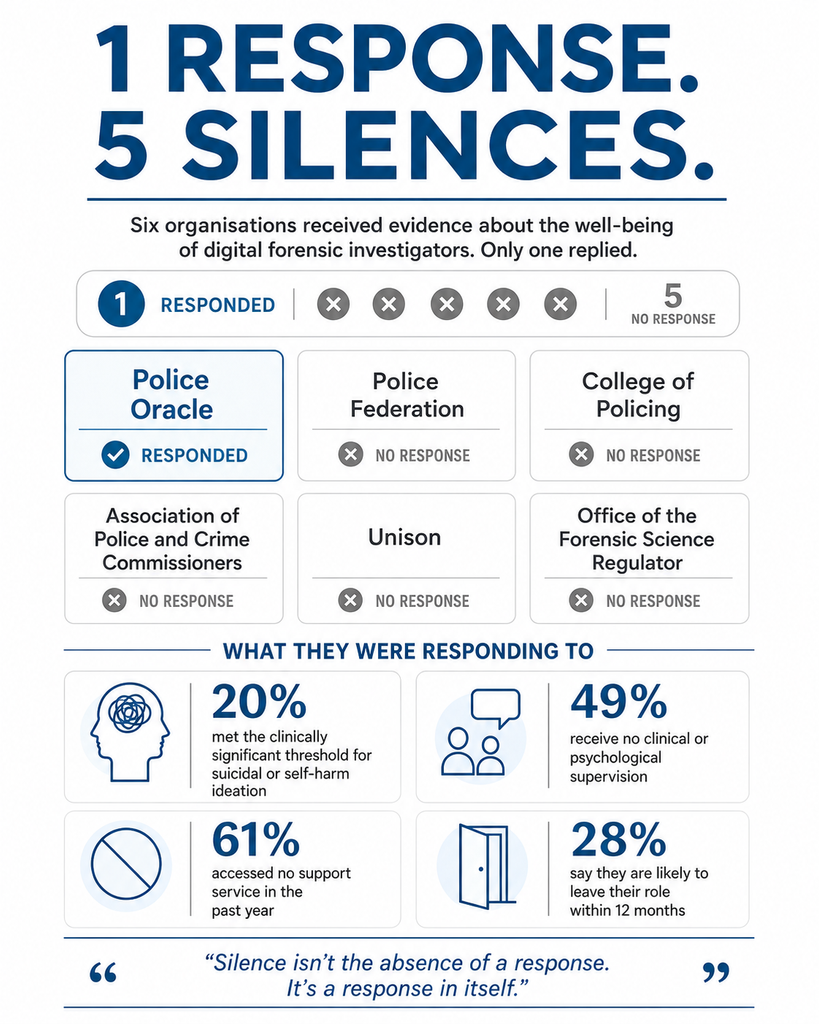
On 1 July 2026, briefing documents summarising the results of the Forensic Focus International Well-Being Study were sent to six organisations with some plausible stake in the working lives of digital forensic investigators (DFIs): Police Oracle, the Police Federation, the College of Policing, the Association of Police and Crime Commissioners, Unison, and the Office of the Forensic Science Regulator. One replied. Police Oracle read the briefing, got in touch, asked questions, and ran a story on the findings. The other five said nothing. Not a query, not an acknowledgement, not even a holding line to say the material had been received and would be considered. As of writing, that silence has now run for the better part of two months.
It would be easy to read that as a footnote to the study rather than a finding in its own right. I don’t think it is. An organisation’s response to unwelcome evidence is itself evidence, about how seriously it takes the population the evidence concerns, and silence from five bodies with direct or indirect responsibility for the people who do this work deserves the same scrutiny we’d give any other data point. DFIs reading this will draw their own conclusions about who, if anyone, is watching out for them at a national level. That conclusion matters as much as anything in the original study.
What the Silence Was a Response To
It’s worth being clear about what these organisations were sent, because the findings weren’t ambiguous or marginal. The study surveyed 179 serving digital forensic investigators internationally, using validated clinical measures (the PCL-5, GAD-7, PHQ-9, PHQ-15 and related scales) rather than informal self-rating. The headline finding was that one in five investigators, 20%, met the clinically significant threshold for suicidal or self-harm ideation, around four times the estimated rate in the general workforce. That is not a soft or ambiguous figure. It is a validated clinical measure showing a fifth of this workforce carrying a level of distress that would, in almost any other occupational context, trigger an immediate duty-of-care response.
The briefing didn’t stop there. It also reported that:
- 49% of investigators receive no clinical or psychological supervision at all.
- 61% had accessed no support service of any kind in the past year.
- 28% said they were likely to leave their role within twelve months, a significant retention risk for a specialist function that takes years to train up.
- 49% rated case-volume backlog as “very” or “extremely” stressful, in many cases placing it above the distress caused by the material itself.
- 60% found AI-generated CSAM as distressing as, or more distressing than, real material, a threat the sector currently has little guidance on.
Taken together, this was not a briefing about a minor process inefficiency. It described a specialist workforce facing clinically significant distress, inadequate support, serious retention pressure and emerging sources of harm, and it asked what these organisations intended to do about it.
Taking Each Silence on Its Own Terms
It’s tempting to treat five non-responses as one undifferentiated wall of institutional indifference, but the organisations involved have different remits, and the silence means something slightly different in each case. It’s also worth saying plainly that these weren’t identical mail-merged PDFs: each briefing was written to speak to the specific levers available to its recipient.
The version sent to the Association of Police and Crime Commissioners, for instance, set out four asks mapped directly onto a PCC’s own remit:
- Make the well-being of high-exposure investigative staff an explicit priority in the local Police and Crime Plan;
- Resource clinical supervision, staffing, and caseload management;
- Hold forces to account on workforce-welfare metrics for these roles; and
- Fund proactive, confidential crisis monitoring and structured peer support in place of relying on self-referral.
That’s not a generic call to “do better.” It’s four specific, fundable actions sitting inside decisions a Commissioner’s office already makes every year.
The Police Federation represents the welfare interests of officers up to the rank of chief inspector. A meaningful proportion of DFIs are civilian police staff rather than sworn officers, which may partly explain why this particular briefing didn’t land squarely in their lane, but it doesn’t fully explain it either. Plenty of DFIs are officers, and an organisation whose entire purpose is officer welfare had reason to at least ask whether this affected their members.
The College of Policing sets professional standards and guidance across policing, well-being among them. Of the five, this is the silence that sits least comfortably, because setting standards for how the workforce is looked after is precisely their stated function. A study showing a serious well-being gap in a specialist function of policing is not adjacent to their remit; it is their remit.
Unison represents police staff, and a substantial share of DFIs are Unison members by virtue of their employment status. Of all five silences, this is arguably the hardest to read charitably. A union’s core purpose is representing the interests and welfare of its members, and evidence that a defined group within that membership is reporting elevated rates of self-harm ideation is about as directly relevant as evidence gets.
The Office of the Forensic Science Regulator oversees quality standards in forensic science, and might reasonably see workforce well-being as outside a remit focused on scientific validity and evidential integrity. But fatigue, burnout and psychological strain are not unrelated to quality: a regulator concerned with the reliability of forensic examinations has a direct stake in whether the people conducting them are operating under conditions that increase the risk of error.
What Silence Tells the Workforce
There’s a second-order effect here that’s easy to miss if you only look at the organisations and not the people watching them. Part of what this study, and the research before it, has consistently found is that DFIs under-report distress because they don’t trust that disclosure leads anywhere useful, whether that’s because of stigma within their own team, scepticism that action will follow, or simple uncertainty about who is meant to be listening. A prolonged, unbroken silence from five national bodies in response to hard evidence of self-harm ideation within this workforce does nothing to correct that belief. If anything, it confirms it. Why would an individual investigator disclose distress to their organisation if the national bodies that exist, in part, to hold organisations to that standard can’t manage a response to a formal briefing? Silence at the top of the system reinforces silence at the bottom of it.
What the Silence Might Mean, and What It Probably Doesn’t
None of this is to say five organisations quietly agreed to ignore the same evidence for the same reason. Large representative and regulatory bodies receive a constant stream of reports and briefings from external organisations, and non-response to any single one of them is common, sometimes reflecting nothing more than volume and triage rather than a judgement on the material itself. It’s also possible that internal governance processes mean a public or even a private response requires sign-off that simply hasn’t happened yet, and that engagement is still coming. I’d genuinely welcome being proven wrong by a response landing the week this goes to print.
But two months of complete silence, across five separate organisations, each with a different and specific reason to have something to say, starts to look less like scheduling and more like a pattern. And the pattern that fits best is one this publication has written about before: diffusion of responsibility. We’ve argued in these pages that telling individual investigators to be “resilient” quietly shifts an organisational hazard onto the individual, letting the organisation off the hook for building the protections that should exist around them. What this silence suggests is that the same diffusion happens one level up. If no single national body sees DFI well-being as squarely its job, each can reasonably assume someone else is handling it, and the evidence simply falls through the gap between them. The individual investigator is told to be resilient enough to cope without organisational protection; the organisations that might provide collective protection can each, quietly, assume that’s someone else’s brief.
Why Silence Is the Wrong Response, Whatever the Reason
Even a critical response would have been better than none. Disagreement with the study’s methodology, a request for more detail, a statement that the issue sits with a different body, any of these would at least have confirmed the evidence had been read and taken seriously enough to engage with. Silence leaves only two possible readings: the material wasn’t considered important enough to warrant a response, or it was considered and the organisation decided saying nothing was the safer option. Neither is a good look for a body with some claim to representing, regulating, or overseeing the people this study is about.
The profession deserves better than a single specialist trade publication being the only outlet willing to engage publicly with evidence that a fifth of digital forensic investigators meet the clinical threshold for suicidal or self-harm ideation. That isn’t a criticism of Police Oracle, who did exactly what a responsible outlet should do: read the evidence, ask questions, and put it in front of a wider audience. It’s a comment on everyone else. What’s required, at minimum, is acknowledgement that the evidence exists, that it concerns people within your remit, and that silence is itself a choice, one that, the longer it continues, becomes harder to distinguish from indifference.
Silence isn’t the absence of a response. It’s a response in itself.
Paul Gullon-Scott BSc MA MSc MSc FMBPSS is a former Digital Forensic Investigator with nearly 30 years of service at Northumbria Police in the UK, specializing in child abuse cases. As a recognized expert on the mental health impacts of digital forensic work, Paul now works as a Higher Assistant Psychologist within the NHS and is the developer of a pioneering well-being framework to support digital forensics investigators facing job-related stress. He recently published the research paper “UK-based Digital Forensic Investigators and the Impact of Exposure to Traumatic Material” and has chosen to collaborate with Forensic Focus in order to raise awareness of the mental health effects associated with digital forensics. Paul can be contacted in confidence via LinkedIn.