By Paul Gullon-Scott BSc, MA, MSc, MSc, FMBPsS, Forensic Mental Health & Well-being Lead, Spectrum Specialist Consultancy Ltd
A recent LinkedIn post advertising for digital forensic investigators, published by a head of forensics at a UK police force, invited candidates to “join our team if you have the skills and resilience to do one of the hardest jobs in policing.” The sentiment behind it deserves scrutiny, because it is not a harmless piece of recruitment copy. It is a statement, from a senior leader, about what determines whether someone can survive this work. And on the evidence, it is wrong.
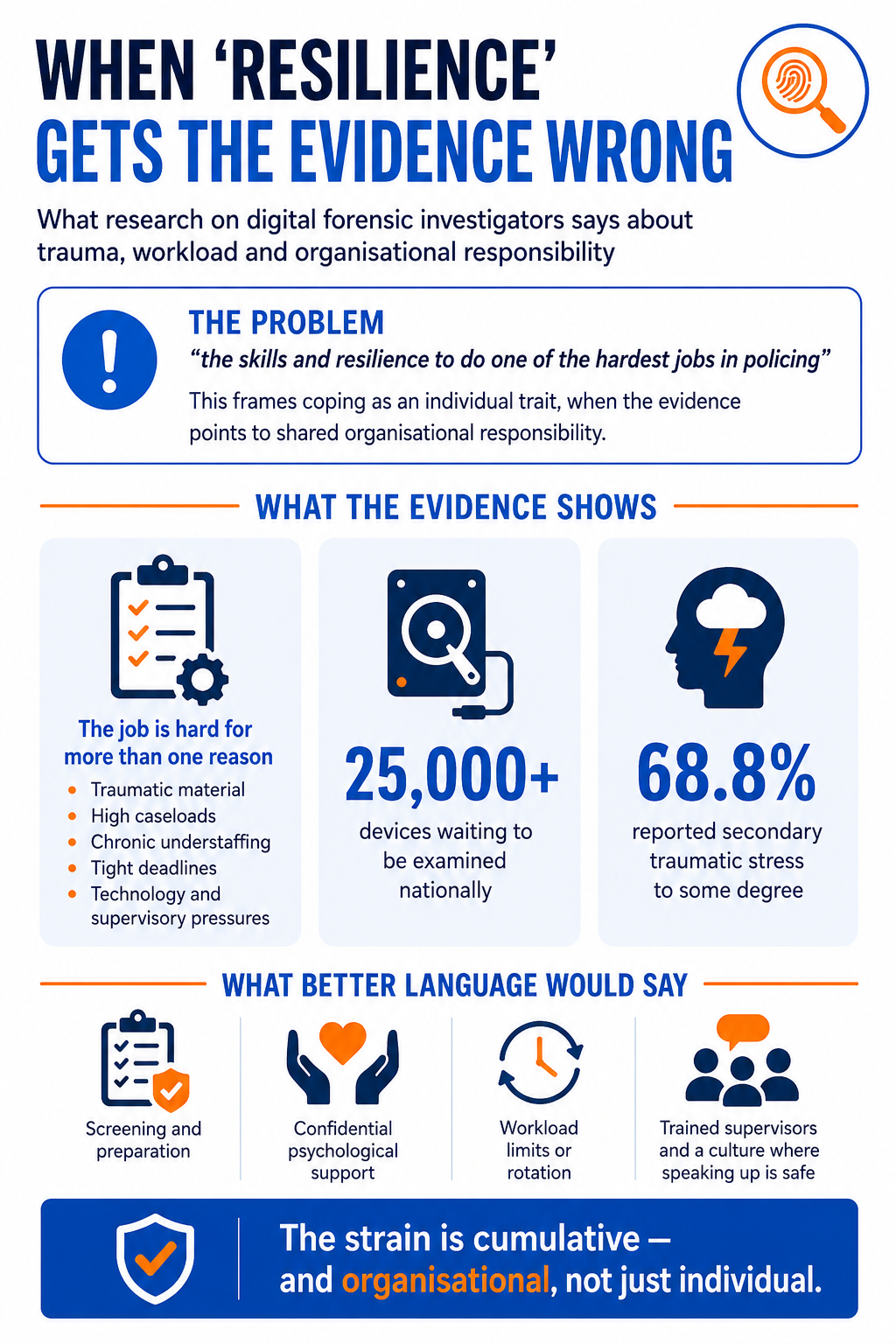
The problem is not that the job is hard. Digital forensic investigators (DFIs) who review child sexual abuse material (CSAM), extreme violence and other traumatic content do one of the most psychologically demanding jobs in policing, and naming that honestly is not the issue. The issue is what the sentence does with that difficulty: it locates the ability to cope entirely inside the individual. If you have “the resilience,” you can do the job; if you struggle, falter, or eventually cannot continue, the deficit is in you. Resilience becomes the entry ticket and the explanation for failure in one move. That framing puts the entire onus on the investigator to be psychologically strong enough to withstand material that was never designed to be survivable, and it lets the organisation that recruits, deploys and manages them off the hook.
What Makes the Job So Hard
It is also worth naming what “one of the hardest jobs in policing” actually involves, because exposure to traumatic material is only part of it. Occupational stressors in digital forensics include:
- High workload volume
- Tight deadlines
- Chronic understaffing
- Poorly managed technology upgrades introduced without any corresponding reduction in casework
- Limited career progression
- Supervisors who are out of touch with the emotional, technical and time demands of the role
These pressures sit on top of the traumatic content itself.
In the UK, HMICFRS’s own inspection of police digital forensics found a national backlog of more than 25,000 devices waiting to be examined and described delays “so egregious that victims were being failed.” That is the operational reality DFIs work inside: rising demand, chronic understaffing, ageing or poorly rolled-out technology, and case backlogs that leave investigators carrying heavier caseloads with less time per case, layered on top of the psychological toll of the material itself.
None of that is solved by an investigator being personally resilient. It is solved, if at all, by resourcing decisions, staffing levels, technology investment and workload management — all of which sit with the organisation, not the individual at the workstation.
What the Evidence Actually Shows
Resilience matters, and most people who do this work show it. Wortley, Smallbone, Powell and Cassematis’s study of internet child exploitation investigators found that many investigators coped well and took pride in the role. But a minority developed clinically significant PTSD, depression and stress over time, despite starting out resilient. Resilience at recruitment did not guarantee resilience years later.
Exposure can still overwhelm good coping. In our 2024 study of UK-based DFIs, Darren Johnson and I found that:
- 68.8% of 114 investigators reported some degree of secondary traumatic stress (STS)
- 46.6% reported moderate to severe STS
- Difficulty viewing CSAM, younger age and mental disengagement were among the strongest predictors
- Established “positive” coping strategies did not significantly reduce STS in the sample
The authors suggest that the material itself may be distressing enough that resilience and good coping do not fully protect against its effects. That is a very different message from “come and join us if you’re resilient enough.”
Individual differences matter, but so does the environment. Tehrani’s research on internet child abuse investigators found that neuroticism was a strong predictor of anxiety, depression, burnout, PTSD and STS. Her work also highlights screening, supervisory awareness and structured support, framing work-related psychological risk as a shared responsibility between employer and employee.
The effects of exposure build over time. Duran and Woodhams’s 2026 longitudinal study found that psychological distress worsened over 18 months as cumulative exposure increased. Staff who initially appeared to be coping well later reported:
- intrusive thoughts
- hypervigilance
- sleep disturbance
- depressive symptoms
Their findings also point to the importance of adequate training, fair workloads and organisational recognition of the emotional demands of the work. Resilience is not a fixed quality that inoculates someone against sustained exposure.
Organisational support is not an optional extra. Kelty and colleagues’ research on burnout and secondary traumatic stress identifies both individual and organisational risk and protective factors, with supportive supervisors and team leaders among the most important protections.
Forensic Focus’s own 2024 Investigator Well-Being Survey found that 84% of respondents felt current mental health support in the field was inadequate, while stigma and fear of judgement discouraged some from seeking help.
Taken together, the evidence points in one direction: resilience helps, but well-being also depends on exposure, workload, leadership and organisational support. A recruitment message that asks candidates to bring their own resilience while saying nothing about what the organisation will provide gets that balance wrong.
Why the Language Matters
This matters more when the message comes from a head of forensics. Senior leaders help shape the very conditions the evidence identifies as protective: workload management, supervisory awareness, access to specialist support, and a culture in which admitting difficulty is not treated as weakness. Framing recruitment around whether candidates are “resilient” enough risks shifting responsibility away from those organisational conditions and back onto the individual.
There is also a quieter cost. Forensic Focus’s own 2026 survey found that stigma and fear of judgement are already major reasons DFIs do not seek help when they are struggling. A recruitment message that presents coping as a personal attribute can reinforce that stigma before someone has even started the job. It risks telling investigators that difficulty later on reflects a lack of resilience, rather than the predictable effects of cumulative exposure and occupational pressure.
What Better Language Would Look Like
None of this means forces should stop being honest about how demanding this work is. Candidates deserve to understand what they are signing up for. But honesty about difficulty is not the same as making resilience the price of entry.
A recruitment message grounded in the evidence would make clear what the organisation itself does to protect the people carrying out this work, including:
- Pre-employment screening and preparation so candidates understand the psychological demands of the role and are properly prepared for them.
- Mandatory, confidential psychological support that does not depend on an investigator first recognising that they are struggling or feeling able to ask for help.
- Workload limits and appropriate rotation to manage cumulative exposure to distressing material.
- Supervisors trained to recognise the risk factors and signs of deterioration, rather than leaving responsibility for monitoring well-being entirely with the individual.
- A culture in which flagging difficulty is treated as sensible professional practice, not as evidence that someone lacks the resilience required for the job.
That framing does not deny the importance of individual coping or resilience. It places them where the evidence suggests they belong: within a wider system of organisational protection and responsibility.
If forces are going to tell candidates that this is one of the hardest jobs in policing, the message should not simply be, bring enough resilience to withstand it. It should also be clear what the organisation will do to ensure that resilience is not being used as a substitute for proper support, manageable workloads and psychologically informed leadership.
Paul Gullon-Scott BSc MA MSc MSc FMBPSS is a former Digital Forensic Investigator with nearly 30 years of service at Northumbria Police in the UK, specializing in child abuse cases. As a recognized expert on the mental health impacts of digital forensic work, Paul now works as a Higher Assistant Psychologist within the NHS and is the developer of a pioneering well-being framework to support digital forensics investigators facing job-related stress. He recently published the research paper “UK-based Digital Forensic Investigators and the Impact of Exposure to Traumatic Material” and has chosen to collaborate with Forensic Focus in order to raise awareness of the mental health effects associated with digital forensics. Paul can be contacted in confidence via LinkedIn.
References
Duran, F. & Woodhams, J. (2026). Ongoing exposure to distressing material is associated with worsening mental health in UK law enforcement staff: a longitudinal study. Journal of Police and Criminal Psychology.
Gullon-Scott, P. & Johnson, D. (2024). UK-based digital forensic investigators and the impact of exposure to traumatic material. Journal of Criminological Research, Policy and Practice.
HM Inspectorate of Constabulary and Fire & Rescue Services (HMICFRS). Inspection of Police Digital Forensics Investigations.
Kelty, S. F. et al. (2021). Avoiding burnout at the digital forensics coalface: Investigating factors relating to burnout and secondary traumatic stress. Forensic Science International: Digital Investigation.
Forensic Focus (2024). Investigator Well-Being Survey 2024 Results.
Tehrani, N. (2017). Extraversion, neuroticism and secondary trauma in Internet child abuse investigators. Occupational Medicine, 66(5), 403-407.
Wortley, R., Smallbone, S., Powell, M. & Cassematis, P. (2017). Understanding and Managing the Occupational Health Impacts on Investigators of Internet Child Exploitation.