Take the State of DFIR Survey

Caseloads, AI, tools and careers. 8 minutes, anonymous, early access to the report.

Take the survey →

Event Recap: Forensics Europe Expo

A young white woman and a young Black woman flank a vertical standing banner with a blue patterned background and white text
With in-person events making a cautious comeback this year in a pandemic-strained environment, attendance at the Forensic Europe Expo in June was perhaps a bit lower than might otherwise have been expected of a free event.  Still, the vendors who

Prudent Design Principles for Digital Tampering Experiments

Mark: Okay. Good afternoon. Welcome to the next full paper session. We have three papers for you in this session on forensic methods. So, Janine will start shortly with a paper on evidence tampering, we have a paper on forensic

Distant Traces and Their Use in Crime Scene Investigation

Starting with a physical crime scene – a fire – Manon Fischer describes how IoT devices such as “smart” plugs and thermostats store “distant traces” remotely, and could be used to help reconstruct a fire’s origin, cause, and timeline. Session

The Wisdom of the Heap: Mesh It up by Weaving Data Structures

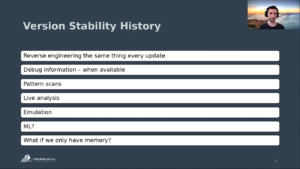
In this short presentation, Trufflepig Forensics’ Aaron Hartel and Christian Müller present some early stage research about the volatility of data in memory as data structures change version to version. Session Chair: We’re now going over to memory forensics and

Toward Graph-Based Network Traffic Analysis and Incident Investigation

At DFRWS-EU 2022, Milan Cermak describes the need to create data associations for use during network traffic analysis and incident investigation. The focus is on robust graph data visualization of the kind that’s commonly used in criminal investigation, allowing analysts