Georg H. Jeitler: The Impact Of AI And Deepfakes On Digital Evidence Authentication
How can forensic investigators separate fact from fiction in the age of AI? Georg H. Jeitler of GFOR Interdisciplinary Forensics shares insights into digital evidence authentication, AI-generated content, and the role of Amped Authenticate in detecting manipulation.
Share
About this article
Interviews 19 November 2026 18 min read 4,125 words
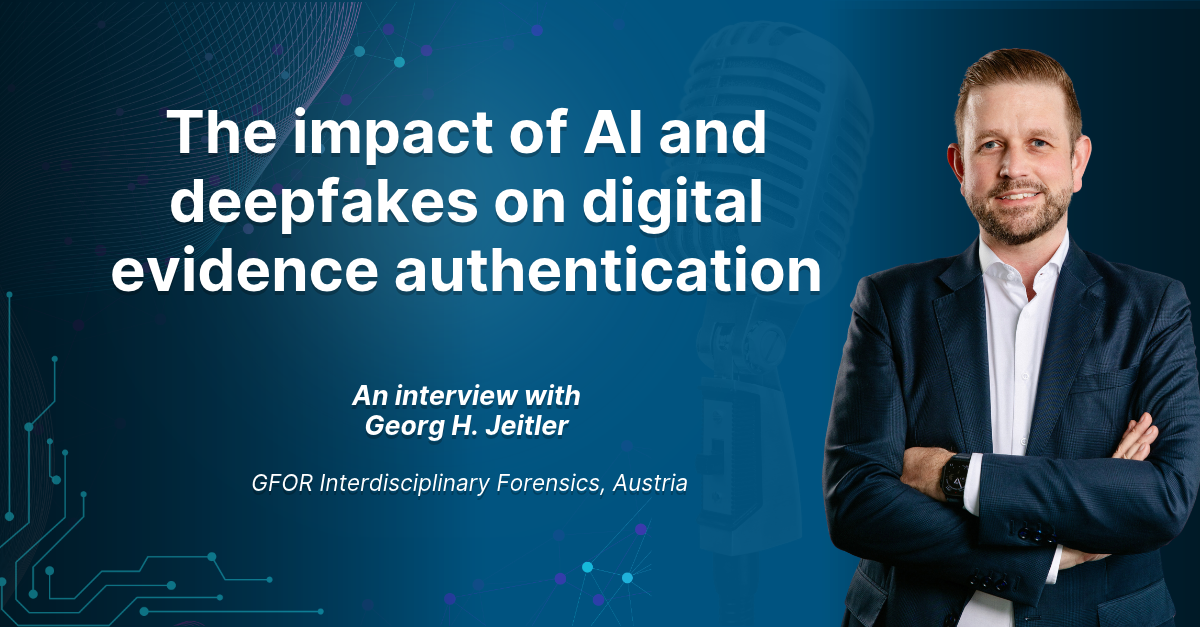
Amped Software recently spoke with Georg H. Jeitler, Managing Partner at GFOR Interdisciplinary Forensics in Austria, to explore how AI-generated and manipulated content is reshaping digital investigations. Drawing on his experience and real-world cases, Georg discussed the challenges of verifying digital evidence, the importance of structured forensic workflows, and how Amped Authenticate supported his team with their work.
Georg, could you start by telling us a little about your background and your previous role at Grant Thornton and now at GFOR Interdisciplinary Forensics, Austria?
I am covering an unusual mixture of expert areas: I am a forensic economist and, at the same time, a court-certified expert for other topics like media, copyright matters and communications. That stems from my career: I studied communication science and later business administration, and in my first professional life I was a communications consultant, graphic designer and professional photographer running my own agency. In the 2010s, a series of cases involving corrupt consultants and fictitious consulting invoices pulled me into forensics. Since 2011, I have been a publicly appointed, sworn and court-certified expert witness in Austria and subsequently mainly worked on forensic matters.
For about eight years, I built and led the forensic practice of Grant Thornton Austria as Head of Forensic Services. Our focus was economic crime, but we always worked holistically and across disciplines, which led us to focus more and more on all areas of crime. In October 2026, I acquired the firm in a management buy-out and rebranded it as GFOR Gesellschaft für interdisziplinäre Forensik mbH, which I run together with the former GT Directors Karsten Theiner and Klemens Sattler as my partners – and, I am proud to say, with our entire team, who made the move with us. We remain allied with Grant Thornton, which I appreciate as a significant global player in forensic services.
Our interdisciplinary set-up is the point of the whole exercise. Karsten and Klemens are court-certified experts in digital forensics, with a strong background in mobile device and mass data analysis for criminal courts; I bring the economic, media and document side. Together, we look at digital evidence from different angles, and the depth of expertise that produces is way above what working from a single discipline perspective would yield.
One more thing that is worth explaining to an international audience: Austria has a particular system – court expert witnesses are civilians, but we are sworn, certified by panels of judges and peers, listed in a public register and appointed directly by courts and public prosecutors. In that role, we act as neutral auxiliaries of the justice system, with an official position and duties that most jurisdictions do not know in this form. It means we see a very broad spectrum of cases, from white-collar crime to violent crime, and that we are expected to deliver findings that hold up in court.
That said, with our interdisciplinary set-up, we aim to be a one-stop shop for the judiciary, as well as lawyers and the private sector.
Your work spans forensic investigations, digital forensics, anti-fraud, compliance, and expert witness work. What does a typical forensic investigation look like for you and your team?
There is no single template, but there is a method. We try to build a complete picture before we touch anything in depth. I like the image of an architect: an architect does not lay the bricks, but they know every trade well enough to see where a specialist is needed, to coordinate them and to judge whether their work is sound. In a forensic investigation, that means first understanding the allegation and the decision it is meant to support, then getting access to and acquiring all data that is still available, and only then deciding which analyses are worth the effort. For this, we’ve developed a specific triaging approach, called EATM, the Evidence Authentication Triage Model.
Also, we apply an AI-first approach in our firm, where AI assists from the very beginning of a project to accelerate progress. However, we firmly believe in continuous human oversight when working with AI, which is critical at every step of the investigation. After all, we’re doing work that may be the basis of life-changing decisions, and as expert witnesses, we’re liable for the correctness of our reports.
In practice, an ideal engagement starts with preservation: forensic images of devices and mailboxes, exports from accounting systems, the original files rather than printouts or PDFs. Then follows the analysis layer, which in our team is deliberately mixed: e-discovery and mass data review, financial flows and valuation questions, document and media examination, mobile device forensics, deep user behaviour analysis using OS artifacts, OSINT where networks of people matter, and interviews. Hypotheses are formulated early and tested against each other constantly; we try to say what the evidence supports and what it does not, and to express that in graded terms rather than as a verdict. Quite often, the whole investigation focuses on one piece of digital evidence, like a PDF containing a contract with an implausible date, a picture that is suspected to be fake, a series of videos from different angles or a single email that must be verified as real. As these items often constitute key evidence, we invest considerable time and effort in examining them through our interdisciplinary approach.
Our experience from working for courts and prosecutors shapes our workflow a lot. Court-appointed work teaches you to document every step, to separate technical findings from their legal interpretation, and to expect that your report will be challenged by the other side. We bring the same standard into corporate internal investigations and compliance matters, where the client is a company rather than a judge.
The spectrum is wide. On the economic side, manipulated documents are the standard tool of the trade: ACFE’s global studies consistently show that approximately 40% of occupational fraud cases involve fabricated physical documents, while roughly a third involve altered documents, with electronic document fraud nearly as prevalent. Yet, despite the central role of document manipulation in occupational fraud, relatively few cases are detected through document examination. Instead, tips remain the most common means of uncovering fraud. Closing that gap is one of my personal missions – for example, we are planning to provide solutions for particularly exposed industries, such as insurers.
Aside from white-collar crime, we are regularly appointed in cases of violent crime, homicide, terrorism and child abuse, often on scene supporting house searches. Violent crime and economic crime look very different, but the evidence problems, from unsecured source devices to screenshots of unclear origin, are surprisingly similar.
Digital images and videos have long been used as evidence. Has the rise of AI changed the way you approach or assess this type of material?
Absolutely, in two ways at once. On the one hand, the claim that an image or recording is fake has become a routine line of defence. We call it the AI excuse: “I swear, that never happened, it must be generated.” On the other hand, we have to be far more sceptical than we used to be, because the claim is sometimes true. Both reflexes are dangerous. Blindly trusting a photo is as wrong as dismissing every inconvenient recording as a deepfake.
Forgery is not new. What has changed is awareness, on the side of victims and of perpetrators alike. In the last one to two years, our workload on authenticity questions has grown considerably, and we have the impression that the subjective barrier for manipulating evidence is dropping. Part of that is simply the democratisation of tools: what required a skilled Photoshop artist and a day of work now takes a minute with generative fill. Part of it may be cultural: underpinning a white lie with a doctored screenshot has become almost ordinary among younger people, and manipulation is tolerated as an option in a way it was not before.
While claiming a photo or a video is AI-generated or manipulated gets more common, we still see a lack of awareness of faked documents and other types of visual digital evidence. Screenshots are, for example, still grossly overrated as evidence. A screenshot only shows how something was displayed on one device at one moment; if the content was manipulated before the screenshot was taken, the screenshot can rarely tell you. Chat conversations can be faked with freely available apps that may appear pixel-perfect.
This collides with the way many continental legal systems evaluate evidence. Austrian courts enjoy free evaluation of evidence, which is a good principle, but it comes from a time in which evidence was hard to forge. In the future, courts will have to pay much more attention to evidence provenance and to the chain of custody, which in Europe is seen as far less important than in the Anglo-American tradition. The Vienna Court of Appeal has already had to deal with a defendant who called an incriminating video AI-generated without any supporting indication; the court rightly rejected the claim as speculative. That is the right outcome in that case, but it also shows the dilemma: without provenance, courts often can only choose between unquestioned trust and unverifiable doubt.
There is also a social problem that technical people tend to overlook. Questioning the authenticity of a document in a courtroom is still treated as an accusation against the party who presents it, and doubt is often stifled before it is examined. That taboo has to go. And finally, there is the liar’s dividend: the same technology that enables new forgeries serves as a tool to discredit genuine evidence. Defending authentic material will become as much a part of our work as exposing fakes.
In your experience, what are the most common misconceptions about determining whether an image or video has been manipulated?
A very common misconception is that a poor transmission path still allows sufficient analysis. Investigators and lawyers routinely photograph a phone display during an interview, print a screenshot and scan it back in, or forward a video through a messenger service. Each of these steps is likely to destroy the information that is needed: metadata, compression structure, device-specific characteristics. In many cases, it degrades the actual content of the evidence – e.g. messengers resize and recompress images and videos before transmission – and may lead to the loss of important details. In the worst case, the content itself is altered; scanners and computational photography both do that. By the time a file becomes part of a court record, it has often been through several lossy conversions, and the Austrian electronic court filing system accepts attachments essentially only as PDFs and re-encodes media files on upload, so the degradation is even forced. Often we then are appointed at a late stage where it is impossible to get hold of original data.
Another common misconception is that the original device is a nice-to-have. In the analogue days, a serious examiner asked for the negative of a photo or an original document. Today the equivalent is the source device: the phone, with its photo database, thumbnails, caches and system timestamps. Analysing the device is the ultimate way to tell whether a picture was taken with the camera app, received via an app, or created with a system clock that had been set back.
Often it is also underestimated how multi-layered a proper analysis is. Automated detection may be useful for preliminary screening, where some false positives or false negatives can be tolerated, but relying on such methods alone is not acceptable in court proceedings. Using a single filter or an online detector that outputs a percentage does not constitute a proper examination. A sound analysis combines multiple findings that require expert interpretation, while the plausibility of the content must also be assessed in the context of the case.This requires experience, training and sound judgement.
Lastly, the converse error is also common: the absence of visible anomalies in an image does not necessarily establish its authenticity. A clean result just means that the methods applied found nothing, which is especially important with photos that are not in their original state. A good forger may re-photograph a high-quality print of a manipulated image – this would produce a file with genuine camera data that may appear flawless if not analysed very thoroughly. Negative findings must be reported as such, including their limits, and should not be dressed up as a certificate of authenticity.
Two further misconceptions are worth noting: that EXIF timestamps or printed signature stamps can independently establish authenticity, and that the human eye is a reliable means of detecting document manipulation. Studies on human deepfake recognition put accuracy somewhere between roughly 58 and 75 percent, barely above chance, and people who perform worst tend to be the most confident. Obviously, with the acceleration of Gen AI quality, we will see these numbers change dramatically.
We often hear about “deepfake detection.” Is determining whether content is authentic really as simple as running it through a detection tool?
No. If it were that simple, our profession would not be needed. Detection tools inevitably lag behind generative tools; every detector is trained on yesterday’s generators, and every time a new model appears, the error rates jump. Many tools are themselves AI-based, which means their output is neither explainable nor reproducible, and that is a serious problem when the result has to withstand cross-examination. False positive rates are frequently far too high for forensic use, and performance collapses under the conditions that characterise real evidence: recompression, re-recording from a screen, messenger transfer, background noise in audio.
The same applies to the provenance mechanisms that are often presented as the solution. Watermarks and content credentials are tool traces, not proof of truth or forgery. In practical tests, the providers’ own watermark detectors missed or misclassified between five and twenty-five percent of their own content, and the first independent security analysis of the C2PA standard, published in April 2026, found that the specifications met none of their stated security goals; timestamps could be exchanged unnoticed. More fundamentally, a signed file only proves the chain from the camera onwards, not that the camera photographed reality. If a high-quality fake is photographed, a perfectly signed picture is produced.
So what is needed is the same as with conventional manipulation: a structured, multi-method examination, interpreted by trained examiners who understand both the technology and the craft of image-making, and who formulate the result as graded support for competing hypotheses rather than as fake or real. The absence of detectable artifacts does not prove authenticity or integrity; also, the presence of an AI trace does not prove the content is false, since upscaling or denoising with AI may leave traces on perfectly truthful images.
Tools like Amped Authenticate are the examiner’s instrument. For a trained expert, it is an enormous help to have the whole analytical toolbox in one environment and to be able to work through it systematically.
Are you already seeing cases in which AI-generated content plays a meaningful role in investigations? If so, what types of cases are emerging?
Yes, we are seeing them, although conventional manipulation is still far more common than AI-generated material, and the volume of conventional manipulation is increasing: we regularly receive edited PDFs, altered screenshots, inserted signature images and photos with falsified timestamps. We must nevertheless expect a massive increase in synthetic content, but for now the real danger lies in misdirection. A single misleading image that works as an alibi or as proof of a transaction is enough: a generated train ticket, a receipt from a real restaurant with the correct logo, a parcel photo for a damage claim. We have produced such examples ourselves in minutes to show judges how low the bar has become. In the early stages of an investigation, this can do a lot of damage, so a high level of awareness is required.
In our own casework, we see the “AI excuse” in criminal proceedings, where incriminating recordings are declared fake without any indication; courts need help to distinguish a speculative claim from a real one. Then, alibi and timeline manipulation happens regularly, mostly by low-tech means such as resetting a phone’s system clock, which produces photos with convincing timestamps that only an examination of the device reveals. Sometimes, AI generation of voice and audio is claimed: we have been engaged in speaker identification matters, and in one case a longer recorded conversation presented as credible evidence showed none of the expected features, so a synthetic origin had to be seriously considered. And in economic crime, generative tools now can produce entire seemingly consistent document sets, contracts with matching invoices and years of plausible correspondence, so that the classic plausibility check through cross-references no longer works like before.
The area with the steepest growth, however, is child sexual abuse material and related offences such as non-consensual synthetic pornography. The Internet Watch Foundation recorded 491 reports of realistic AI-generated child sexual abuse imagery in 2025 compared with 193 the year before, and the number of AI-generated videos rose from 13 to over 3,400; Europol’s IOCTA 2026 confirms that synthetic CSAM and sexual extortion are rising. My colleague Karsten Theiner and I have published on synthetic pornography in the Austrian criminal law journal JSt, because it raises questions of proof and attribution that the law is not yet prepared for.
Where does Amped Software fit into this workflow, and what types of examinations do you typically perform with it?
Amped Authenticate is valuable to us primarily because it brings so many analyses together in one place, and it has vastly reduced the number of tools needed. Before, we used a patchwork of tools, scripts and viewers; now tools like the file format and structure analysis, JPEG quantization and compression history, ELA and DCT-based maps, double-compression detection and the geometric tools sit in one environment with a consistent reporting layer. That alone changes the quality of the work, because it makes a systematic walk through the evidence the default. Also very valuable is that the methods applied by Amped Authenticate are scientifically documented, which makes it easier to defend an examiner’s findings under cross-examination.
It does require training, but the investment is worth it. For me, the most important lesson was how to read and use the filters together. Equally important is to work with the software regularly. Image authentication is a craft, and the tool only pays off if you practice it.
We use Authenticate in two different workflows. The first is triage: a quick, structured first pass that tells us whether a file is what it claims to be, whether it has been through some transmission channel, whether the metadata and compression are consistent, and whether a deep examination is justified at all. This feeds directly into the triage model we have developed, the Evidence Authentication Triage Model (EATM), which is designed to concentrate effort on the cases where the stakes and the indications warrant it. The second workflow is the deep examination itself, where the software provides a useful set of tools to also conduct this type of analysis in a structured, reliable and sped-up way.
The workflows have paid off. With the depth of the tools, we have repeatedly been able to expose complex manipulations that were not visible to the eye. Typical findings include inserted image elements exhibiting a different compression history from their surroundings, inconsistent levels of degradation across different parts of the same document, or file structures that are inconsistent with the devices from which the files purportedly originated.
Is there a particular feature or type of analysis that you find especially valuable when investigating images and videos with Amped?
I really appreciate the newer analyses that check the physics of a scene: mirror reflections, perspective and vanishing points, and the consistency of lighting and shadows. These are particularly valuable because they do not depend on metadata or compression traces, which are the first things lost or faked. A convincing composite or a generated image frequently gets the physics subtly wrong, and having that check available in a structured, reproducible form is a great advantage over the trained eye alone. For an examiner like me who started out as a photographer, this is also the part that connects the tool to the craft.
Aside from this, the breadth of the conventional toolbox and the way it is organised are particularly valuable. Because the filters are grouped along the analytical workflow, from file format and metadata through compression history to local analysis and camera identification, it is possible to work through an image methodically and to document why each step was taken. That structure matters as much as any individual result: in court, the question is always whether the examination was complete and whether another examiner could follow and repeat it. Amped Authenticate makes that discipline much easier to maintain.
Could you walk us through a case study in which the authenticity or integrity of digital media was questioned?
In a recent case, our client had purchased a riding horse. After the purchase, the horse developed health problems, and radiographs revealed changes in the bone structure. When the seller was confronted, X-ray images were provided that were supposed to show that the animal was in good health before the sale: the changed bone structure was not visible in the earlier images. Veterinarians considered it highly questionable that such changes could have developed within such a short period, and a part of the image also seemed to be atypical due to its blurriness.
The images had not been provided in DICOM, the standard format for radiologic imagery, but as JPEG files, even after having specifically asked for it. The original files were allegedly difficult to obtain because they had been taken by a veterinarian abroad. As we were able to show in a previous proof of concept, DICOM files are by no means immune to manipulation, but JPEGs are technically much easier to alter, so manipulation must generally be considered more likely – especially if a request for DICOM data is declined.
An analysis using several tools in Amped Authenticate, especially using the ELA functions, then – aside from typical visual cues – revealed clear traces indicating that a specific area of the image had been changed. To approach the examination with as little bias as possible, we had deliberately chosen not to be told in advance where exactly the original radiographs should have shown the degeneration. Only after we had identified the traces of manipulation did we speak to the client, who confirmed that the areas we had identified matched their suspicions.
Looking ahead five years, what do you think will be the biggest challenge for forensic practitioners dealing with AI-generated and manipulated media?
I think the central problem will be trust, and specifically the defence of authentic material. Today most of our effort goes into exposing manipulation. In five years, I expect a large part of it to go into demonstrating that genuine recordings are genuine, against a background assumption that anything could be fake. The liar’s dividend will grow, and courts will need methods and rules to separate a speculative claim from a founded one without simply reversing the burden of proof.
Technically, I fear that generated images and video will at some point be good enough to be authentic in depth, not only on the surface: consistent compression history, plausible sensor noise, physically correct light. When that happens, content-based detection will have reached its limit, and the original device, with its system traces and databases, will be the last resort. That has a hard consequence for the justice system: evidence has to be secured at the source and preserved in its original form with a verifiable integrity chain, something that most European procedures still do not do systematically.
Also, a regulatory answer will not solve the problems. The AI Act’s transparency obligations for synthetic content have applied since August 2026, and the major model providers comply. The risk will come from open models that anyone can run locally, fine-tune and strip of any marking – and those models keep getting better. Watermarks and content credentials will help only in the mainstream. I see some risk that regulation will lead to false trust.
For us practitioners, I see that our methods will need to express probability in their results, because binary verdicts, which are not very feasible even today, will become less and less possible. The work will become even more interdisciplinary, combining signal analysis, device forensics, media expertise, and an understanding of how documents and transactions work in the real world to interpret their content. And we will have to be economical: not every file can receive a full examination, so triage to direct effort where the indications justify it will become a core competence.