








The following transcript was generated by AI and may contain inaccuracies.
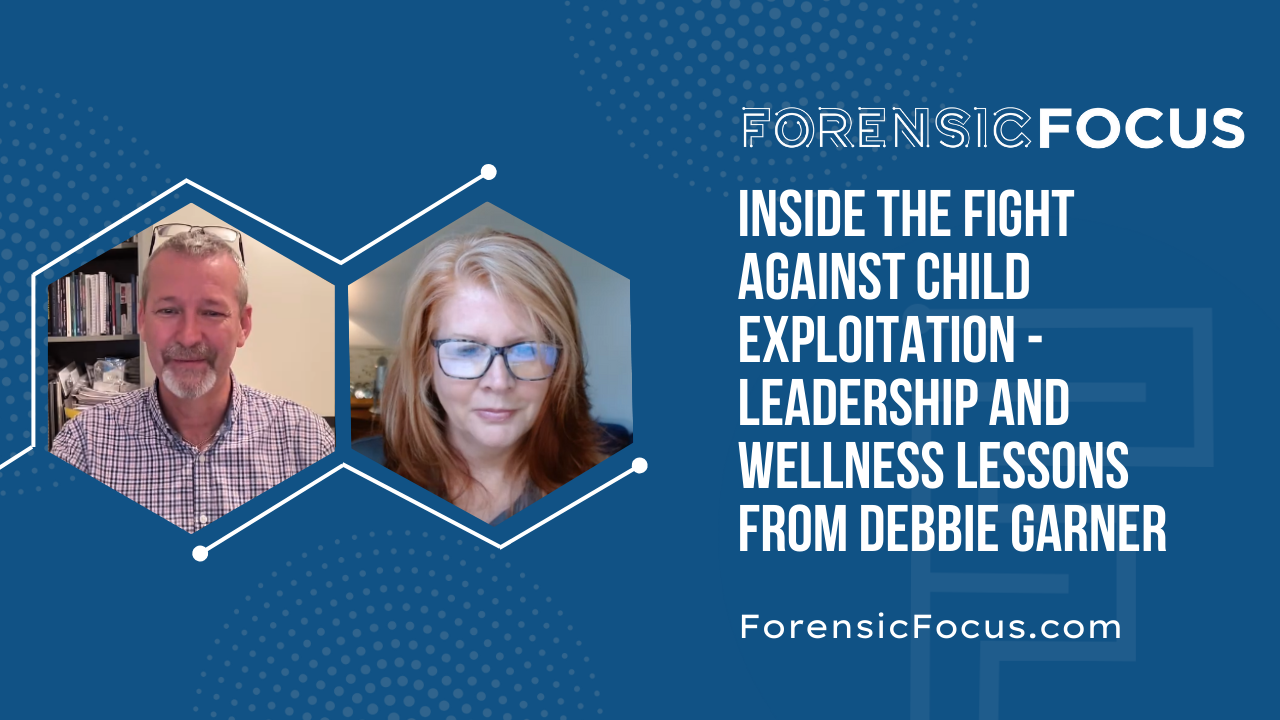
Paul: Hi, and welcome to the Forensic Focus podcast. Today I am talking to Debbie Garner. I’m not going to do the usual introduction for Deb. Deb’s got a really interesting backstory, so I’m going to ask Deb to introduce herself.
Debbie: Certainly. It’s always interesting to hear that someone else thinks your background is interesting, because you lived it. I wouldn’t say it’s boring, but it’s always interesting to hear that someone else finds it interesting.
I started my career with the Georgia Bureau of Investigation in the United States. That is a state level law enforcement agency here in the US. I had a variety of assignments during that time.
I started out working undercover narcotics – that was entry level position at the time. They basically took me at 22 years of age, straight out of college, gave me about seven weeks of training and sent me out all over Georgia to buy crack undercover in my personal car for $17,000 a year.
That was my entry into law enforcement and things have changed a lot. They have changed for the better, in my opinion. From there I did the opposite end of the spectrum – I worked healthcare fraud for many years.
I helped manage our terrorism intelligence portion of our fusion center in Georgia, which is an intelligence based work unit. I helped manage our field office in metropolitan Atlanta. In that office we worked everything from rape, robbery, homicide, political corruption, officer involved use of force.
But for the last eight years of my career I was the special agent in charge of GBI’s Child Exploitation and Computer Crimes Unit. Whoever holds that position in the GBI is also the Internet Crimes against Children Task Force Commander, the ICAC Task Force Commander for the State of Georgia.
I did that for the last eight years of my career, and by far it was the most rewarding, the most fun time in my career. I retired about three and a half years ago from active law enforcement, but still work with law enforcement in a variety of ways with digital forensics companies.
I actually help teach wellness and resiliency skills to law enforcement through the Innocent Justice Foundation. I also belong to an organization called Raven here in the United States. That is a lobbying organization that lobbies the United States Congress for additional funding for the ICAC task forces here in the United States.
Paul: That is a hell of a background, I have to say. I’m going to jump back to when you first joined the force and you said in your early twenties, you were sent out in your own car to buy drugs?
Debbie: Yes, and they paid us mileage for doing that, but yeah, it was in our personal car. Now they wouldn’t let us work around or close to where we lived. I was in a completely different part of the state.
But that still wasn’t – it is still very unusual to use your own personal car for things like that. That was probably 34 years ago when I started doing that, and yeah, it sounds crazy now. They certainly wouldn’t do that now, but that’s how I started in law enforcement.
Paul: There was obviously no risk assessments back then, neither was there…
Debbie: No. And we had cover, but they were probably six miles away on the radio with a partner. Again, I’m not saying this was best practices.
Paul: And obviously, as you say, wouldn’t be done in the same way these days, would it?
Debbie: No.
Paul: What we are going to concentrate on is how many years in total were you in law enforcement?
Debbie: 30 years. I did 30 years, a few months, which is full retirement with the agency that I was with, and I still loved my job. I absolutely still loved my job.
But I had some opportunities that came along and I decided to take them and allow the people that I had mentored – I felt very confident in their abilities and I was like, I think I’m going to take this other opportunity here. I know that I am leaving the work unit in great hands.
My kids were starting college about that time and I’ll be honest, I was going to pull a retirement paycheck, a pension paycheck and another paycheck, and that was going to help pay for college for my kids. That’s one reason I did it. I still loved my job at the time of retirement.
Paul: That’s good to hear. So we’re going to focus on the last eight years of your service being the commander of the internet child investigation team in Georgia. Can you tell us a bit about that?
Debbie: Sure. The ICAC Task Force program in the United States consists of about 61 ICAC task forces throughout the country. Every state in the United States has one, at least one ICAC task force, and some have two for a variety of reasons.
The funding for this national program comes from the federal government. In Georgia we had – it’s supposed to be a way for state, local and federal law enforcement to all work together in a particular area.
In Georgia, we probably had, at the time I retired, about 280 law enforcement agencies that were part of the ICAC task force in Georgia. We used our federal funding to train and equip law enforcement officers in the state of Georgia to help us work child exploitation investigations and mainly cyber tips from the National Center for Missing and Exploited Children.
We had more cyber tips than my work unit could handle, and it was a force multiplier. We trained and equipped local and state and even federal law enforcement to all work together in our state on this problem of child exploitation and CSAM investigations. That was just Georgia.
But in reality, all the task forces worked together. We were all under the same program. Me being the commander in Georgia, I knew the commanders in the surrounding states, all of the commanders. Three times a year we all got to know each other.
We talked about best practices, what works well in your state, what are the challenges you’re having, what are the solutions that you’re considering. That’s the ICAC task force program in the United States.
Just a little bit about ours in Georgia – the money that was received by the federal government was managed by the agency that I worked for. That’s true throughout the country. One agency in each task force receives that federal funding and administers and coordinates the ICAC task force in that area.
We would receive cyber tips from the National Center for Missing and Exploited Children. Your listeners probably know that in the United States, there is federal law that requires internet service providers to report instances of child exploitation that they find on their platform to the National Center for Missing and Exploited Children.
Those all end up getting passed to – not all of them, but some of them get passed to the ICAC task forces. We would take those in and determine which jurisdiction in Georgia and send them to those agencies that we had trained to help us work those.
Paul: How does it work if you had, say, a cross border investigation that went into the next state? How did the cooperation between the states work?
Debbie: It worked excellent most of the time. When a cyber tip is referred from the National Center for Missing and Exploited Children to an ICAC task force, sometimes it’s referred to multiple task forces.
In Georgia, we may have had the suspect and there may have been a victim in Iowa and New York. All three of those task forces would receive that cyber tip, and we would all coordinate that investigation. For the most part, the entity that had the jurisdiction, the ICAC task force that had the suspect would lead the investigation.
Sometimes it happened organically. We may get a cyber tip, begin an investigation, and find victims ourselves in other states. Me as the commander, I would call the commander in the other state – in Iowa or New York – and say, “This is what we have found. Can you provide us some assistance? Can you retrieve the phone of the victim and dump the phone and get that information for us?”
It literally was phone calls, emails and if you were part of the ICAC Task Force network, that network really did answer your phone call and provide you with assistance. It really was and is one of the greatest collaborations I think in law enforcement in the United States.
Paul: I think that’s superb actually, because speaking as an ex investigator myself, one of the cases that I was involved with involved a large number of victims who were in the US and we served all kinds of warrants. One of them was on a very famous social media platform who basically stonewalled us.
Even though we knew they held really important information for the investigation. I have to say, had it not been for your Homeland Security and FBI agents who got involved in the investigation, we would never have got that information.
Debbie: I’m glad you got it eventually, but it shouldn’t have been that hard.
Paul: Yeah, it shouldn’t. The warrants that we get in this country, when they center to your country, they don’t have to abide by them. They don’t have to supply the information. Quite often they don’t. But thanks to your agencies who became part of the investigation, we got it.
Debbie: I find that this is a crime type where if you’re one of the passionate investigators, examiners, detectives, law enforcement professionals that work these types of investigations, I don’t care where you come from in the world, I truly believe most often we are all going to work together.
I don’t think I’m saying that it’s exclusive to this crime type. I’m just saying I think it’s a little bit better in this crime type.
Paul: I think so too.
Debbie: I’ll admit I’m biased, but I do think that there is a particular dedication for the law enforcement professionals around the world for child exploitation investigations. We know it’s cross border.
Whether it’s state lines in the United States or countries around the world, we know that we’re going to be dealing with someone who’s probably not close by and that it is a global issue. I think a lot of us are just used to that. It’s actually fun to work with people from all over the world.
Paul: It was, I have to say it was great to work with the guys from the FBI and Homeland Security who actually came across and we met them here in England to explain the case. Then I created evidence packages for each of the victims in the States. Those guys dealt with it on the other side of the water, and they were fantastic.
The cooperation between the two countries and agencies was amazing.
Debbie: That’s good. Ultimately that’s what we want. We all have the same goal.
Paul: Yeah, we do. If we work together, we are going to achieve it so much easier, can’t we?
Debbie: Yes, absolutely. A hundred percent.
Paul: So let’s talk about wellbeing. While you were the commander, you mentioned earlier on about the creation of a scheme while you were in charge.
Debbie: When I first started as the commander of the task force, or in my supervisory role at the GBI for the Child Exploitation and Computer Crimes Unit in 2013, wellness was already being talked about in ICAC world.
When I would go to the commander’s meetings, they would talk about how important wellness is. In my work unit, the previous supervisor had talked about it some, and they had already instituted an annual check-in with a mental health provider which was a start.
I personally came to believe that wasn’t enough, and I still think that, but it was being discussed. I took it upon myself to talk to the people that were in my work unit, the people that I was leading, the people that I was supervising, and they were fairly open about how it was affecting them.
My take on being a supervisor or a leader is my main job was to get them what they needed to do their job and to make sure that they are well in every sense of the word. Getting them what they needed to do their job – anything from software tools to training to recognition for a great job – and wellness.
Wellness did become a big issue in my work unit and in the task force right when I started. Wellness check-ins were due everybody. It was time for everyone to do their annual check-in with a mental health provider.
I went to mine and it lasted about 15 minutes. They asked very normal questions. “Are you sleeping okay? Are you eating okay? Are you drinking too much? Is looking at CSAM bothering you?” Those types of things. As long as you said yes, no, whatever, they’re like, “Okay, great.”
I came out of there feeling this is a check-the-box. The agency is doing it so that they can say that they did it. There was nothing beneficial about it to the people going to see the mental health professionals.
I gave it some thought. With the funding from the federal government, we could use some of that for wellness, but we have a lot of other things to spend that money on also. I started trying to figure out how to keep them well, what could I do?
Over time, over the eight years, I would say we built a program, a wellness program and more importantly, developed a culture, and it was on a budget. There are actually a lot of free resources that we used – I call them building blocks.
For example, we had the mental health professional and I used that as like a grand finale kind of thing. Everything else was built around that. We started group discussions. We had the advantage of having a peer support team in our agency, our larger agency, so that was free.
Our peer support team would lead us – I would prepare them, but they would lead us in group discussions. The group discussions were sometimes talking about parenting as an ICAC investigator. Parenting as someone who investigates these types of crimes – that’s a whole different world that maybe some people don’t think about.
It may have been anything related – how do you feel when you see something, particularly the worst CSAM? Everybody’s “oh, I’ve seen the worst,” and then there’s another image. We would talk about that may end up being the worst you’ve ever seen.
We would talk about issues like that. It gave people a sense of “okay, I’m not alone.” Even if they didn’t really want to talk about it, they got to listen to others and it made people not feel as alone.
Paul: I have to say, I think that is an excellent thing to do because there’s a lot of research out there which actually says, which encourages group discussions around this, within the teams that are working on this. Because if you don’t work in that arena, you have no sense really of what these people do, what they’re exposed to, and how that affects them as an individual.
But if you’ve got your team members around you who are part of that discussion, they do. It’s a safe space to open up and talk about it. It’s not something you’re going to take home and talk to your wife about.
Debbie: I’ll take it one step further. One of the most profound realizations that I had relates to this – we had task force meetings three times a year, just for the Georgia ICAC task force. It was a chance for the people, not necessarily in my work unit at the GBI, which was about 35 people.
It was the people from the 280 agencies that were part of the task force. They would come, we would normally have about 100 to 120 people at our meetings. More than once I had people who were from other agencies, local agencies come to me and say, “These task force meetings are so important to me because it is the only time I am around other people who work these types of investigations.”
“It’s the only time I’m around people who understand what I’m looking at. In my own agency, they don’t understand.” That was a profound realization for me of how important those meetings were. It was speakers and training and things like that, but it was just being around other people who were working the same types of investigations and that they could talk.
There are other stories that spun out of that. But that’s a profound thing to just simply be around people who understand.
Paul: It absolutely is. To have that understanding, that real understanding from someone else who has been there, who’s done the job, who understands how it changes your view of the world.
Debbie: Across law enforcement, even in our own agency, across law enforcement, people in agencies don’t understand what child exploitation investigators are doing. A lot of times they think that “oh, they’re not doing anything. Oh, they get to watch porn all day.”
They have no clue what they’re looking at. That’s not even not understanding, it’s a misunderstanding. Sometimes it’s of what they’re doing. I know in my own agency, the leaders of my agency, there were times where the executives in my agency thought we were just investigating teenagers sexting.
Like there was a misunderstanding in police leadership a lot of times as well as law enforcement in general about what these types of investigations entail and that affects mental wellness of the people doing it.
Paul: It absolutely is because it almost puts a stigma on them. That people think that’s what they’re doing when in fact they are dealing with the most horrific material that anyone can be exposed to.
Debbie: Yes. One more story about that and then I’ll go back to the building blocks. There was an ICAC commander who was having trouble getting his leadership and his agency to really understand the impact of what the investigators were dealing with.
He decided to show them what they were dealing with, showed them CSAM and he definitely got a different reaction from then on, or different support level from then on. We always say we don’t want to show it to anyone that doesn’t need to see it, but maybe there was some justification in that.
Paul: I’m not going to argue at that point.
Debbie: The building blocks that we came up with – there was the mental health professional, there was the group discussions. We would also have speakers. There are organizations here in the states – the National White Collar Crime Center has wellness and resiliency videos on their website, webinars, they’re free on their website.
There’s an organization called Yoga for First Responders here. They will come and talk about breathing techniques. There’s an organization called Innocent Justice Foundation and I do training with them, wellness and resiliency training with them to train specifically ICAC investigators. There are building blocks.
What I ended up doing is I would have, say, a speaker from an organization or we might watch a webinar. We would have the group discussion and then we would see our mental health provider, and it was a way to get people talking.
We’d have a speaker and then our group discussion, and then they were – I’m not a mental health professional, but in my mind they were prepped to then go in and talk to their mental health professional.
We did that a couple of times a year. That ended up being our program on a budget. There’s more aspects to it, but that’s the basics of our program on a budget that we started doing. It did work.
There were things that occurred that definitely told us that we had built a culture where it was okay to talk about these things.
Paul: And that’s the thing, isn’t it? Changing the culture of the workplace, so it becomes okay to talk about it.
Debbie: Agreed. That takes time. It does not happen overnight. There were some things that happened, some instances that happened that we had to deal with that over time, us dealing with those in an appropriate way, built trust in the supervisors. “Okay, if I had trouble, they would handle it the same way or they would handle it appropriately.”
There were things that occurred and goodness, I don’t want anything bad to happen, but the way that we handled those things did build trust. There were little building blocks of trust that helped other people say, “okay,” again, culture of wellness.
Paul: That’s fantastic because all too often, and there is a lot of research out there, which identifies the culture within policing as one of the main barriers to investigators reaching out for help. Because then they’re seen as weak and they’re worried about the impact it might have on them for promotion in the future. So changing that culture is a major step.
Debbie: That is a real concern and I’m going to tell you two stories, but I’m going to preface it by saying, I worked for – the agency that I worked for was amazing. I hear a lot of people saying that they don’t have the support in their agency. We did.
I realized that some of these stories may – people still may say that would never happen in my agency. I hope that instead it will make agencies and police leaders look at maybe the things that occurred and how we handled them and say, “we could handle it the same way.”
I’ll give you two examples. One was of an agent in my office who, and I’m not going to go into all of the details, but who ended up being suicidal. He came to me and we got him help.
But I will also say – you become friends with a lot of the people even as a supervisor. This actually was my undercover partner. Remember when I said I started working buying crack undercover? This was my partner who I then supervised later on in this work unit.
Paul: So he came later on in your career?
Debbie: Yes, in my whole career. He came to me and we ended up having to take him to a hospital. But the reason I’m telling this story – there’s a lot more to the story, but the reason I’m telling this story is neither one of us knew how our agency was going to handle that.
Our agency had never had this problem before. But yet they said the way that they ended up handling it was obviously he needs to get help. There are certain things that need to occur and if these things occur and he gets a doctor to say that he is fit for duty again, we will allow him to come back. And they did.
He worked for about another year before he retired. The fact that they first didn’t – they had never had to deal with that before, but their main goal was obviously they have to protect the agency, but their main goal was to protect that agent, to do what was right by that agent and they did.
And so it is possible, my whole point with that story – there’s a lot more detail, but it’s possible.
There was another person not in our agency, in one of our affiliate agencies who was having trouble viewing CSAM and told the leader of his agency, who said “we don’t have anybody else to do that, so you’re going to have to keep doing it.”
He was self-medicating. He turned to alcohol, those types of things. He came to a training that we had put on, it was actually Child Rescue Coalition training and we had talked in the task force at our task force meetings about wellness also for the extended task force.
I could not pay for mental health check-ins and things like that, but we always talked about it at our meetings. He came to that Child Rescue Coalition training and one night, as law enforcement officers do, they may have been having a few beers and he told one of his classmates that he was “two pounds away on an eight pound trigger pull of killing himself.”
That night, that student took his gun, found his gun, and took his gun and told the instructors the next day, so we confronted him and he readily broke down and said, “Yes, I need help.” We got him help. We took him to a facility that’s specifically for law enforcement officers, actually, in a neighboring state.
He got the help he needed. His agency’s response initially was, “I can’t believe he went to that training and caused all this trouble.”
Paul: What?
Debbie: So we had to have a talk. We had to have a very stiff talk. To that agency’s credit, I hope it was – they began to see it a different way. That officer also was eventually welcomed back into their agency the next year.
He won investigator of the year, then went on to a larger agency with better pay and better benefits and is doing very well.
Paul: I think that’s superb. The first story by the agency, giving that officer the guarantee that when he’s well he can come back again and was ultimately welcomed back again and went on to work for another year until he actually retired, is so important to do that.
Because again, researchers identify that one of the main points that prevents investigators from reaching out is the worry about what will happen in the future. How will this impact my career? But to have that level of promise from the agency itself would’ve helped to alleviate that and allow him to get the help that he needed.
Debbie: Yes. It’s things like that though, that occur, that help future people with issues. Like people see that happen and then they become less – or they become more likely to seek help as well. It sets a precedent in the agency.
I guess the point that I want to leave listeners with though is it is possible and especially police leaders. It is possible to do this, to accept people back after – because obviously they had to jump through some hoops. They had to prove that they were not suicidal anymore.
We’re giving them a badge and a gun here in the United States, and the ability to take people’s constitutional rights away. They need to be fit for duty. We don’t have an issue with proving that you are, but at least give them that chance to go through these steps and prove that they have recovered from that incident.
I think that police leaders need to know that it’s incredibly possible to do.
Paul: I think it’s also important to have the right leader in the right position at that time as well. Because if the leader of the task force for example, wasn’t aware of the effects that this work can have on the individual or the work that we’re doing, then their opinion, their decisions around that might have been very different.
Debbie: Yes.
Paul: Just a couple of quick questions before you disappear. Before you introduced the wellbeing program that you brought in, what was the retention of staff like around child investigators?
Debbie: Prior to me becoming the supervisor over that work unit, they had several people leave that were either directly related to viewing CSAM or peripherally related to viewing CSAM. Wellness was being discussed. There just weren’t any solutions necessarily, actions.
But the retention, there were some people who had left. While I was there, the retention in that work unit was actually fairly high. Mainly because there was a lot of satisfaction in the mission. These people were – this is also another issue probably to their detriment – so dedicated and so passionate to their detriment.
One of the things that we haven’t necessarily talked about – we’ve talked about viewing the images and the horrific nature of what they’re viewing, but the biggest stressor that the people that I supervised expressed to me was the overwhelming workload.
The fact that they had cases sitting on their desk, cyber tips coming from the National Center for Missing and Exploited Children. They’re constantly receiving information, requesting information, receiving information, prioritizing those cyber tips and reprioritizing those cyber tips based on new information. They knew that they would never get to them all.
There was no way for them to ever get to them all. They knew that there was information sitting on their desk in their computer that could help safeguard a child. They knew that they would never get to it, and that bothered them much more than viewing the content.
Paul: Yeah, it’s really interesting you say that because again, over here in the UK it’s the same. It is one of the factors that increases the stress of the investigators. The thought of the – we call it here, the backlog. The thought of the backlog of cases to come into the lab to be examined is ever increasing.
Debbie: Yes. And knowing that there’s children attached to those cases, or those investigations or those devices that are sitting in evidence and you can’t get to them all. Or you can’t get to them in a timely fashion and you likely – I know for us, we would never get to every cyber tip that was sent us, so we had to deprioritize some and it always made us feel like, “but what if that’s the child that needs us?”
And but there was no physical way to get to all of the cases and they would go home at night to their own families knowing that there were kids out there that needed them. That was a much bigger stressor for them than viewing the content.
Paul: Yeah, I can understand that. I can absolutely understand that. So before we wrap up, have you got any final words you’d like to share with the viewers of Forensic Focus?
Debbie: Take care of yourself. If law enforcement agencies and law enforcement leaders either don’t have the willingness or the capacity or the resources to provide help with the backlog or the overwhelming workload or have the capacity to provide a wellness program, my comment would be, please do it yourself.
You can do it on your own. Learn some resiliency techniques. There are free resources that will teach you breathing techniques. They will teach you mindfulness. While those things seem really small, if we can’t change or manage the day-to-day stress that our body feels that is going to impact us.
Help manage what you can. I would say do what you can and also be a leader. If your agency cannot necessarily provide these things you can be a leader in your own work unit and start talking about these things. It doesn’t have to be a formal program.
You can be a leader in your own work unit and talk about these things amongst yourselves. It doesn’t have to be a formal program. I think that’s probably do what you can, even if your agency isn’t going to.
Paul: And I think from what you’ve said today, it proves that all it takes is one person with the initiative to make that change and use what they have to try and impact the stresses that the investigators are actually suffering.
Debbie: Yes, absolutely.
Paul: Awesome. Debbie, thank you very much for taking the time to talk to us here at Forensic Focus. I really appreciated it very much.
Debbie: I’ve enjoyed our conversation. Thank you for having me.