By Paul Gullon-Scott BSc, MA, MSc, MSc, FMBPsS, Forensic Mental Health & Well-being Lead, Spectrum Specialist Consultancy Ltd
Forensic Focus, in collaboration with Northumbria University, is urgently seeking current and former investigators for an international well-being study to highlight this crisis. Please help protect investigators and TAKE THE SURVEY NOW.
Digital forensic investigators (DFIs) sit at the heart of online child protection. Every day, they carry the emotional weight of humanity’s darkest material so that others, especially children, can be safer. They witness things that most people will thankfully never have to see, yet they do this work quietly, diligently, and often without the recognition, support, or protection they truly deserve. The psychological toll of this work is significant, and for many investigators it builds slowly, silently, until it becomes difficult to ignore.
This is why the International Centre for Missing and Exploited Children (ICMEC) Model Framework for Employers of Content Moderators is so valuable. Although designed for content moderators, its principles offer something deeply needed in the world of digital forensics: a clear, compassionate, structured guide for safeguarding the well-being of those who must routinely confront traumatic material. When read through the lens of DFI experience, the framework becomes more than a document – it becomes a call to care for the carers, a reminder that those who protect children online also need protection themselves.
In this article, we explore how this framework could be applied to DFIs, and how its adoption could create a healthier, more humane environment for those doing some of the most emotionally challenging work in modern policing.
Understanding the Emotional Weight Carried by DFIs
Unlike with many other occupations, DFIs enter a role that steadily exposes them to trauma in a way that is both intimate and prolonged. They read grooming conversations in full, sit with a child’s fear as it unfolds through messages, and reconstruct offences frame by frame. They spend hours in front of screens, absorbing extreme distress with no choice but to continue, because stopping may mean delays in safeguarding a child or progressing an investigation.
Many investigators have spoken about how the work slowly alters their worldview, how trust becomes harder, sleep becomes less, and home life becomes overshadowed by what they’ve seen. These experiences are human reactions to inhuman material, and they deserve to be met with empathy, not silence. The ICMEC framework acknowledges these emotional realities and offers guidance that recognises both the fragility and resilience of those doing this vital work.
Starting with Care: Recruitment and Early Support
One of the most powerful elements of the framework is its emphasis on transparency and compassion from the very beginning of a person’s career. For DFIs, this means moving away from the “sink or swim” approach so many have experienced, and instead offering candidates an honest, supportive, and realistic understanding of what the role will entail.
Applicants should be told clearly about the psychological risks, the nature of the material they will be exposed to, and the long-term impact the work can have. This isn’t to deter people, it’s to ensure they make informed choices, with their well-being at the forefront. It is an act of respect.
Creating space for open conversation, offering realistic job previews, and providing opportunities to speak with experienced DFIs can help individuals prepare themselves emotionally. This caring approach strengthens people before they even step into the room.
Psychological baseline assessments conducted ethically and compassionately can help identify those who may need additional support. These assessments are not barriers; they are safety nets. They give investigators a starting point and offer employers vital information to tailor care appropriately.
Nurturing Resilience in the Early Months
The framework encourages a gradual introduction to traumatic material, supported by close supervision, time to process reactions, and opportunities to build coping strategies. This aligns perfectly with what many DFIs say they wish they had received: a slower, more humane transition into the hardest parts of the job.
A gentle, phased approach helps individuals build confidence and emotional resilience. It acknowledges that trauma exposure is not something people should be “thrown into”, but something they should be prepared for, carefully and respectfully.
For the first months in post, DFIs would benefit enormously from:
- Frequent check-ins
- Structured welfare sessions
- Guided exposure to material
- Reflective practice with senior investigators
These steps can prevent early overwhelm and lay the foundations for long-term psychological health.
Creating a Safe and Supportive Environment During Employment
This is where the framework becomes profoundly relevant to digital forensic units. It provides practical, evidence-based strategies that can make every day work safer.
Regular Psychological Check-Ins
DFIs often push through distress because they feel they must because safeguarding a child matters more than their own discomfort. But repeated suppression of emotional reactions doesn’t protect them; it slowly erodes their well-being.
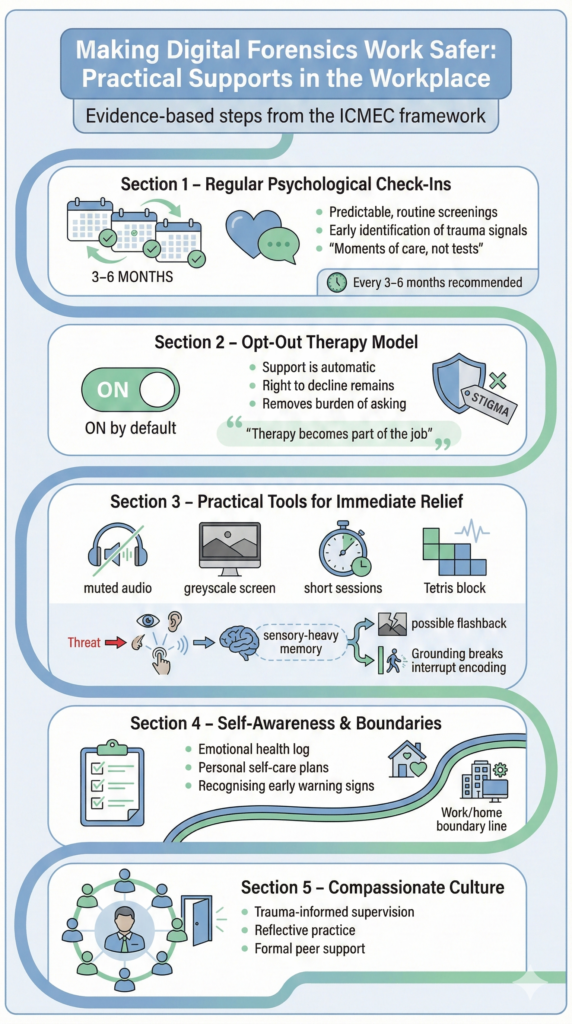
Regular psychological screenings, at predictable intervals, would allow organisations to spot early signs of trauma – the ICMEC framework suggests every 3 – 6 months for check-ins. These check-ins are not tests; they are moments of care, opportunities to pause and listen to what the mind and body might be trying to say.
Opt-Out Therapy: Making Support the Norm
One of the most compassionate recommendations in the framework is to make access to therapy opt-out. This model of psychological support means all staff are automatically enrolled in psychological support but retain the right to decline if they wish to. This removes stigma, removes fear, and removes the burden of asking for help. Therapy becomes part of the job, as routine as supervision or casework meetings.
For DFIs, many of whom struggle to admit when they’re struggling, this approach could be life changing. It sends the message, “You don’t need to prove your strength. We will take care of you.”
Practical Tools for Immediate Emotional Relief
The framework recommends several evidence-based strategies that can reduce the impact of repeated trauma exposure. These are not complex interventions; they are simple, practical adjustments that can significantly reduce psychological strain.
These include:
- Greyscale viewing to reduce sensory intensity
- Muting audio to limit emotional triggering
- Shorter exposure sessions to prevent overwhelm
- Scheduled breaks to allow emotional decompression
- Cognitive interventions (such as playing Tetris) to disrupt trauma encoding
Trauma encoding occurs when distressing material is stored in a raw, sensory-heavy form during a heightened stress response. By reducing sensory intensity and interrupting encoding processes, these techniques can lower the likelihood of intrusive memories and flashbacks.
These strategies are modest but powerful. They create small, protective pauses within deeply challenging work — moments where the investigator’s well-being is actively safeguarded, not silently sacrificed.
Encouraging Self-Awareness and Healthy Boundaries
The framework highlights the importance of teaching individuals to recognise their own signs of distress, to notice when they are becoming overwhelmed, exhausted, or emotionally detached.
Encouraging DFIs to create personalised self-care plans, to log their emotional health, or to set clear boundaries between work and home life can make a profound difference. It reminds investigators that their well-being is not an afterthought; it is a priority.
Building a Compassionate Organisational Culture
Digital forensic units often carry a quiet culture of stoicism. Many DFIs feel they must cope alone because others are coping too, or because admitting distress may affect vetting or career progression. The framework challenges this silence and encourages a culture where emotional honesty is welcomed and supported.
Managers play a crucial role here. Trauma-informed supervision, reflective practice, and emotionally literate leadership can transform a team’s well-being. When leaders set a tone of empathy and openness, it becomes safer for everyone to speak about their struggles.
Peer support networks, too, can be powerful. Shared understanding is deeply healing, and DFIs often find comfort in talking to those who truly understand the emotional impact of the work. Formalising these networks ensures that no investigator feels alone.
Caring Beyond the Role: Support After Leaving
One of the most compassionate elements of the framework is its recognition that trauma does not end when employment does. The psychological impact of prolonged exposure can surface — or intensify — after an investigator steps away from the role.
A responsible organisation should consider offering:
- Follow-up well-being checks after departure
- Continued access to therapy for a defined period
- Structured exit debriefs to process cumulative exposure
- Clear pathways to ongoing psychological support
Many DFIs leave not because they lack skill or commitment, but because the emotional burden has become unsustainable. Providing structured post-employment support acknowledges the reality of long-term trauma exposure and prevents individuals from navigating its effects alone.
This approach sends a powerful message: your well-being matters beyond your productivity. Care should not end when service does.
Honouring the Work and Protecting the People
The ICMEC framework, when applied to digital forensics, becomes more than a set of guidelines – it becomes a foundation for a culture of care. It offers a path towards a healthier, more sustainable profession, where the protectors are themselves protected with thoughtfulness, compassion, and respect.
Digital forensic investigators are indispensable. Their courage, skill, and perseverance save lives. They should never be asked to sacrifice their own well-being in the process. By adopting the principles of the framework, organisations can create environments where DFIs feel valued, supported, and emotionally safe.
Ultimately, applying this model is an act of humanity. It is a recognition that the heroes who spend their days confronting harm deserve to work in a system designed to heal, support, and protect them. It is also a reminder that safeguarding children begins with safeguarding the well-being of those who fight tirelessly on their behalf.
The ICMEC framework can be downloaded here.
Paul Gullon-Scott BSc MA MSc MSc FMBPSS is a former Digital Forensic Investigator with nearly 30 years of service at Northumbria Police in the UK, specializing in child abuse cases. As a recognized expert on the mental health impacts of digital forensic work, Paul now works as a Higher Assistant Psychologist at Roseberry Park Hospital in Middlesbrough and is the developer of a pioneering well-being framework to support digital forensics investigators facing job-related stress. He recently published the research paper “UK-based Digital Forensic Investigators and the Impact of Exposure to Traumatic Material” and has chosen to collaborate with Forensic Focus in order to raise awareness of the mental health effects associated with digital forensics. Paul can be contacted in confidence via LinkedIn.