Early findings from the Forensic Focus International Well-Being Study reveal the scale of strain across digital forensics — and why your participation matters.
The initial cohort comprises eighty completed responses from an experienced international sample, with participants drawn from the United Kingdom, United States, Canada, Australia, Germany, South Africa, Brazil, Japan, Sweden and elsewhere. Nearly half have more than ten years in the field. These are not newcomers. They are seasoned professionals. Here’s what we’ve learned so far:
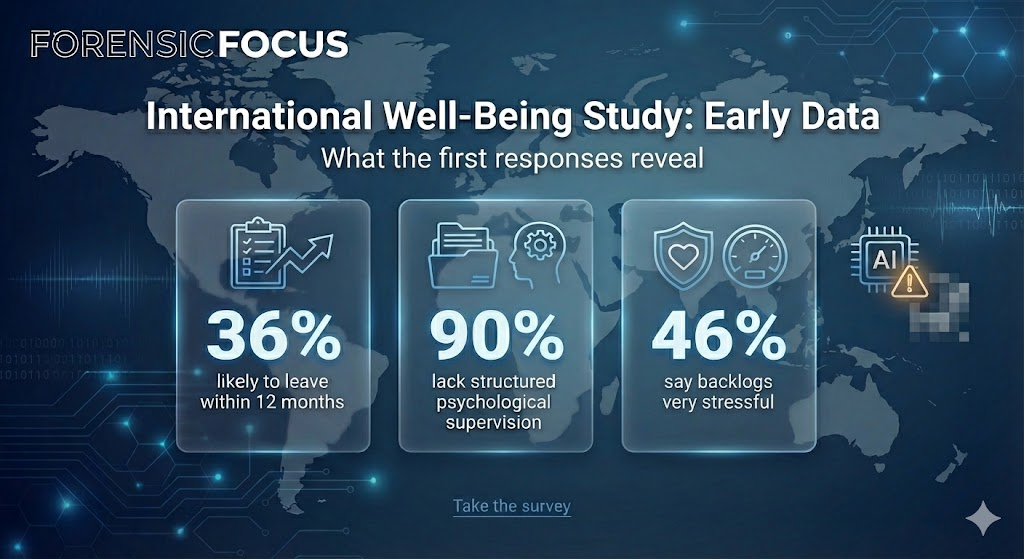
36% Likely to Leave Profession Within 12 Months
And a further 20% are unsure. In a field already facing workforce pressure, that finding alone warrants serious attention — particularly given the specialist skills these roles require and the difficulty of replacing experienced staff.
Backlogs and Lack of Support Causing Extreme Stress
46% rated case backlogs as very or extremely stressful. 43% said the same about time pressure. More than half rated management support as moderately to extremely stressful, and nearly half reported serious work–life balance strain. Trauma exposure does not happen in isolation. It becomes far harder to manage alongside heavy workloads, limited resources, and poor leadership support.
Nearly 90% Lack Structured Psychological Supervision
55% of respondents receive no clinical supervision at all. A further 34% receive it only on an ad hoc basis. If subsequent modelling confirms that supervision buffers against trauma symptoms, there will be a strong case for reframing it not as a discretionary benefit but as an operational safeguard.
AI-Generated CSAM Causing Same Distress as Real Material – Or Worse
58% of respondents reported a similar emotional impact from AI-generated child sexual abuse material as from real material, while 25% found it even more distressing. A third reported anxiety linked to uncertainty about whether a child depicted is real. The stress is not only emotional but ethical — a moral decision-making burden that requires focused research and targeted support.
Why Your Participation Matters
These findings are preliminary. Full statistical modelling will follow, along with peer-reviewed publication. But the direction of the data is clear. The more people who take part, the stronger this evidence becomes — and the harder it is to ignore.
The survey is completely anonymous. No identifying data is collected. No employer will see your responses. It is open to anyone who works or has worked in digital forensics, anywhere in the world.
“Supporting digital forensic professionals is not solely a welfare issue. It is central to workforce sustainability, retention, investigative quality, and organisational integrity.”
Paul Gullon-Scott
If you have twenty minutes, use them. Take the survey. Share it with colleagues. The more voices we hear, the stronger our case for change.
Take the survey: www.forensicfocus.com/survey