
By Paul Gullon-Scott BSc, MA, MSc, MSc, FMBPsS, Forensic Mental Health & Well-being Lead, Spectrum Specialist Consultancy Ltd
Earlier this year, I read a LinkedIn post authored by Inspector Ben Dimmock, Well-Being Lead for Bedfordshire Police, which prompted significant reflection. I have followed Inspector Dimmock’s work for some time, in light of the thoughtful and progressive well-being initiatives he and his team continue to introduce within the force. The post, entitled “Can Trauma Show Up as Misconduct?”, raised an important and timely question that resonates strongly with current debates around well-being, accountability, and organisational responsibility within policing. Ben also joined Forensic Focus recently to discuss cumulative trauma in digital forensics and policing, exploring many of the issues that prompted this article.
Across policing and digital forensics, professional standards, misconduct, and public confidence are often discussed alongside but separate from mental health and well-being. In practice, these domains frequently operate in parallel rather than in partnership. Yet a growing body of peer-reviewed research suggests that this separation may obscure an important reality: cumulative trauma and organisational stress often manifest behaviourally long before they are recognised psychologically, and by the time organisations formally intervene, escalation to a misconduct hearing may already have occurred.
The Hidden Weight of Cumulative Stress
Policing has consistently been identified as a high-risk occupation for psychological distress. Research in the UK which has used validated psychological measures has demonstrated elevated rates of depression, anxiety, and stress compared with the general population, with clinically significant comorbidity. Importantly, these findings challenge the assumption that distress in policing is driven primarily by exposure to traumatic incidents alone. Evidence suggests that organisational stressors including workload, staffing shortages, conflicting demands, lack of autonomy, and insufficient recovery time are often more strongly associated with stress than trauma exposure itself, particularly during the first 15 years of service. This distinction is critical, as organisational stress is chronic, cumulative, and frequently normalised, making it less likely to trigger early concern or intervention.
Within this broader context, Police Officers and Digital Forensic Investigators occupy a particularly vulnerable yet under-recognised position. Unlike frontline officers, DFIs may not routinely encounter physical threat, but they are exposed to sustained and repeated engagement with highly distressing material, including child sexual abuse imagery, extreme violence, and exploitation. This exposure is often prolonged, cognitively demanding, and carried out in relative isolation. Added to this, both Police Officers and DFIs are exposed to significant performance pressures, evidential responsibility, court scrutiny, backlog demand, and limited control over workload. Together, these factors create a risk profile characterised by post-traumatic stress disorder, moral injury, cognitive overload, and emotional numbing, rather than the more visible forms of operational trauma commonly associated with policing roles such as physical injury.
When Psychological Injury Looks Like a Conduct Problem
Crucially, the psychological impact of cumulative exposure does not always present as overt distress or diagnosable mental ill-health. Within policing and digital forensic roles, chronic occupational stress and repeated exposure to potentially psychologically traumatic material can lead to neurobiological dysregulation, affecting autonomic nervous system functioning, emotional regulation, and executive control. These impairments may subtly erode judgement, impulse control, and ethical decision-making capacity, increasing the likelihood of maladaptive coping behaviours, procedural errors, or interpersonal difficulties. In organisational contexts, such vulnerabilities can manifest not as recognised well-being concerns, but as performance issues or conduct breaches, thereby increasing the risk of formal misconduct investigations if left unaddressed.
When the nervous system becomes primed for threat, individuals may experience heightened irritability, impulsivity, withdrawal, reduced tolerance under pressure, or rigid decision-making. These responses are not conscious choices, but adaptive survival mechanisms (fight or flight response) which could become maladaptive when sustained over time. From an organisational perspective, however, such changes are often interpreted primarily as performance, conduct, or attitude issues.
Why Waiting for a Crisis Is Too Late
This brings the issue of timing sharply into focus. Organisational systems tend to respond once a threshold has been crossed – a complaint, an error, a breach of standards, or an incident that triggers investigation. By this stage, the individual may already be experiencing significant psychological injury. Qualitative research into the lived experiences of officers undergoing internal misconduct investigations provides compelling evidence of the profound emotional, psychological, and existential toll these processes can have. Officers described intense anxiety, identity disruption, moral injury, feelings of organisational betrayal, and social isolation, with some reporting suicidal ideation during the investigative process itself. Importantly, these investigations often occurred against a backdrop of pre-existing stress and vulnerability, rather than in isolation.
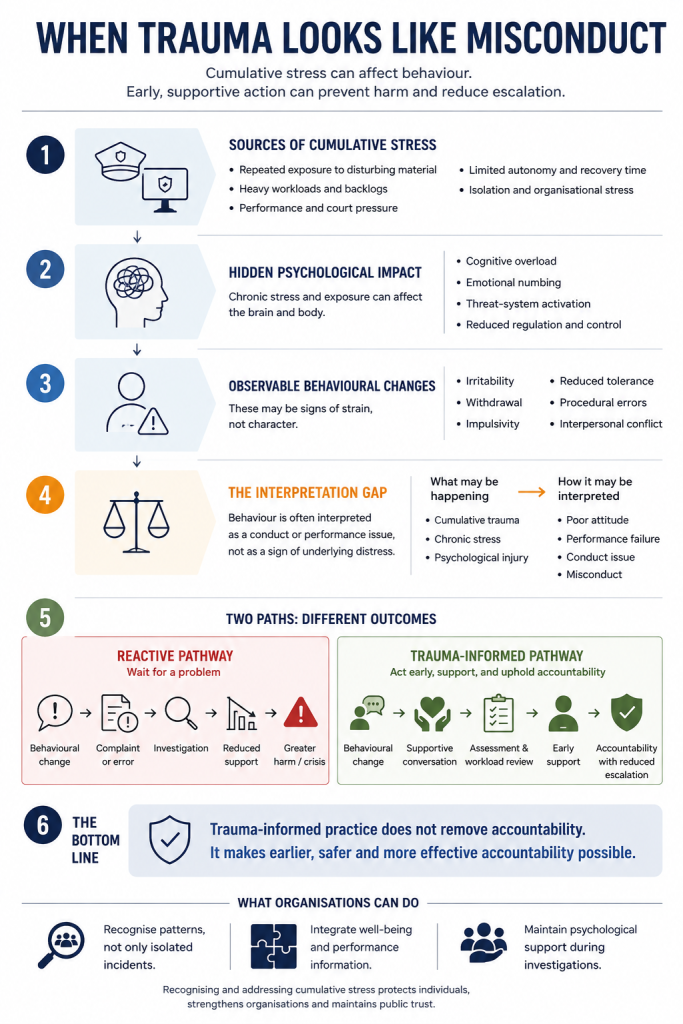
The findings also highlight a troubling paradox. While misconduct investigations are essential for maintaining professional standards and public trust, they frequently coincide with a reduction or withdrawal of support at precisely the point of greatest vulnerability. Officers under investigation may find themselves excluded from welfare services, peer support, or occupational health pathways due to procedural constraints, despite evidence that the investigative process itself can compound psychological harm. From a trauma-informed perspective, this represents not only a missed opportunity for prevention, but a potential amplification of risk and psychological damage.
Moving From Punishment to Prevention
Contemporary research into police misconduct increasingly rejects simplistic “bad apple” explanations. Instead, evidence-based models emphasise the interaction between individual vulnerability, organisational strain, cultural norms, and situational pressures. General strain theory, in particular, highlights how chronic stress, emotional dysregulation, and perceived injustice can increase the likelihood of maladaptive coping and impaired decision-making. Importantly, these patterns are neither random nor unpredictable. They often emerge gradually and are detectable through changes in behaviour, engagement, and functioning over time.
Early intervention systems, where implemented effectively, demonstrate that misconduct risk can be identified before escalation occurs. Such systems focus on patterns rather than isolated events, integrating indicators such as workload, exposure to traumatic situations, complaints, well-being markers, somatic symptoms and supervisory observations to prompt supportive, preventative responses rather than punitive ones. However, the success of these approaches depends heavily on organisational culture. When early intervention is perceived as surveillance or discipline by another name, trust in the system erodes and help-seeking is discouraged, particularly in policing cultures where stoicism, self-reliance, and silence around distress remain deeply embedded.
Trauma-informed approaches do not seek to excuse misconduct or dilute accountability. Rather, they recognise that cumulative trauma and organisational stress can impair the very psychological capacities upon which ethical decision-making, emotional regulation, and professional judgement depend. From this perspective, maintaining professional standards requires earlier, not later, engagement with risk before behavioural changes escalate into harm, investigation, or crisis.
What Would a Trauma-Informed System Look Like?
This is why I have long advocated for a proactive approach to mental health and well-being within policing, an approach similarly advanced by Inspector Dimmock and his team at Bedfordshire Constabulary, who also argue for early identification and preventative support rather than post-incident response. Yet policing systems remain predominantly reactive, with support too often mobilised only after behaviour has escalated or formal processes have begun. By that point, critical opportunities for prevention may already have been missed.
For digital forensic practitioners and the wider policing family, this raises difficult but necessary questions. Are supervisors adequately supported to recognise cumulative behavioural change, rather than responding solely to isolated incidents? Are well-being indicators and performance oversight meaningfully integrated, or do they remain organisationally siloed? Do individuals in high-risk roles receive routine, confidential psychological screening, or is support triggered only once distress becomes visible, disruptive, or operationally consequential? Critically, are appropriate support pathways maintained during misconduct processes, or are they withdrawn in the pursuit of procedural purity? In my view, well-being considerations should be integrated and actively considered throughout investigative processes, rather than treated as peripheral or incompatible with accountability.
Are We Doing Enough?
In my humble opinion, we are not doing enough. But there are encouraging examples of what a different approach can look like. As Wellbeing Lead at Bedfordshire Constabulary, Inspector Ben Dimmock is helping to demonstrate how early identification, preventative support and psychologically informed leadership can sit alongside – rather than in opposition to – accountability and professional standards. I greatly admire the work Ben and his team continue to do, particularly in breaking down the barriers that can deter people from seeking help.
Paul Gullon-Scott BSc MA MSc MSc FMBPSS is a former Digital Forensic Investigator with nearly 30 years of service at Northumbria Police in the UK, specializing in child abuse cases. As a recognized expert on the mental health impacts of digital forensic work, Paul now works as a Higher Assistant Psychologist within the NHS and is the developer of a pioneering well-being framework to support digital forensics investigators facing job-related stress. He recently published the research paper “UK-based Digital Forensic Investigators and the Impact of Exposure to Traumatic Material” and has chosen to collaborate with Forensic Focus in order to raise awareness of the mental health effects associated with digital forensics. Paul can be contacted in confidence via LinkedIn.