By Paul Gullon-Scott BSc, MA, MSc, MSc, FMBPsS, Forensic Mental Health & Well-being Lead, Spectrum Specialist Consultancy Ltd
A critical analysis of the HMICFRS (2026) inspection report on online child sexual abuse policing.
In April 2026, His Majesty’s Inspectorate of Constabulary and Fire & Rescue Services (HMICFRS) published The Policing Response to the Investigation of Online Child Sexual Abuse and the Management of Registered Sex Offenders, a significant inspection report drawing on findings gathered across the 2021–22 and 2023–25 police effectiveness, efficiency and legitimacy (PEEL) inspection cycles. The report examines how police forces across England and Wales respond to online child sexual abuse and exploitation (OCSAE) and the management of sex offenders and violent offenders (MOSOVO). Alongside its operational findings, the report gives substantial attention to a concern that a growing body of research has been raising for more than a decade: the mental health and well-being of those who carry out this work, and in particular the digital forensic investigators (DFIs) whose daily role involves prolonged, close-range examination of child sexual abuse material (CSAM).
This article identifies the key well-being-related findings of the HMICFRS inspection, situates them within the existing research literature, and considers the implications of the report’s recommendations for the mental health of investigators, with particular attention to those working in digital forensic roles.
What the Inspection Found
Well-being as a systemic concern
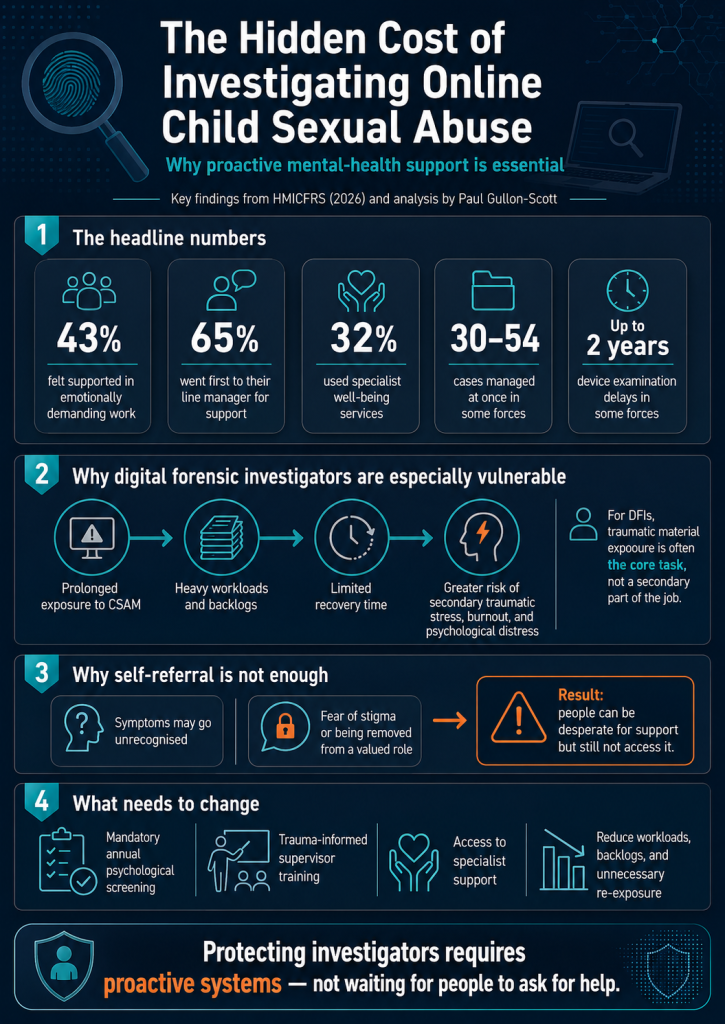
Staff and officer well-being is identified in the report as one of six core themes underpinning all 16 recommendations, alongside governance, capacity, guidance, technology, and partnership. This is not merely a rhetorical positioning: the report’s Chief Inspector opens by commending the progress some forces have made in well-being provision but immediately frames this as insufficient. She states that well-being assessment, specifically psychological health screening, “should be mandatory” for all OCSAE and MOSOVO teams given the disturbing material they encounter on a daily basis.
The inspection found that during the 2021–22 cycle, two of the four formal causes of concern (COCs) issued were specifically for poor well-being provision in MOSOVO teams. More troublingly, when those forces were reinspected in 2023–25, their well-being provision had deteriorated further rather than improved. This trajectory is concerning and reflects a pattern the wider research literature has long documented: that without structural intervention, investigator well-being in this field does not stabilise or self-correct over time.
High workloads and the nature of the work
The report links investigator well-being directly to workload. In some forces, OCSAE investigators were managing between 30 and 54 cases simultaneously. As the report states, “high workloads, as well as the nature of the work, can affect investigator well-being.” This finding aligns with research across the field. Kelty et al. (2021) identified excessive and unmanaged workloads as a primary driver of burnout in digital forensic professionals, while Levin et al. (2021) found that secondary traumatic stress (STS) in forensic science professionals was predicted by exposure volume, inadequate recovery time, and poor organisational support. Gullon-Scott and Johnson (2024) similarly found that UK-based DFIs reported that heavy workloads compounded the impact of traumatic material exposure, reducing their capacity to use healthy coping strategies.
The report also highlights digital forensic examination timescales as an underappreciated well-being stressor. Devices submitted for examination were waiting up to two years in some forces before analysis could begin. Inspectors found that these delays “negatively affect the victim, investigator and suspect’s well-being” and described OCSAE investigators as carrying unnecessarily high caseloads as a direct result. For DFIs specifically, this creates a structural condition in which the volume of yet-to-be-processed material accumulates, maintaining chronic occupational pressure rather than allowing the natural resolution of cases.
The failure of self-referral systems
Perhaps the most clinically significant finding in the report concerns the structural inadequacy of the well-being systems many forces had in place. The HMICFRS inspectors found that some forces were not proactively offering well-being provision; instead, staff and officers were expected to identify their own need for support and self-refer. The report is unambiguous in its assessment: “This isn’t acceptable.”
This finding has direct and well-evidenced psychological underpinning. Officers and staff, the report notes, “aren’t trained to understand or pick up on the signs of welfare issues” and “may incorrectly attribute changes in their behaviour to something else.” The report also documented a cultural barrier compounding this cognitive one: staff were reluctant to self-refer out of fear of being perceived as unsuitable for their role and removed from work they were passionate about. In some cases, this left people “desperate for support but not receiving it”, language that is unusually emotive for an inspection report and appears deliberately chosen.
This two-part failure – an inability to self-identify need and a cultural deterrent to help-seeking even when need is recognised – is well established in the research literature. Tyagi and Seigfried-Spellar (2025) found that digital and multimedia forensic examiners demonstrated significant unmet mental health need, with many meeting criteria for clinical-level distress despite not accessing support. Gullon-Scott and Johnson (2024) documented that UK DFIs frequently minimised or normalised their symptoms, attributing difficulties to personal characteristics rather than occupational exposure. Denk-Florea et al. (2020) found that law enforcement professionals working with distressing material often did not feel psychologically safe to disclose difficulties within their organisations, citing fears around professional reputation. Conway et al. (2024) identified stigma around help-seeking as a significant barrier to support access among UK officers investigating CSAM, with moral injury compounding this reticence where individuals experienced conflict between the demands of their role and their personal values.
Survey data: the scale of unmet need
The report draws on the “2025 National Police Wellbeing Survey”, commissioned by the National Police Wellbeing Service (Oscar Kilo), to quantify the scale of the problem. The findings are striking: only 43% of OCSAE and MOSOVO practitioners and supervisors reported feeling supported in their emotionally demanding work. When officers and staff sought support, 65% reported going to their line manager rather than to occupational health or a dedicated well-being officer, with only 32% using specialist services. This pattern reflects a near-universal finding in the research literature on this population: that peer and supervisory relationships are the primary support mechanism, meaning the quality and availability of supervisory support becomes the single most influential protective factor in the system.
The survey results also confirm that many individuals who need support will not self-refer and may not recognise that they have a problem, a finding that directly parallels Strickland et al.’s (2023) qualitative work with digital forensics analysts, where participants described a gradual and largely unnoticed erosion of their psychological functioning over years of sustained CSAM exposure. Potz et al. (2025) similarly found that emotion dysregulation, itself a consequence of sustained traumatic stress, was the strongest predictor of psychological health outcomes in exploitation investigators, creating a self-reinforcing cycle in which those most in need of support were also those least able to recognise or articulate that need.
Digital Forensic Investigators: A Distinct and Underserved Population
While the HMICFRS report addresses OCSAE and MOSOVO teams broadly, digital forensic investigators occupy a particularly high-risk position within these structures. Unlike investigating officers who encounter CSAM within the broader context of case-building activity, DFIs are exposed to this material as their primary, sustained occupational task. The Forensic Focus Well-Being Survey 2024 found that a substantial proportion of DFIs reported clinically significant levels of secondary traumatic stress, burnout, and work-related psychological distress, with many receiving no formal well-being provision specific to their role. Gewirtz-Meydan et al. (2024) found, using network analysis, that forensic examiners showed significantly higher levels of depression and avoidance symptoms than investigating officers examining the same material, suggesting the sustained, high-volume nature of forensic examination carries an additive psychological burden.
The report’s acknowledgement that the CAID (Child Abuse Image Database) system “potentially reduces trauma for officers and staff as they spend less time viewing indecent images” represents a notable, if brief, recognition of the DFI-specific problem. Technological tools that reduce unnecessary re-exposure to already-categorised material are an important protective measure, and the report’s call for all forces to upload images to CAID comprehensively rather than maintaining backlogs carries direct implications for DFI well-being, not only for operational efficiency. Duran and Woodhams (2023) found that the mode and volume of exposure were significant predictors of depression in professionals working with aversive crime material, reinforcing the case for any system that limits unnecessary re-exposure.
The Recommendations and Their Evidence Base
Recommendation 15, the report’s primary well-being-focused directive, requires forces to implement mandatory annual psychological health screening for all OCSAE and MOSOVO team members and supervisors by October 2026, with access to follow-on well-being services. It also requires supervisors to receive regular trauma-informed training to identify signs of trauma and burnout and to facilitate timely referrals. These two elements directly address the dual failure, cognitive and cultural, identified above.
The case for mandatory rather than opt-in screening is strongly supported by the research. As Mitchell et al. (2023) argue, harm mitigation in this population must be proactively structured rather than reliant on individual recognition and disclosure. Edgelow et al. (2022) found in their review of workplace mental health interventions in public safety organisations that multi-component programmes addressing both individual and organisational factors outperformed single-component approaches, and that stress management alone without structural change produced limited sustained benefit. The approach endorsed by the inspection report – combining mandatory screening with supervisor training and access to specialist support – is broadly consistent with this evidence base.
The good practice examples in the report are instructive. Dorset Police’s model begins at recruitment, with candidates completing a controlled image-grading exercise followed by a counsellor appointment before appointment to role. Once in post, staff undergo three mandatory health monitoring appointments per year and two supervised welfare days away from the office. Essex Police has developed a bespoke well-being course for its MOSOVO teams, a “Pause Point” process allowing temporary redeployment to refresh psychological resilience, and in-house NHS therapist provision offering confidential drop-in access. These models reflect the finding from Fallon et al. (2023) that peer support and specialist psychological provision, where confidentiality and shared occupational experience are embedded in programme design, are most effective in reducing stigma and improving help-seeking in law enforcement populations.
The emphasis on supervisor training is particularly important given that 65% of personnel rely on their line manager as their primary source of support. Supervisors who have not received trauma-informed training cannot reliably identify developing well-being problems in their teams, and are themselves at significant risk of secondary traumatisation, burnout, and compassion fatigue through their dual exposure to the material itself and to the distress of those they manage. Brady (2017) found that supervisory and managerial roles in child exploitation investigation carried distinct risks not adequately captured by standard well-being frameworks, reinforcing the recommendation that supervisors must be considered a target group for support in their own right rather than simply conduits to support for others.
Conclusion
The HMICFRS (2026) report represents the most authoritative national statement to date on the inadequacy of current well-being provision for those investigating online child sexual abuse in England and Wales. Its findings that only 43% of personnel feel supported, that forces have deteriorated rather than improved since prior causes of concern, and that self-referral systems fail at both the cognitive and cultural level are consistent with and supported by a substantial body of peer-reviewed research.
For digital forensic investigators in particular, who occupy the highest-exposure point in the investigative process, the report’s direction of travel towards mandatory, proactive, professionally administered screening is both necessary and overdue. The challenge now is implementation, ensuring that Recommendation 15 produces systemic rather than performative change, and that the structural conditions driving psychological harm- excessive workload, prolonged exposure volume, examination backlogs, and stigmatised help-seeking – are addressed alongside the screening mechanisms designed to detect its consequences.
Paul Gullon-Scott BSc MA MSc MSc FMBPSS is a former Digital Forensic Investigator with nearly 30 years of service at Northumbria Police in the UK, specializing in child abuse cases. As a recognized expert on the mental health impacts of digital forensic work, Paul now works as a Higher Assistant Psychologist within the NHS and is the developer of a pioneering well-being framework to support digital forensics investigators facing job-related stress. He recently published the research paper “UK-based Digital Forensic Investigators and the Impact of Exposure to Traumatic Material” and has chosen to collaborate with Forensic Focus in order to raise awareness of the mental health effects associated with digital forensics. Paul can be contacted in confidence via LinkedIn.
References
Bourke, M. L., & Craun, S. W. (2014). Secondary traumatic stress among Internet Crimes Against Children Task Force personnel: Impact, risk factors, and coping strategies. Sexual Abuse: A Journal of Research and Treatment, 26(6), 586–609. https://doi.org/10.1177/1079063213509411
Brady, P. Q. (2017). Crimes against caring: Exploring the risk of secondary traumatic stress, burnout, and compassion satisfaction among child exploitation investigators. Journal of Police and Criminal Psychology, 32(4), 305–318. https://doi.org/10.1007/s11896-016-9223-8
Conway, P., Redmond, T., Lundrigan, S., Davy, D., Bailey, S., Lee, P., & Landi, G. (2024). Protecting the protectors: Moral injury, coping styles, and mental health of UK police officers and staff investigating child sexual abuse material. Depression & Anxiety, 2024, 1–25. https://doi.org/10.1155/da/1854312
Denk-Florea, C.-B., Gancz, B., Gomoiu, A., Ingram, M., Moreton, R., & Pollick, F. (2020). Understanding and supporting law enforcement professionals working with distressing material: Findings from a qualitative study. PLOS ONE, 15(11), e0242808. https://doi.org/10.1371/journal.pone.0242808
Duran, F., & Woodhams, J. (2023). Associations between individual cognitive factors, mode of exposure and depression symptoms in practitioners working with aversive crime material. European Journal of Psychotraumatology, 14(2), 2264612. https://doi.org/10.1080/20008066.2023.2264612
Edgelow, M., Scholefield, E., McPherson, M., Mehta, S., & Ortlieb, A. (2022). A review of workplace mental health interventions and their implementation in public safety organizations. International Archives of Occupational and Environmental Health, 95, 645–664. https://doi.org/10.1007/s00420-021-01772-1
Fallon, P., Jaegers, L. A., Zhang, Y., Dugan, A. G., Cherniack, M., & El Ghaziri, M. (2023). Peer support programs to reduce organizational stress and trauma for public safety workers: A scoping review. Workplace Health & Safety, 71(5), 230–240. https://doi.org/10.1177/21650799231194623
Gewirtz-Meydan, A., Mitchell, K. J., & O’Brien, J. E. (2024). Trauma behind the keyboard: Exploring disparities in child sexual abuse materials exposure and mental health factors among investigators and forensic examiners—A network analysis. Child Abuse & Neglect, 152, 106757. https://doi.org/10.1016/j.chiabu.2024.106757
Gullon-Scott, P. (2024, December 5). Forensic Focus 2024 wellbeing survey. Forensic Focus. https://www.forensicfocus.com/articles/forensic-focus-investigator-well-being-survey-2024-results/
Gullon-Scott, P., & Johnson, D. (2024). UK-based digital forensic investigators and the impact of exposure to traumatic material. Journal of Criminological Research, Policy and Practice. https://doi.org/10.1108/JCRPP-08-2023-0047
His Majesty’s Inspectorate of Constabulary and Fire & Rescue Services. (2026, April 15). The policing response to the investigation of online child sexual abuse and the management of registered sex offenders. HMICFRS. https://hmicfrs.justiceinspectorates.gov.uk/publication-html/policing-online-child-sexual-abuse-and-managing-registered-sex-offenders/
Kelty, S. F., McQueen, E., Pymont, C., & Green, N. (2021). Avoiding burnout at the digital forensics coalface: Targeted strategies for forensic agencies in the management of job-related stress. Forensic Science International: Digital Investigation, 38, 301127. https://doi.org/10.1016/j.fsidi.2021.301127
Levin, A. P., Putney, H., Crimmins, D., & McGrath, J. G. (2021). Secondary traumatic stress, burnout, compassion satisfaction, and perceived organizational trauma readiness in forensic science professionals. Journal of Forensic Sciences, 66(5), 1758–1769. https://doi.org/10.1111/1556-4029.14747
Mitchell, K. J., Gewirtz-Meydan, A., Finkelhor, D., O’Brien, J. E., & Jones, L. M. (2023). The mental health of officials who regularly examine child sexual abuse material: Strategies for harm mitigation. BMC Psychiatry, 23(1), 940. https://doi.org/10.1186/s12888-023-05445-w
Potz, A., Maheux, J., & Gendron, A. (2025). Emotion regulation, secondary traumatic stress and psychological health at work among child sexual and physical exploitation police investigators. Policing: An International Journal, 48(6), 1153–1170. https://doi.org/10.1108/PIJPSM-09-2024-0160
Strickland, C., Kloess, J. A., & Larkin, M. (2023). An exploration of the personal experiences of digital forensics analysts who work with child sexual abuse material on a daily basis: “You cannot unsee the darker side of life”. Frontiers in Psychology, 14. https://doi.org/10.3389/fpsyg.2023.1142106
Tyagi, S., & Seigfried-Spellar, K. C. (2025). A behavioral health needs assessment and general psychological well-being of digital and multimedia forensic examiners. Journal of Forensic Sciences. https://doi.org/10.1111/1556-4029.70207