By Paul Gullon-Scott BSc, MA, MSc, MSc, FMBPsS, Forensic Mental Health & Well-being Lead, Spectrum Specialist Consultancy Ltd
On 10 July 2026, the Home Office announced a £2.4 million investment in police well-being, channelled through the National Police Wellbeing Service (NPWS). The funding supports an expanded programme of clinical psychological risk assessments and “lighter-touch” mental health checks, a new sleep, fatigue and recovery app called ResetU, continuation of the 24/7 Mental Health Crisis Line, and new guidance to help forces roll out trauma tracking. On paper, it is a welcome and overdue acknowledgement that policing is psychologically dangerous work.
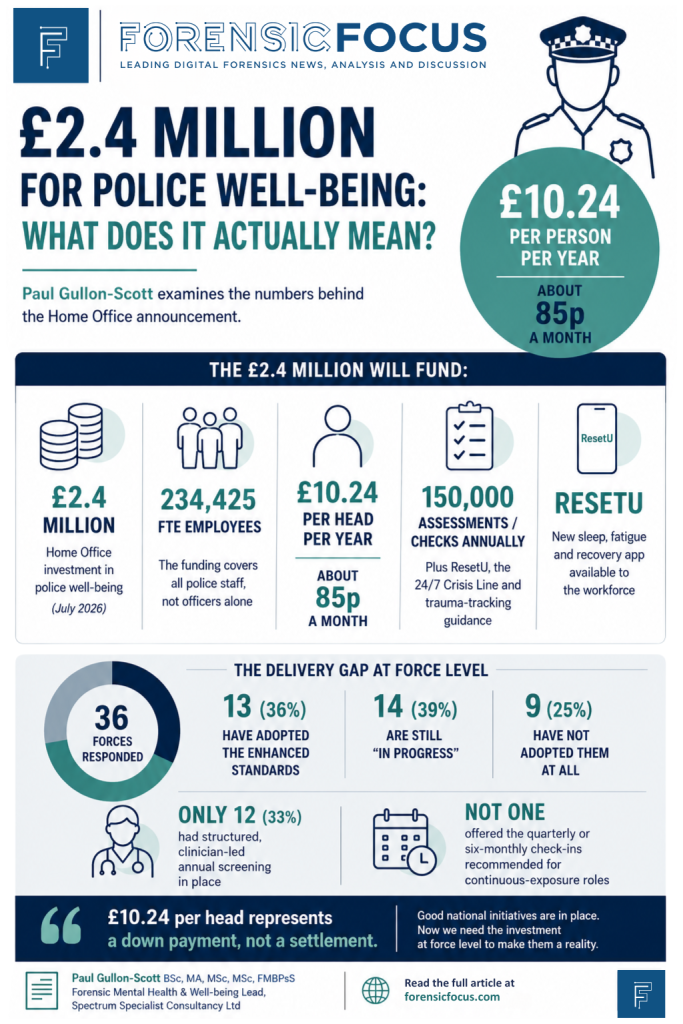
But headline figures rarely survive contact with a calculator. The funding covers all 234,425 FTE police employees, not officers alone. Divide £2.4 million by that figure and the investment works out at roughly £10.24 per head – about 85 pence a month. Narrowed to the 145,550 FTE officers alone, the figure rises to £16.49, but since the funding covers staff and PCSOs too, £10.24 per head is the more accurate reflection of what it actually buys.
This is not a criticism of the intent behind the announcement. It is an observation about what happens when valuable interventions are asked to do heavy lifting on light funding.
What the Money Is Actually For
£2.4 million is not being handed to individual officers. It funds national infrastructure and services. According to the Home Office, the funding will support around 150,000 clinical psychological risk assessments and mental health checks annually, the national rollout of ResetU, continued operation of the Crisis Line, and new trauma-tracking guidance to help forces record cumulative exposure to traumatic incidents.
Crime and Policing Minister Sarah Jones framed this as part of a wider commitment that well-being will be “prioritised, protected and never treated as an afterthought.” Andy Rhodes OBE QPM, NPWS Service Director, described the funding as a step toward support that is “practical, confidential and available before problems reach crisis point”. Rhodes and his team at Oscar Kilo deserve real credit here. Trauma tracking, in particular, addresses something the sector has needed for years: a systematic way of recording cumulative exposure rather than relying on individual disclosure or crisis-point referral. None of this is wasted money.
The problem is not what Oscar Kilo designs. It is what forces are resourced to deliver.
The Maths Problem
Deloitte’s modelling, cited in the National Police Health and Wellbeing Strategy 2024–2026, estimates that employer investment in mental health returns £5 for every £1 spent once absenteeism, presenteeism and turnover are accounted for. The same strategy puts the annual cost of poor mental health to the UK public sector at £10–10.2 billion, with turnover costs rising from £8.6 billion to £22.4 billion, driven largely by early-career leavers, who now account for 70% of resignations.
Set against that backdrop, £2.4 million is a fraction of what the evidence base the government itself cites suggests is proportionate. The original National Police Welfare Service pilot in 2017 was funded at £7.5 million over three years, more than three times today’s single-year figure once adjusted for timescale. Ambitions have grown considerably since then; funding, in real terms, has not kept pace.
The Gap Isn’t Oscar Kilo – It’s the Forces
Credit where credit is due. Andy Rhodes OBE QPM and the NPWS team have built a genuinely strong body of work under the Oscar Kilo banner: the 2019 Foundation Standards, the 2023 Enhanced and Advanced Standards, trauma-tracking guidance, and now ResetU. These are well-designed, evidence-informed initiatives, and Oscar Kilo is not the problem.
The problem, as Freedom of Information research across all 43 UK police forces shows, is delivery. Of the 36 forces that responded, only 13 (36%) had formally adopted the Enhanced Standards, 14 (39%) were still “in progress,” and 9 (25%) had not adopted them at all. Only 12 (33%) had structured, clinician-led annual screening in place, and not one offered the quarterly or six-monthly check-ins recommended for continuous-exposure roles. Most forces cited resourcing, insufficient funding for occupational-health staff, or difficulty recruiting trauma-qualified clinicians, rather than being in disagreement with the standards themselves.
That distinction matters for how the new £2.4 million should be judged. Oscar Kilo can design excellent frameworks; it cannot force an under-resourced force to deliver them. Unless this funding, or something alongside it, closes the staffing and budget gap at force level, new initiatives risk landing on the same uneven ground as the standards that preceded them.
Where Does This Leave High-Trauma, High-Exposure Roles?
The more pressing question is distribution, not the average per-head figure. Digital forensic investigators, child abuse investigation teams, firearms officers and major crime units carry a disproportionate trauma load, often cumulative and invisible to occupational-health processes built around single-incident exposure rather than repeated exposure to material like indecent images of children.
Most DFIs are employed as police staff rather than warranted officers, counted within the 81,662 FTE staff and designated officers that make up part of the 234,425 FTE total workforce. Had the calculation been narrowed to the officer-only £16.49 figure, DFIs and the rest of the police staff workforce would have been excluded entirely – a reminder of how easily officer-centric framing writes specialist, staff-grade roles out of the picture.
The government’s announcement does not specify how the 150,000 annual assessments will be allocated across roles, nor whether trauma tracking will be prioritised for units with known high cumulative exposure. The Forensic Focus International Well-Being Study 2026 identified two specific gaps in existing provision: remotely administered psychometric assessments without clinical oversight, and support capped at six sessions. A generalised, per-head funding model does not clearly address either problem.
Why No App Can Conduct a Psychological Check-In
An app can track sleep, prompt rest, and signpost support. It cannot conduct a psychological check-in. Nor can a psychometric questionnaire emailed to staff for self-completion, however well-validated the instrument, substitute for one.
A genuine check-in depends on things a screen cannot capture: tone of voice, hesitation, what is left unsaid. A trained clinician notices incongruence a self-report tool cannot detect, and can follow an unexpected answer with a clarifying question. This matters in a workforce where fear of disclosure – concern that admitting distress could affect vetting or career progression – is already a primary barrier to help-seeking. A questionnaire completed alone, on the honour system, does nothing to counter that culture of silence.
In my earlier Freedom of Information analysis of 43 UK police forces, I found that remotely administered psychometric assessments with no clinical oversight were a recurring structural gap in current provision — a model that lighter-touch, digitally delivered check-ins risk reproducing at scale. Where forces get this right, they do it face to face: of the 12 forces offering structured annual screening, only five Kent, South Wales, Cumbria, Essex and North Wales provide face-to-face reviews with trauma-trained professionals. Check-ins should be face to face, by a trauma-trained clinician, as standard.
Leadership Is Well-Being
Responding to the announcement, Inspector Ben Dimmock, a serving well-being lead within policing who recently joined the Forensic Focus Podcast to discuss cumulative trauma, welcomed the investment but offered a caution worth repeating:
“The biggest factor influencing an officer’s well-being isn’t an app. It isn’t a well-being strategy. It isn’t a well-being team. It’s the person they work for.”
Officers with access to every well-being initiative imaginable can still dread coming to work because of the culture around them, while others in extraordinarily difficult jobs remain resilient because a supervisor “asks twice if someone is okay,” protects rest days, and creates psychological safety rather than fear.
The research bears this out. Craun and Bourke (2014) found supportive supervision predicts lower secondary traumatic stress over time; Redmond et al. (2023) identify leadership engagement as a significant mitigator of cumulative trauma. Yet my Freedom of Information analysis of UK police forces found that only 8 of 36 responding forces (22%) offered structured trauma supervision as standard, while several treated the Enhanced Standards as advisory rather than mandatory. Leadership is one of the best-evidenced levers available, and one of the least resourced.
None of this argues against apps, screening or national infrastructure. It is a reminder that none of it substitutes for the conversation a supervisor has at the start of a shift. As Inspector Dimmock put it:
“No amount of investment can compensate for poor leadership … leadership isn’t separate from well-being. Leadership is well-being.”
A Step, Not a Solution
None of this is an argument against the announcement. Trauma tracking, a national fatigue app, continuation of the Crisis Line, and expanded psychological checks are things this sector has been asking for. The Police Reform White Paper’s commitment to mandatory national well-being standards is, if delivered, arguably more consequential than any single funding round, because it moves provision from “if your force chooses to fund it” toward a consistent, enforceable floor.
But £10.24 per head is a down payment, not a settlement, and the gap it needs to close sits at force level, not at Oscar Kilo. Two-thirds of forces still lack formally adopted Enhanced Standards; structured screening remains the exception; not one force offers the interim check-ins the evidence recommends. Success should be judged not by app downloads or completed questionnaires, but by whether forces are funded and staffed to deliver a face-to-face conversation with someone qualified to notice what a form cannot, backed by supervisors equipped to do the same every shift.
Andy Rhodes and his team have given policing the frameworks it needs. What remains is making sure every force has the funding and qualified staff to use them.
Paul Gullon-Scott BSc MA MSc MSc FMBPSS is a former Digital Forensic Investigator with nearly 30 years of service at Northumbria Police in the UK, specializing in child abuse cases. As a recognized expert on the mental health impacts of digital forensic work, Paul now works as a Higher Assistant Psychologist within the NHS and is the developer of a pioneering well-being framework to support digital forensics investigators facing job-related stress. He recently published the research paper “UK-based Digital Forensic Investigators and the Impact of Exposure to Traumatic Material” and has chosen to collaborate with Forensic Focus in order to raise awareness of the mental health effects associated with digital forensics. Paul can be contacted in confidence via LinkedIn.