
Digital forensic investigators (DFIs) perform some of the most psychologically challenging roles within modern policing. Their work involves the systematic examination of digital devices, many of which contain child sexual abuse material (CSAM), violent imagery, and other forms of traumatic evidence. This exposure has been empirically linked to post traumatic stress (PTSD).
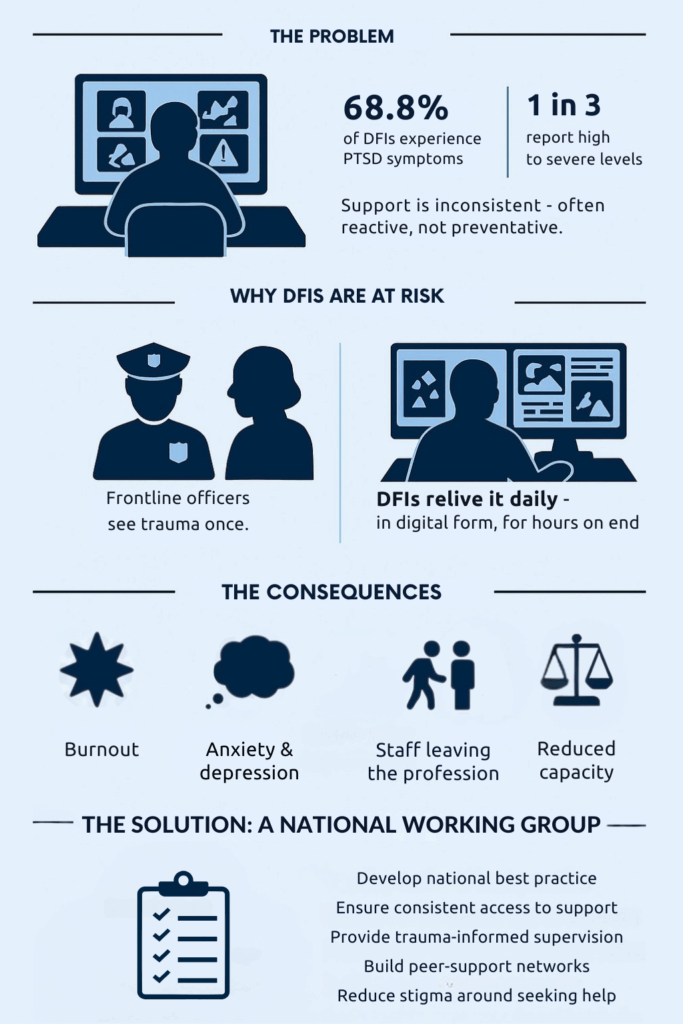
Recent UK-based research has revealed that 68.8% of DFIs experience some degree of PTSD, with nearly a third reporting high to severe levels. Despite these stark findings, decisions about occupational health provision are typically made by senior management or policymakers who have never undertaken this work and therefore lack lived understanding of the emotional toll. As a result, provision remains inconsistent across forces, often reactive rather than preventative, and very limited in scope.
To protect the well-being of DFIs and ensure long-term workforce sustainability, there is an undeniable need to rethink the way mental health support is designed and delivered. This article proposes the establishment of a National Working Group made up of DFIs from across the country, alongside clinical psychologists, occupational health specialists, and researchers. The group would capture best practice, identify unmet needs, and design an evidence-based national support package tailored to the realities of the role.
Why DFIs Need Specialised Support
The risks to DFIs are qualitatively different from those experienced by many other policing professionals. While frontline officers encounter traumatic incidents in real time, DFIs engage with evidence after the fact, yet are repeatedly and intensively exposed to disturbing material in digital form, often for prolonged periods. The sheer volume, coupled with the forensic obligation to analyse minute details, means they are unable to “look away” in the same way a first responder might.
The consequences are well-documented. Research demonstrates that difficulty in viewing CSAM is the strongest predictor of PTSD among DFIs. Younger investigators and those who rely on negative coping strategies such as mental disengagement are particularly vulnerable. Moreover, stigma surrounding help-seeking and a “judgmental workplace culture” discourage DFIs from accessing the limited support that is available.
Without adequate intervention, these stressors contribute to burnout, depression, anxiety, and attrition from the profession. Losing experienced DFIs not only affects individuals and their families but also undermines policing capacity to safeguard children and prosecute offenders. The case for systemic change is therefore both humanitarian and operational.
Current Approaches and Their Limitations
Some police forces have introduced progressive measures. For example, Nottinghamshire Police has implemented staged exposure to CSAM, regular well-being checks, and ongoing psychological support, which have been positively received. The Child Abuse Image Database (CAID) also reduces exposure to duplicate material by automating image recognition.
However, these initiatives remain patchy. Not all forces provide routine access to psychological support, and the six-session therapy cap common in occupational health services is wholly inadequate for cumulative trauma. Furthermore, technological solutions like CAID, while valuable, cannot remove the burden of first-generation material that DFIs must grade.
In short, there is no nationally consistent model of care, and the absence of DFI voices in designing support frameworks perpetuates a mismatch between need and provision.
The Case for a National Working Group
A National Working Group on DFI Mental Health would provide a much-needed structural solution to the challenges faced by investigators. The group’s purpose would be to bring together Digital Forensic Investigators from across UK police forces and private sector laboratories, ensuring that both police officers / staff and civilian staff are represented.
Alongside them would sit mental health professionals with expertise in trauma, occupational psychology, and forensic contexts, together with researchers experienced in evaluating stress, resilience, and coping in demanding roles.
Policy stakeholders from the Home Office, the College of Policing, Oscar Kilo and the Forensic Capability Network would also play a key role. By combining lived experience with clinical expertise and policy insight, the group could co-design interventions that are not only evidence-based but also practical, achievable, and grounded in the day-to-day realities of digital forensic work.
Benefits of Collaboration
The benefits of collaboration within a National Working Group on DFI Mental Health would be wide-ranging and impactful. By placing authenticity and lived expertise at its core, DFIs themselves would be able to articulate the subtle but profound stressors of their work, such as the guilt that arises from detaching when reviewing disturbing material, or the moral injury of witnessing repeated abuse without being able to prevent it. These are insights rarely visible to senior decision-makers, yet they are vital for shaping support that genuinely resonates with those on the front line.
Mental health professionals would play a crucial role in translating these lived experiences into structured interventions, drawing upon established therapeutic frameworks, including trauma-informed care, cognitive-behavioural strategies, and resilience training. Their input would ensure that support is clinically sound while remaining sensitive to the unique occupational demands of digital forensics.
Equally important is the need for consistency across forces. At present, provision of psychological support often depends on geography, leading to a postcode lottery of care. A national body would create standardised frameworks to ensure that all DFIs, regardless of employer or location, have access to appropriate, high-quality support.
The group would also bring rigour to policy development through evidence-based practice. Interventions could be evaluated using validated psychometric measures, such as the PCL-5, PHQ-9, GAD-7, and burnout inventories, generating robust and comparable data to inform national strategies and funding decisions.
In the longer term, workforce retention and professional sustainability would also be strengthened. Supporting DFI mental health is not only a moral obligation; it protects organisational investment in training and preserves valuable expertise, enabling skilled investigators to sustain their careers without reaching breaking point.
Finally, collaboration between DFIs and clinicians has the potential to reduce stigma. Co-production helps normalise open conversations about trauma and well-being, directly challenging the outdated perception that needing support is a sign of weakness. Embedding these discussions into the culture of digital forensic practice would help create a healthier, more resilient workforce for the future.
Proposed Functions of the Working Group
A National Working Group on DFI Mental Health would not only bring people together but also deliver a clear programme of action. One of its first tasks would be a best practice review, collating and evaluating existing initiatives across different forces to identify what is already working well and where the gaps in provision remain. This evidence would provide the foundation for framework development, ensuring that a national support package is designed to meet the specific needs of DFIs. Such a package could include proactive psychological screening, regular debriefs, trauma-informed supervision, and access to long-term therapeutic input rather than short-term, reactive, one-size-fits-all provision.
Training and education would also be central to the group’s work. By developing tailored resources, DFIs could be supported to recognise early warning signs of distress in themselves and others, learn effective coping strategies, and build the skills to support colleagues in difficult times. Alongside this, research integration would be prioritised through partnerships with universities to conduct longitudinal studies of DFI well-being, moving beyond the current cross-sectional picture to understand how exposure to traumatic material affects investigators over the course of their careers.
Policy advocacy would ensure these insights are embedded into practice. By working with the Home Office, Oscar Kilo, and the College of Policing, the group could push for mental health provision to be written into national policing standards, supported by sustainable funding and clear accountability mechanisms.
Finally, peer support structures would be formalised, giving DFIs the opportunity to share experiences and coping strategies within a safe, professionally supervised environment. These peer networks would help build solidarity, reduce isolation, and create a culture where well-being is openly valued and prioritised. Together, these actions would form a comprehensive and sustainable response to the mental health challenges faced by the digital forensic community.
Towards a Model of Best Practice
Drawing on current research and international practice, a national support package for DFIs should be comprehensive, preventative, and sustained. It would begin with mandatory pre-employment psychological screening to identify vulnerabilities before staff are placed in high-risk roles. Day-to-day exposure would be actively managed through structured limits on cumulative time spent reviewing CSAM and routine rotation of duties wherever operationally possible.
Support should be clinical as well as managerial: regular, confidential debriefs facilitated by trained psychologists with expertise in trauma and PTSD, not solely line managers, would normalise help-seeking and provide a safe space for processing difficult material. Crucially, therapeutic provision must extend well beyond the common six-session cap, with pathways tailored to cumulative and vicarious trauma rather than single-incident events.
To strengthen protective factors, DFIs should receive resilience training focused on active coping strategies shown to reduce PTSD risk. Technological solutions must also be accelerated: continued development of CAID and careful integration of AI should prioritise minimising investigator exposure while maintaining evidential integrity.
Finally, a national peer-support network would give DFIs access to trained peers outside their immediate team, reducing isolation and ensuring timely, stigma-free support wherever they work. Together, these measures would create a consistent, evidence-informed framework capable of protecting the workforce and sustaining professional effectiveness over the long term.
Challenges and Considerations
Establishing such a group is not without obstacles. Funding pressures within policing are acute, and mental health support is often perceived as discretionary. There is also cultural resistance: a “stiff upper lip” mentality persists, and some officers fear disclosure of distress could harm career progression or remove them from their current roles.
To overcome these barriers, the group must frame support not as an optional extra, but as integral to safeguarding both investigators and victims. Evidence demonstrates that untreated PTSD leads to reduced productivity, errors in evidence handling, and staff attrition. In this sense, investing in DFI mental health is both ethically responsible and financially prudent.
Final Thoughts
The psychological risks faced by digital forensic investigators are now beyond dispute. UK research confirms high levels of post-traumatic stress, particularly linked to CSAM exposure. Yet provision of mental health support remains fragmented, inconsistent, and largely designed without input from those most affected.
A National Working Group would offer a transformative solution. By bringing DFIs and mental health professionals together, it would ensure authenticity, clinical rigour, and consistency across the country. The benefits would extend beyond individual well-being to organisational resilience, workforce retention, and ultimately the protection of children and communities.
DFIs perform work that is indispensable yet psychologically hazardous. They deserve a support system designed with, not just for, them. Establishing a national collaborative working group should be the next logical and urgent step in ensuring that those who protect others from harm are not themselves left unprotected.
Paul Gullon-Scott BSc MA MSc MSc FMBPSS is a former Digital Forensic Investigator with nearly 30 years of service at Northumbria Police in the UK, specializing in child abuse cases. As a recognized expert on the mental health impacts of digital forensic work, Paul now works as a Higher Assistant Psychologist within the NHS and is the developer of a pioneering well-being framework to support digital forensics investigators facing job-related stress. He recently published the research paper “UK-based Digital Forensic Investigators and the Impact of Exposure to Traumatic Material” and has chosen to collaborate with Forensic Focus in order to raise awareness of the mental health effects associated with digital forensics. Paul can be contacted in confidence via LinkedIn.