Tamas Zelczer is the co-founder and CEO of Cursor Insight, a company pioneering gait and body recognition technology for forensic investigations. With accuracy levels comparable to facial recognition, Cursor Insight’s system can extract biometric evidence from low-quality or obscured video footage — even when suspects are masked or wearing helmets.
Tell us about Cursor Insight and what inspired you to co-found the company.
I was fascinated by the AI-based motion analysis technology that my co-founders, Dr Gergely Hanczar and Bence Golda, had been developing for years — long before AI was mainstream. It was clear from the outset that this innovation had immense potential. Cursor Insight initially focused on biometric identification based on cursor patterns and handwriting. It quickly became clear that our proprietary motion analysis platform could support a very broad set of applications.
Today, our solutions are deployed across several domains. In cybersecurity, we analyze mouse and touchscreen dynamics for continuous user authentication to prevent account takeovers and fraud. In healthcare, we contribute to clinical research, including recognizing early signs of Alzheimer’s by detecting subtle changes in motor function. In finance, our models enhance default prediction by incorporating behavioral motion signals into risk evaluation. We also deliver biometric e-signature verification, already trusted at scale by major banks. And in forensics, our gait recognition system enables investigators to extract biometric evidence from video footage where traditional methods such as facial recognition cannot be applied.
With Cursor Insight, we’re creating an AI platform that acts like ChatGPT for body language — turning subtle human movements into actionable insights in real time.
How would you explain gait recognition in simple terms?
Gait recognition is the scientific method of identifying individuals through their unique body dimensions, posture, and motion patterns. Every person has a distinctive set of movement dynamics and structural traits that together form a fingerprint-like biometric signature.
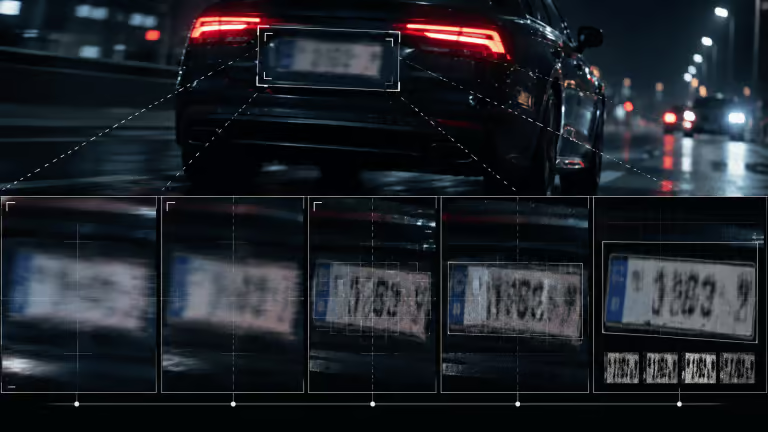
Cursor Insight’s system builds highly precise 3D digital twins of people captured on video — potentially accurate to within millimeters — and extracts hundreds of anthropometric parameters, such as stride length, rhythm, and joint movement characteristics. Unlike facial recognition, this method does not depend on visible faces, making it effective even when faces are covered, lighting is poor, or video resolution is low.
In what cases does gait recognition prove most valuable, and how does it maintain accuracy even with poor-quality footage?
Gait analysis is particularly valuable in criminal investigations, where facial recognition often fails when analyzing surveillance video evidence. Beyond forensics, our technology can be applied in facility access control, perimeter monitoring, and smart cities.
The robustness of our approach is its key strength. Gait recognition continues to operate when individuals wear masks or helmets, when lighting is inadequate, or when only low-resolution video is available. The system typically analyzes hundreds of static body dimensions and dynamic motion features, generating a detailed biometric signature. Combined with our camera-specific preprocessing methods and feature selection algorithms, this multi-layered analysis allows Cursor Insight to maintain high levels of accuracy even under difficult recording conditions.
Can you walk us through a recent case where gait analysis supported suspect identification?
A recent homicide investigation in an EU member state demonstrated the revolutionary nature of our forensic gait analysis. The incident was recorded at night by two infrared surveillance cameras from approximately 30 meters away. On the low-contrast footage, the perpetrator that had to be identified was only about 120 pixels tall, their face literally a few pixels wide. Not only was facial recognition completely impossible, but even our technology was somewhat restricted by the low data quality.
Despite this limitation, the analysis revealed clear statistical consistency: 15 out of 15 key metrics and 15 out of 16 supplementary features strongly matched the perpetrator’s gait to one of the suspects. Eventually, our technology enabled investigators to achieve a reliable identification, turning otherwise unusable video into admissible biometric evidence.
How do investigators and courts typically respond when you present gait-based evidence?
Investigators value gait recognition because Cursor Insight provides them with a tool that works when conventional biometrics do not — for example, in cases where faces are obscured or the video resolution is inadequate. Courts have also responded positively. We do not provide a single opaque score; instead, our reports include visual overlays, statistically validated metrics, and clear methodological explanations. This transparency ensures that the results are interpretable for investigators, judges, and juries, and supports admissibility in court.
What safeguards make your analysis transparent, reliable, and court-admissible?
Our methodology combines AI-driven automation with expert oversight. The results are presented with statistical evidence, visual annotations, and structured reports, ensuring transparency and consistency. This safeguards against subjectivity and provides a clear evidential chain, making the outcomes reliable for forensic and legal use.
What needs to happen for gait recognition to gain the same trust as fingerprints or DNA?
DNA and fingerprints are absolute biometrics: they either produce a conclusive result or none at all, but they do not generate false positives. Gait recognition, by contrast, is a probabilistic biometric, more comparable to facial recognition. The difference is that gait recognition remains effective in conditions where facial recognition fails, such as low light, partial occlusion, or poor video resolution.
To reach the same level of trust as established biometrics, several steps are necessary: continued peer-reviewed validation, the adoption of standardized protocols, and the establishment of legal precedents through consistent use in criminal investigations and trials. As Cursor Insight’s forensic gait analysis continues to demonstrate reproducibility and withstand cross-examination, confidence will increase. Ultimately, gait recognition will complement fingerprints and DNA by providing reliable evidence in situations where those methods cannot be applied.
And finally, what do you enjoy in your spare time?
I’m an avid tennis player, and even though I’m always working on my topspin and footwork, I leave the motion analysis AI back at the office.