








The following transcript was generated by AI and may contain inaccuracies.
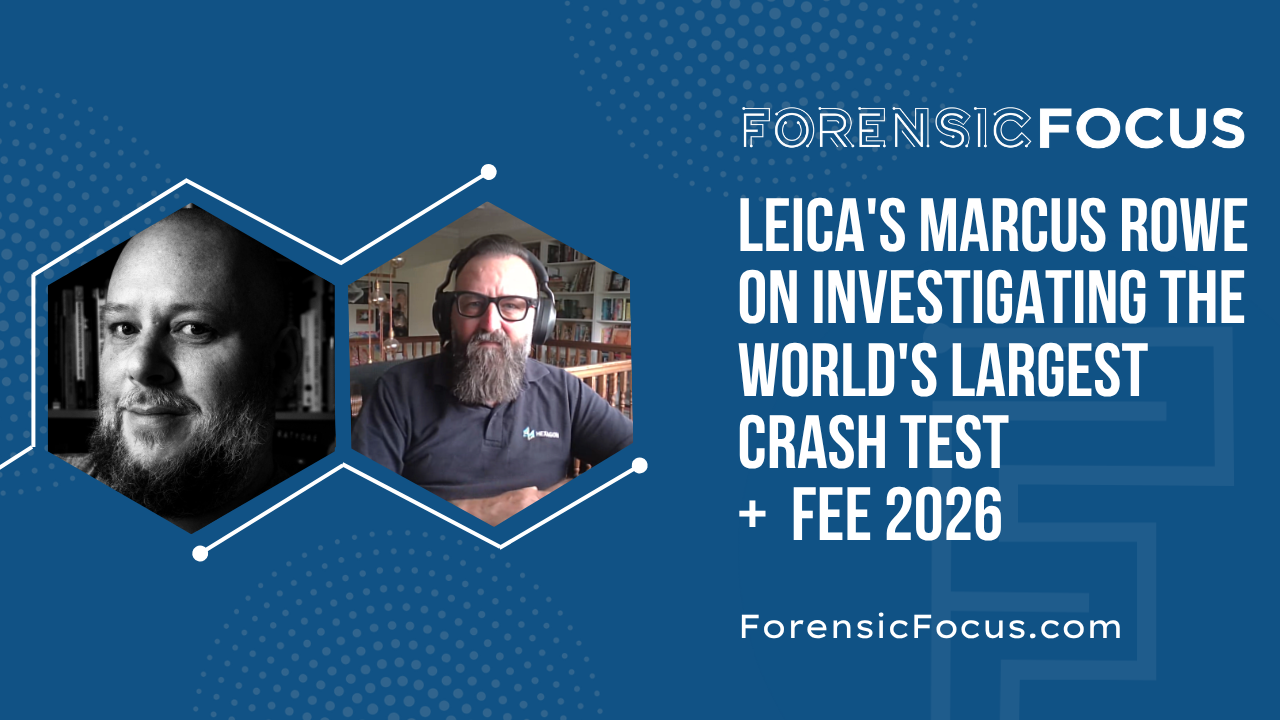
Si: Today, ladies and gentlemen, boys and girls, those of you joining us for the Forensic Focus Podcast, we have Marcus Rowe. Marcus is from Leica Geosystems, but today he’s coming on to tell us about all sorts of things, because Leica Geosystems is brilliant. He’s brilliant, they’re brilliant, the kit they have is brilliant, their conference is brilliant.
And they’re going to go and be brilliant at the Forensic Expo in London — FEE, Forensic Expo Europe — which is based at Olympia in London this year. Forensic Focus will be there. Leica Geosystems will be there. Some other friends of the show, like Sarah Morris, will be there. I believe she’s giving some talks as well. We’re collaborating with them — we’re media partners. So we’re here to talk about that in a minute.
But first, we haven’t had Marcus on yet. I’ve actually been trying to get him on for quite some time, because we met at the first Forensic Expo that I went to. Although we’re not quite aligned in terms of industry, I think the way that the digital space is coming together far more as an overall concept means that what we’ll start to see is the understanding of the stuff Leica does — or Hexagon, sorry, you’ll correct me in a minute when I give you an opportunity to speak — will become more common knowledge in the industry.
So, Marcus, thank you so much for joining us. Could you tell us a little bit about yourself before we kick off and start talking about other things?
Marcus: Yeah, for sure. Simon, thank you. You say it’s been a bit of a pathway to get here. It has — we’re both very busy people, which is great, because we’re both so engaged with our community and with our customers.
So, Marcus Rowe. I’m the Business Director of Public Safety and Forensics at Leica Geosystems. You’re quite right to reference Hexagon — Hexagon is the parent group, the global group that owns Leica Geosystems. A lot of people know Leica from many different things — historically, the camera brand, as well as the microscopes and everything. But we own a town called Heerbrugg in Switzerland, which now has a 200-year history related to Leica and its former identity, which is Wild.
It’s all to do with optics, of course, which is where the cameras, microscopes and survey equipment all come together. And that’s where I work. My background — I was a military police officer for a short period of time as a stepping stone from education to find my way into the traditional civil police in this country.
Devon & Cornwall Police, where I operated, don’t recruit youngsters straight out of school. They like them to have a little bit of worldly experience, and they were, at the time, very strong recruiters of ex-military, so that was a stepping stone that many of us took. I completed a full career in Devon & Cornwall Police, where I focused on traffic straight out the bag — into traffic, into firearms.
And whilst I was in that world, I realised there was forensic collision investigation. The use of science and physics and maths, all the knowledge of vehicles and road design, all those things coming together into one compressed area of expertise where we identify the what, the how and the why of fatal and serious injury collisions. It was my nirvana. I found my operating space that just brought together all the tech that I love, the maths and the science that I love.
I drive an EV now, but I’m still a petrol head at heart. It just brought all of that together in one world. And I have an opinion — I’m quite good at forming an opinion, and I’ll share that opinion. So a court expert role was also quite appropriate for me as an individual, as I’m sure many people who know me would say.
So that’s my background. In 2018, with 30 years accrued in the bag, I left the police and took my money — why wouldn’t I? Then I found myself on this side of the fence in business, at a different role at a different company prior to moving to Leica. I did okay there, which brought my profile to the attention of Leica, and in 2021 I moved over and I’ve never looked back.
I love my job. I love still being able to deal directly with the same people that I used to work with — all those experts in the police field doing the same jobs, doing crime, doing crash. I love being able to empower them, support them, give them extra information and extra tools to do their job, and seeing the work that they do and being fully embedded in that still, but from a different angle. I always thought I had the best job in the police. I think I have the best job now.
Si: And I think you’re right. Education is something that’s really interesting in what you said, because, again, I met you at FEE and you were there showing off — and rightly so, I have to say — the equipment that Leica Geosystems makes, these LiDAR scanners, and how you can map a scene. The first year I saw the handheld one and you showed me how it all worked.
You’re such a good educator, and even though I have absolutely no skin in this game to spend money on one — much as I would love to have one just for the purposes of wandering around my own house — you took so much time to explain it to me, and I have such a wonderful understanding of it. I found it hugely inspiring.
And you put together this conference — you’ve run it for, is it four years now?
Marcus: On the whole, six, I guess. It’s three years in the more solid two floating days with an evening event format that works so well now. But three years before that, more as an open house, a series of open house events that were one day after another. I had it before as crime on one day, crash on another. I just wanted to get everybody together. So in the current format, three years, but six overall.
Si: And the current format is so wonderful because you’ve got such interesting people in to talk about such diverse subjects. To this day, I still quote the fact that I’ve learnt more about how knife wounds deteriorate in arson because of somebody burning a pig than I ever, ever wanted to know.
Marcus: Yeah, for sure.
Si: I think you couldn’t have won whether you scheduled that before lunch or after lunch, because nobody felt comfortable about what was being roasted in this shipping container. But you pulled together such a diverse group of people, and it really showed me how we can all learn from each other in this industry. Kudos to you — it’s the best conference I’ve ever been to, and I’ve been to a few.
For engagement, for the subjects that are there — and you’ve brought in every year a couple of young guys and girls (I didn’t mean that in any sense), who’ve come up and it’s been like their first presentation. They’ve never done anything like this before, and it’s such a great audience to enable them to do it. You’ve enabled that, and it’s absolutely brilliant. Education is a very strong point of yours.
And again, at FEE, I know that you’re giving a talk. Is Dan giving a talk as well?
Marcus: No, just me this year. Dan did last year. I like Dan speaking — he’s one of our best assets. He’s an unbelievable trainer. He’s so, so good at storytelling. But I’m also aware that he doesn’t want to do it every year. So this year I decided that it was my turn to take that role, and I’ll be doing a presentation basically weaving around the concept of forensic digital twins, something that I’ve spoken about for many years now.
I wrote a paper on it and brought it forward as a definition and everything else to the space. I think it’s really important to understand how we’ve basically snapshotted and freeze-framed in a digital format for permanence. So for cold case and revisits and better understanding and a hypothesis and every other kind of push-and-pull bit of work we want to do with an event location, we can do without touching the original evidence, which is just fantastic.
I just want to pick up on a couple of things you said about the conference, my conference, focusing in on myself — again, another trait that I like to do occasionally. I’m just so grateful for your positive feedback, your response and your attitude towards what we’re trying to do.
To people that haven’t been: where are you? Why are you not coming to this? Globally, there is no better free, totally free, two-day CPD conference anywhere in our subject matter. There isn’t. And the speakers that come — I’m just so well supported. I’ve been in the space quite a long time. I engage with a lot of people. I have a strong network, like yourself. We’re in each other’s network.
It’s a big community, but equally it’s a very small community in terms of how close you can be. I have people coming from all over the world at their own expense to talk and present and network with the quality of delegates that we have in the audience. The support I get from those people is unbelievable. That’s key — we don’t just come to listen to who’s on the stage, we come to talk to who’s in the seats, because the quality of the delegates is so high.
It’s phenomenal the way it’s been supported and the way it’s grown. I’ve got to thank Hexagon, I’ve got to thank Leica for continuing to support my vision. It is a non-sales, non-down-your-throat event. It’s not a 1990s timeshare event where you’ll leave after eight hours of brainwashing with a bottle of cheap prosecco. It is true sales-free CPD learning, community event, peer-to-peer education and networking.
That’s something I wasn’t sure that this company would back me with. We’re a serious sales organisation, of course. We exist to make and sell product and support the industries that we engage with — that’s the bottom line. But on this, they support me fully that this is nothing to do with income. It’s all to do with recognition of the segment, supporting the segment, and education from each other — not from us, from each other in the segment.
It’s a beautiful envelope and space for people to turn up and learn. And the one final thing I want to say is: do come, everybody come, but don’t come with a preconceived idea of what you’re going to hear. Because my vision is that you’re going to spend two days living within the Discovery Channel.
So 70% will be in your swim lane, but 15% each side will be stuff that’s so interesting but not what you do day to day. We learn — or I can only speak for myself — very selfishly, all the speakers that come are people I want to listen to. So if I want to listen to them, I hope that you want to.
Equally, I learn from their methodology and their thought patterns and how they problem solve, or how they approach a set of conditions and what their rationale is about testing or other things. So it can be a subject matter completely different to your own, but you will learn a methodology or an approach standard, and you’ll go, “You know what? I’m going to take that away.” That may be your takeaway — nothing to do with the nuts and bolts of their forensic practice, but you’ll take away something about their methodology of how they approach it. And that’s where the learning is.
It’s not just, “Oh look, DNA,” or “Oh look, digital media.” It’s the approach and the standard and how we go about our business. Anybody that hasn’t been before, please come. Next year will be awesome. That’s enough about my show.
Si: I can say, it is enough about your show, but I’m still going to say it. Fundamentally, it struck me this year how much methodology there was. The audio analysis — and I’m going to forget names, which is even worse because I sat next to him and talked to him all dinner — the American gentleman who did the audio analysis…
Marcus: His name’s slipped from me now. We’ll put it in the show notes later, gentlemen. It’ll come to me in a second.
Si: And the police officer who did the experiments with the e-scooters, which was a fantastic piece of work.
Marcus: Dan. I can remember Dan’s name, yeah.
Si: Both of those were highly demonstrative of forensic science done at its best. The experiment to prove a hypothesis to gain an understanding. In both cases, expanding the field in a way which actually adds huge value to what the capabilities of an individual are to determine the outcome of an investigation. Both incredibly novel research, and it was amazing to hear.
Last year we had some discussion around some digital aspects, especially with regard to Fran Peacock, who told us about digital chain of evidence and things with regard to CCTV, tying very neatly into that. So there’s a really good broad spread of knowledge to take away.
It’s very easy to get stuck in your own industry. Certainly my side, I look at a computer day in, day out, and it becomes hard to find alternative approaches because you’re so used to doing something. It’s that inspiration from people who’ve actually gone, “You know what? I’m going to try something different.”
The crash day, testing for the speedometers — what does actually happen? We’ve been doing this, but what does it actually mean? We’ve been making assumptions. Is it true? And then the methodology to figure that out. It’s all fascinating. The recommendations and assistance with regard to academia and the academic side of things, with publication and doing publishing, and the various institutes that actually stood up at the end and said, “Come join us, because we’re brilliant.”
I find myself to be a member of the Crash Investigation Institute all of a sudden, which is fascinating, because I am now. All I did was sign up to see when the crash day was. And all of a sudden I’m on the mailing list and they keep sending me things, which is lovely.
So yes, it’s fascinating that as an industry we should expand it out. And actually, to come slightly back on topic to FEE — the whole show is, we’ve got our little digital section, which covers off that, and obviously you’ve got us there, and there are a couple of guys selling various software products. Amped are there again this year. I think Magnet are there for phones and things like that. So we’ve got all of our digital people.
But then the rest of the expo — we were situated next to the body bag people last year, for the retrieval of floating cadavers, which was both fascinating and slightly disturbing. There are the counter-terrorism guys in there, and they’ve done demonstrations in various years of loud shouting of stuff. Last year, the fire teams were in cutting people out. So the expo is such a fascinating place to be as a whole — looking at the wider policing and public safety angles of the industry.
Marcus: Yeah, very much. It’s a very broad spectrum. I obviously spend a lot of time on my own booth — that’s what I’m there for. But there are times where I try to get a walk around, and also I try to encourage Dan or whoever else is manning the booth with me to go on a mingle and to take it all in.
It’s a unique opportunity to weave throughout all the different sub-sectors of forensics. Such a big word, forensics. It can mean so many things to so many people, and it’s one of those opportunities where it’s a bit like a zoo, right? There’s so many species in one place at one time. Why not experience it all?
I get to briefly visit and enlighten myself on so many areas that I wouldn’t ordinarily engage with on a day-to-day, week-to-week basis. That’s one of the draws of these kinds of events. You’ve got your specific 5 to 10 places you’re definitely going to go and engage with. You’re going to speak to them — there’s things you either want to catch up on, you want to talk about developments or improvements, or heaven forbid, you’ve maybe got a bug or two. Things that are either touch points or they’re genuine things that you need to catch up on.
But then outside of that, it’s an absolute smorgasbord of forensic approaches to different things. I love participating. I don’t get as much time as I’d like to engage in around all those things, and sometimes I’m quite envious of the attendees. If you’re in this segment and you don’t go to these events, I do wonder how you keep current — and not just in your own field, but how you keep current to where the developments are coming from, what the future looks like in the broad spectrum of forensics. It’s these kinds of events that give you that insight and should give you the energy and passion to get through the rest of this year and into next year when it can all start again. These things I find very empowering.
Si: And the mix of people that turns up is great. We have some very interesting people that you’d expect to see. I see you there. I see some of the digital forensic analysts that I know coming round. But last year there were a couple of guys who came round to the stall from a horse racing stables — they actually worked out at Lambourn, which isn’t terribly far away from me. They were there because they wanted to buy a new ambulance. They had managed to find one they liked, they phoned the boss up, and they bought a £150,000 ambulance on the credit card while they were in the show, and had it delivered.
We also get the students coming around. It’s a great opportunity if you’re a student. It’s a free event, in London, so there’s a reasonably large number of people who can make it at a reasonable cost — if you don’t have to stay over. It’s a two-day event, and it’s the same people exhibiting on both days. The talks are different, but the event is the same. If you can make it for one day as a student, you will learn so much about the industry.
Certainly I’ve had students come and talk to me about getting jobs in the industry, and as with everybody else on the stand, we’re all here — we’ve all been there, done that. The ability to come and ask, “Okay, so how do I do this? Do you know of anything going at the moment?” It’s a really good opportunity to come and do that early networking.
Marcus: Because there’s no one answer, right? We’ve all taken different pathways — different levels of academia. Some people preloading with academia and then going into the field, some people in the field and then gaining qualifications as they progress. You’re absolutely right. Students should — we probably should say it’s the 1st and 2nd of July, because we’ve covered the name, we’ve covered the location, but we haven’t covered the date. So 1st and 2nd of July, Olympia in London, Forensics Europe Expo. There’s the plug.
Those students who come in should make as many touch points as possible. They should engage and listen and ask people how they got to where they are and what the routes were, because there will be no one answer that fits all people. You and I have completely different pathways to where we are. Completely different. That’s also part of what’s very exciting in this field — you do not have to leave college or university with a prescribed set of qualifications to find yourself in this field.
You can find yourself here — I won’t say accidentally, but you can find yourself here secondary to what you originally thought your life journey was going to be, and that’s great. You find yourself here because you’ve got a passion and a connection with detail and with problems. If you see something, you ask yourself how and why. You don’t just walk past it.
The number of people, I think, that just exist in life without understanding the physics and the science and everything around them. The number of people that think if you stand on a grass bank with both feet, there’s more friction than if you put all your weight through one. They exist in life and they’re happy and everything, but there’s a lot of people who just go, “How? Why? What?” These are the people that need to come to our world.
Si: If your parents despaired at you disassembling things to see how they worked when you were a child, you should be a forensic analyst. It is that simple.
Marcus: Absolutely. There’s no two ways about it. Especially long before the warranty’s out. If the warranty’s out and it’s dead, take it apart. But when it’s two days old and you’ve got the screwdrivers out — yeah, you’re absolutely right. Come and join us. It’s a great old forensics pool. Jump in.
Si: So I’m going to segue, slightly back to education. One of the most instructive things that I’ve watched on television of late — and I know famous people now, it’s really cool — Emi, who we’ve interviewed here, he turned up in the Sycamore Gap documentary on TV. I was like, “Oh, I know him.”
And you and Dan did the most amazing documentary, and you talked about it at the conference. I haven’t watched the Channel 4 one — I actually went and watched the slightly more science-based PBS American one. Is that right?
Marcus: PBS — but it was shown on Nova. Of course, PBS are the owners of Nova and the global streaming platform.
Si: It’s a two-part show. You were involved in what is billed as — and I see no reason to disagree with it — the world’s largest crash test.
Marcus: Yes, that certainly was the primary objective at set off for the whole project.
Si: Did it still work out as the world’s largest crash test at the end?
Marcus: To be honest, I don’t know, because it’s, I guess, not my claim, and I didn’t do any research beforehand to know what the numbers are. I would certainly think in terms of duration from start of the run to the end, possibly in numbers. There are many reasons you could validate it as that — especially not least because it’s probably the largest number of remotely driven vehicles to be crashed at one time, with the transference of belief that you are physically in them.
That’s going to sound very weird to anybody that hasn’t watched it. I’m speaking now with a degree of hindsight because, of course, as I’ve explained at the conference and to anybody that listens to me, I had zero knowledge of the collision. That would completely and utterly ruin the premise that a collision investigator can come along, apply science, and reverse engineer or visualise what had occurred. So I was kept totally in the dark — but now I know.
What’s really obvious to me watching it back is that so many of the drivers were in smart two-seater cars, but with curtains around them and a screen in front of them, fully controlling, in this sub-vehicle, the main vehicle on the airfield. They absolutely transferred their presence into the primary vehicle. Even though they’re physically not moving, there’s no vibrations, there’s no forces acting on them, but their belief was that they were in the vehicle. Some of their reactions, some of their behaviours — it’s so apparent that they had transferred their presence. That’s just amazing.
I’ve got to say that I think they can justify that claim, albeit you might do a little bit of political manoeuvring — answer the question that you want to answer, not the one that’s asked — but I think it’s a substantive claim still on several footings, yes.
Si: And the outcome of the particular aspect that you were involved in was that you did accurately reconstruct what had happened. In fact, you reconstructed in more detail when you figured out that lorry piece than was captured by all of the cameras that were actually watching, by post-event analysis.
Marcus: Even though there were 90 cameras.
Si: Yeah. Drones, cameras in every vehicle. And you were still able to reconstruct more from the post-event analysis than the cameras captured, which is phenomenal. We’ll give Leica their due for the LiDAR stuff, and Dan’s posing capabilities for his shots that we saw as he maps this huge scene.
But LiDAR for anybody — actually, I’ll let you explain LiDAR. You’re the expert.
Marcus: Let’s break it down to real basics. Most people have seen an estate agent come into a house, put a little box on a wall, seen a little red light hit the other one, and it’ll tell them the length of the room. The estate agent does that many, many times, and from those measurements they’ll draw a plan. That is a single point measurement done with a beam of light, that being a laser. The most common brand is, of course, the Leica DISTO, which is what all estate agents use. That’s again where we’re commonly known.
Now if you imagine a device that’s capable of doing that 2 million times per second, sending out a beam of light on a rotating basis both vertically and horizontally, and just hitting everything and anything it can, and based on the time of flight, the bearings and the angles of that emittance and receptance, it can map the world around it. That’s what we’re doing in 3D laser scanning technology. We’re just mapping the world around us with light, and that’ll give us a reflectance value, or a grayscale value if you want to view it as grayscale.
By adding photography into that as a phase, and taking the RGB value of a pixel and applying it to the measured point within the point cloud, we can colourise that point cloud and make it look quite realistic, quite true to life. We just take a series of those stations, a series of survey locations, and you just bring them all together — like building with Lego, you know, another block and another block — and in the end you just create an ever bigger map, a 3D model of the environment as it was captured.
As Dan showed — and it’s there for everybody to see either on Channel 4 or on Nova, if you want to go and stream it, it’s on YouTube; the Channel 4 one is on YouTube as well, I think it’s called Pileup on the Channel 4 edition — we ended up with a several hundred metre long model of this motorway, with all the crashed vehicles and all the data around them, all the damage, and then we can work with that. That was the forensic digital twin, if you like — the captured format.
Then Dan breaks it and works with a model to the side, and he can recreate the vehicles more than once and then move them within that model. You can run through the hypothesis as he did with the lorry and with the Golf. I’m not going to tell the story to ruin it for anybody who’s going to go and look. It’s a one-in-a-million event, a one-in-a-million outcome. It’s almost impossible, which was why it was so difficult to detect it. And then such a penny dropped at the moment that it landed. It’s like, “Oh, that happened.”
To take that “oh, that happened” moment that landed in my brain, how do I tell that to millions of laypeople? That’s where the power of 3D visualisation and the ability to model, remodel, and model again, and show all the different phases, is just so powerful. Going back to Dan’s normal presentations — evidence is storytelling, and that’s what you’re doing. You’re taking the evidence of the scene, you’re interpreting it, and you’re using it to tell the story of the event — what unfolded, what you absolutely know, what you maybe prefer because the evidence supports it (although it’s not definitive), and then what we don’t know.
An absence of evidence is not evidence of absence, as we know. As experts, whether that’s physical experts of scenes or digital experts, you are extracting the story, and you’re using the evidence to tell the story to the laypeople. It’s a privilege. It’s also bloody exciting.
I’ve turned up at some absolute… Of course, that was a staged event — the pressure though was insane. Knowing there were 90 cameras, knowing that the world was going to be witness to my ability or not, the pressure was insane. But nobody’s life mattered. No justice mattered in that moment. Credibility mattered, but justice did not.
I’ve turned up to some real carnage and destruction where you just think, where do I start? Until, of course, you derive your where-do-I-start because you know yourself and you know your logic. The belief of the people around you is that this one is unsolvable. They’ve been to tens and there’s witnesses, and then you’re all at this one where there are no witnesses, there’s less evidence. One tumbler at a time, you start to put the story back together.
Honestly, that was quite a rush — to be the person there that can unlock this puzzle when no one else around you can. As an expert, the proof is not only to unlock it but to prove it. If you’re going to prove it’s A, you’ve got to disprove B to Z. You can’t just have them hanging. If all your weight’s on A, B to Z also have to be disproved. Being the person that can not only interpret and understand and find the evidence, but bring it all together and take that package to court with surety — that was always quite exciting. Stressful, but exciting.
Si: Absolutely. And that is ultimately what we’re here for, or at least a vast majority of us are here for — to take something to court, to explain it to somebody who genuinely doesn’t have a clue what you’re talking about from the very beginning. When you guys are able to put together such incredible visual representations and demonstrations because of the accuracy of your data to show how something has happened…
I’ll slightly preempt this, because it doesn’t come out in the discussion in the film — although I guess technically it’s obvious — that Dan put together the simulations for the purposes of your investigation, and the production crew went, “That’s brilliant. Can we use that in the final footage?”
Marcus: Yeah. They had a team of graphic experts. They went into this as a television production company with all of their assets lined up, as they would do anything else. They had a team of visualisation experts who believed they were going to have to create product to match my storyboarding of the physical events. And then they met Dan.
They had an insight into what experts like myself and Dan, and the tens of expert police officers that we support up and down the country, can do with the right tools and the right software, with the right training. When those graphics people and the editors saw the product, they just kind of went, “Yeah, no, we’re not going to… Can we use that, please? Can we have that just in this format, because that fits in TV?”
What you see on the TV is Dan’s work. He’s a bloody genius. He’s a Star Wars geek, and we refer to him as our 3D Jedi. I think he quite likes that. He doesn’t shy from it.
We can do hand mapping where I’ve captured tunnel systems as fast as you can walk — high accuracy, millions of points per second. It’s just phenomenal what can be achieved, all the way down to micron level stuff. There’s a tool for every access.
And it’s underused. I understand the financial challenges — this isn’t a sales pitch — but there are so many things that could serve justice better, that help the layperson, because we all work in 3D. Juries work in 3D. The reason they can reach out and pick up the water glass, take a sip and put it back, is because they work in 3D. They don’t work in 2D. Show them a map or a plan and they turn it every which way. Show them 3D and they instantly understand it, because we all work in 3D.
I’m really warmed by the uptake of 3D now that is in the forensic field, and it’s quite widespread. But I think there’s still so many areas we could do more, for the benefit of the process. You’ll get more guilty pleas, you’ll get quicker court times because juries don’t have to spend so long deliberating. There’s not necessarily the defence argument about this model and this sketch plan that somebody’s drawn, because it’s actually more validated from the outset.
Yes, there’s an investment requirement, but in the end there is a return on investment, in process.
Si: It’s one of the biggest arguments in digital forensics, especially where we’re looking now at the privacy aspects of victims to protect their data, and then just taking a subset of it. You’re going, “Well, what’s in the rest of it? What are we missing?” In the crime scene, if you’re not careful, you’re saying, “Well, okay, here’s a picture of a blood splatter.” And the jury’s there like, “Well, that’s one wall out of four. What’s in the rest of the room? What are we not seeing?”
What you’re doing is doing the full capture of all of the environment so that the jury can — and again, we’ve seen this at the conference with the guys coming down from the Institute in Glasgow. Up north anyway. They’re doing the virtual arson investigation. I wore it and wandered around — it was incredible. It was so realistic.
That recreation was done partially with the point cloud and partially with the photography, that very clever thing. If you can suddenly put a jury into a pair of 3D spectacles where they can see the whole of the room that the event happened in, all questions are gone. You can see exactly what the events were. It saves time and cost — you’re not shipping the jury out to a site, and also something that may be unsafe as well.
Marcus: Inevitably. And preservation, right? If you’ve captured it right, you’ve preserved it. But there are a couple of things there really.
I think the problem with giving a jury 3D environments via VR or something similar at the moment is one of trust. A jury should make a decision based on the information that they’ve been given and only that information. That is the role of the barristers in the room and the judge, to make sure that the trial is based on the evidence that’s heard. Juries often become investigators, and they can start looking around and doing all sorts. There’s a control element and a trust element that needs to be dealt with, and that’s very important.
But going back to the investigation side at this moment in time, and just dealing with that alone: you only know what you know. Going back to your example — sure, the blood on the wall is quite obvious, that’s critical to this investigation, we know that. But the hallway outside, we think is irrelevant. Until two or three days later a witness comes forward, and there’s some discussion about the hallway and the time and the length and everything else about the hall, and suddenly the hallway becomes a feature in a crime where we only knew that the blood on the wall was important.
Holistic capture of extended scenes, I would suggest, is critical, but it isn’t really practised. Because you only know what you know — you don’t know what’s going to be important tomorrow or what is yet to be added to the story. Preserving it, capturing it and preserving it, is so critical.
If I gave you a camera and told you to go in a room and take a series of photos, based on your skill level, your perception and your knowledge, you will take a series of photos that you believe are valuable. If I go into the room with the same camera equipment and I do the same number of photos, we will end up with some that are harmonious and similar, but there will also be some that are grossly different. They will still be conscious bias photos, because you’ve applied your knowledge and I’ve applied mine, and we’ve done what we think is right.
The thing again with 3D laser capture, accompanied with the photos and everything, is because you are infilling the whole space, you are basically removing conscious bias on behalf of the operator. You have a holistic capture. Because it’s a 3D model, you can take any visual cue or position and check at any point of view, even ones that you never had. By removing data like the ceiling, you can look down on the whole floor, or take the side off the house and look at the stairwell — things that are impossible views.
This is the power of this technology. Technology now empowers the visualisation and understanding of evidence like never before. It just needs to be treated, and I think we’re doing it very well — and I don’t mean us here, I mean the investigators and the presentation of evidence in court is being done very well. We are using the powerful tools ethically, correctly, purposefully, to visualise and understand in a way that’s never been possible.
Again, go back to FEE. If what I’ve just said doesn’t make sense to you, come and see us and we’ll show you what we mean, or come and listen to my presentation and I will tell you what I mean. But we are basically generating impossible views, truthful views, validated views, factually based views — but impossible views. They help to understand the story of the evidence. This is where the power of 3D laser scanning surpasses any photography, any videography, any drone work, anything at all, because you cannot do what we’re doing with the data.
Si: I’ll just tack onto that, that you actually have a drone-based LiDAR, which I so want for Christmas.
Marcus: Okay, I’ll see what I can do.
Si: What a fantastic way to lead us out for the day, because we’re just coming to the top of the hour. We’ll both be at FEE — in fact, we’re on stands next to each other. I rigged that when we were at your conference and Faye was asking about it, so that was quite a good opportunity.
Come and see this for real, because certainly if you’ve never seen it before, it is magic. It is magic. And then you realise that Arthur C. Clarke was right — any science that is sufficiently advanced is indistinguishable from magic. And this is just science, but it is done beautifully. The equipment is, like all Leica equipment, both out of my price range and incredibly beautifully made.
I aspire to one of the Leica monochrome cameras eventually.
Marcus: Make your mind up. I can’t give you a drone and a camera.
Si: Oh, it is actually a difficult choice, which is kind of irritating. I thought I would know. So do come and see the stand. Come to FEE. Come and talk to Marcus and to Dan and myself, and also all of the other people who we know there. There’ll be people from Amped there, there’ll be people from Magnet there. There’ll be loads of really, really good vendors and individuals.
It’s a fascinating opportunity to see what the state of the industry is. Spend a day in London at somebody else’s expense if you can expense it. It’s a cheap day if you can’t. It is well worth it. From a student perspective, it’s well worth it. From a practitioner perspective, it’s great to keep up to date with the state of the industry.
You’ll be able to, as Marcus said, talk to your vendors and see what their latest releases are, what they’ve got in the pipeline, complain about the fact that it doesn’t have the feature that you want. But also to compare with what the competition is doing. I’m not suggesting that you should jump ship and go from one product to another if you’re happy, but we are very, very good at sticking with something that we know, because that’s easiest for us. That’s not necessarily always the best thing. Unless you go out and look at the competition, you’re never going to do it. So it’s a great opportunity to see what else is going on in the world.
Marcus: Personally, I truly welcome due diligence. I absolutely welcome it, because it’s only when you go and do that due diligence and you look and satisfy yourself that you’ve asked the key questions and you’ve been shown the key things by everyone else, that you realise you’ve made the right choice in choosing Leica. No matter what your segment, no matter who you’re dealing with, go and do that due diligence to ratify the choices you’ve made. It’s empowering to know that you have made the right choices.
Due diligence — go and talk to everybody. But it is a festival of forensics. You’ve got two days where all the energetic and knowledgeable people in the segment are in one space for 48 hours, rejoicing about the segment, correcting the things that are wrong. It is a festival. Come and spend time there. Talk to Si, talk to me, talk to Dan, but also walk the floors and see everybody else.
Don’t avoid it and go, “Oh, that looked good,” when you look at it on LinkedIn later, or, “Oh, I wish I’d listened to that.” Be there. Be a part of it — forensics is really now and happening. And the thing is, it’s a European event with good reason. Europe looks to what we’re doing in this country and how we do forensics, and where we’re leading with some of the regulation, and they travel across and they spend time at FEE.
If you’re in this country and you’re in this segment and you don’t come to something that’s on your doorstep, if you have the opportunity, I would very gently ask you why not. So come. Come and make the most of it.
Si: And on that note, sir, thank you very much for your time. I do thoroughly look forward to meeting up with you at FEE again this year. And playing with new kit, of course. Wouldn’t have it any other way.
Thank you, and thank you to all the listeners who’ve come and stuck with us for the hour and heard all about this. We’ll put into the show notes all of the links for FEE, all of the links to the documentary, all of the links to Leica so that you can go out and buy one. Everything that you need to know will be linked in the show notes, along with the transcript if you don’t want to listen to us talking and you just want to read it.
But by the time we’ve got to this point, that’s a pointless statement. Anyway — Desi and I have been doing this for years, and we still haven’t mastered the intro and the outro sections. It’s terrible. But there you go. So anyway, I’m going to stop recording. Marcus, thank you very much. Take care, and I’ll see you soon.
Marcus: Nice to see you, Simon. Thank you. Bye-bye-bye.
Si: Cheers.