
By Paul Gullon-Scott BSc, MA, MSc, MSc, FMBPsS, Forensic Mental Health & Well-being Lead, Spectrum Specialist Consultancy Ltd
Forensic Focus, in collaboration with Northumbria University, is urgently seeking current and former investigators for an international well-being study to highlight this crisis. Please help protect investigators and TAKE THE SURVEY NOW.
Childlight’s Into the Light Index 2025 represents the most comprehensive global analysis to date of child sexual exploitation and abuse (CSEA). Building on the 2024 edition, this year’s report combines data from representative surveys, police statistics, child helplines, and child sexual abuse material (CSAM) repositories across Western Europe and South Asia. The resulting picture is sobering: CSEA is widespread, transnational, and evolving rapidly through technological change. For those working in digital forensics, particularly investigators routinely exposed to CSAM, the findings demonstrate both the scale of the problem and its profound human and occupational consequences. Behind every dataset lies a victim whose suffering becomes the digital evidence that investigators must confront, often at great personal cost.
The Scale of the Crisis
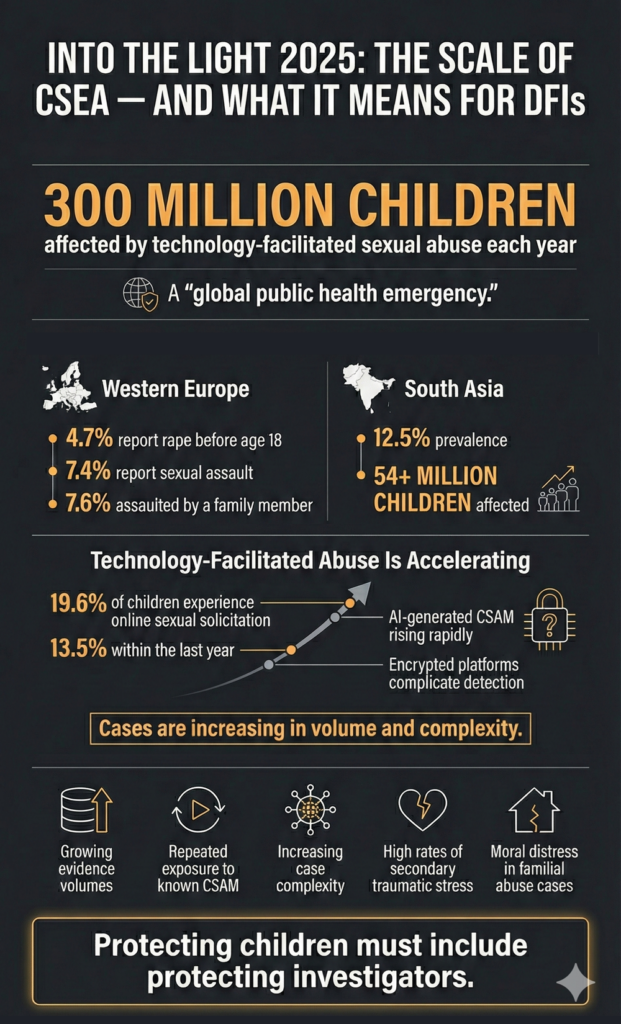
The report estimates that 300 million children worldwide are affected by technology-facilitated sexual abuse each year, a figure that Childlight describes as a “global public health emergency”. In Western Europe, 4.7% of children reported rape and 7.4% sexual assault before the age of 18. In South Asia, prevalence rises to 12.5%, equivalent to over 54 million children in India, Nepal, and Sri Lanka alone.
Equally alarming is the concentration of CSAM hosting within specific jurisdictions. The Netherlands accounts for more than 60% of all CSAM detected in Western Europe, equating to 880.9 reports per 10,000 people. This demonstrates that decisive national regulation and enforcement can produce regional benefits but also exposes how infrastructure gaps in one country can fuel global harm.
For digital forensic investigators (DFIs), these statistics translate into ever-growing volumes of evidence. Each report, image, or video represents not only a crime scene but also a psychological weight that accumulates over years of exposure.
Technology-Facilitated Abuse and the Digital Landscape
Childlight identifies technology-facilitated CSEA (TF-CSEA) as one of the fastest-expanding global threats. Nearly one in five children (19.6%) have experienced online sexual solicitation, and 13.5% within the last year.
The proliferation of social media platforms, encrypted messaging services, and generative artificial intelligence (AI) has transformed how offenders exploit children and distribute material. Of growing concern is AI-generated CSAM, which is rising sharply across all data sources and often depicts more severe abuse involving female children. Because AI-generated material can be infinitely replicated and customised, its detection and classification present new investigative and legislative burdens.
For DFIs, this shift means cases are not only increasing in number but also in complexity. Identifying what is synthetic, composite, or genuine now requires advanced analytical tools and cross-disciplinary expertise. Without legislative frameworks to regulate AI misuse, investigators are left navigating a rapidly changing digital environment, with limited resources impacting their well-being further.
Familial Abuse: The Hidden Source of CSAM
Perhaps the most distressing finding from the Into the Light 2025 report is the scale of familial sexual abuse. In Western Europe, nearly one in thirteen children (7.6%) report sexual assault by a family member. Data from the National Center for Missing and Exploited Children (NCMEC) further reveals that most CSAM production involves perpetrators known to the child, frequently within their immediate family.
For DFIs, this knowledge redefines the context of what they are viewing. Many of the images processed daily are not the work of strangers, but of parents, siblings, or caregivers. This profoundly affects the emotional response of investigators, who must repeatedly engage with evidence of a stolen childhood and betrayal within a child’s supposed place of safety. These findings underscore why occupational exposure in digital forensics is not only cognitively taxing but also morally distressing. The emotional resonance of familial abuse material often leads to compassion fatigue, intrusive imagery, and long-term somatic and psychological strain.
Youth-Produced Imagery and Ethical Complexity
Childlight reports a global increase in youth-produced or ‘self-generated’ sexual imagery, reflecting changing digital behaviour among adolescents. The distinction between consensual peer exchange and coerced exploitation is increasingly blurred. For DFIs, such cases pose complex ethical and investigative questions: how to differentiate adolescent error from criminal victimisation, and how to avoid secondary criminalisation of victims.
This evolving category challenges existing definitions of CSAM and demands nuanced approaches to analysis, charging decisions, and victim safeguarding. It also introduces new psychological stressors for investigators, who must assess distressing material involving children close in age to their own families or peers.
Systemic and Legislative Challenges
The Into the Light report highlights how inconsistencies in national legislation, reporting mechanisms, and removal processes perpetuate harm. End-to-end encryption (E2EE), when implemented without safety provisions, restricts the ability of investigators and platforms to detect illegal content. Variations in crime recording and reporting distort the apparent prevalence of abuse. Known CSAM continues to circulate due to slow or inconsistent removal times, meaning investigators repeatedly encounter the same imagery.
Such systemic failures erode morale, creating a sense of futility and moral distress among DFIs who see the same victims re-victimised each time an image resurfaces online.
The Human Impact on Investigators
While the Childlight report focuses on victims, its findings hold equal relevance for those tasked with identifying them. The scale and persistence of CSAM have a direct and cumulative effect on investigator well-being. Research has consistently shown that DFIs experience elevated rates of secondary traumatic stress, depression, anxiety, insomnia, and burnout.
The emotional toll is magnified by organisational factors: high caseloads, insufficient decompression time, and limited access to specialist therapy. The repetitive nature of known CSAM imagery often revisited across multiple cases amplifies psychological injury. The report’s emphasis on data to action provides a roadmap that could also inform occupational health strategies for DFIs: prioritising exposure management, long-term counselling, trauma-informed supervision, and proactive well-being monitoring.
Data to Action: A Global Framework for Change
Childlight proposes six core action areas for governments and institutions, several of which have direct implications for digital forensics practice:
- Enhancing data access and triage – ensuring law enforcement agencies can effectively process referrals from global reporting bodies.
- Improving data completeness and quality – standardising how CSEA is measured and recorded across countries.
- Addressing familial abuse – developing indicators to better capture perpetrator relationships.
- Regulating online spaces – creating child-centred safety standards within digital platforms.
- Integrating gender-based violence research – recognising sex and gender disparities in victimisation.
- Including survivor voices – embedding lived experience into national policy design.
For DFIs, these initiatives can enhance international cooperation, streamline evidence handling, and reduce unnecessary exposure. More importantly, they reinforce the principle that protecting children must include protecting those who protect them.
Final Thoughts
The Into the Light 2025 Index casts an unflinching light on the global scale of child sexual exploitation and the digital ecosystems that enable it. For digital forensic investigators, it validates what many already know: that the problem is vast, complex, and worsening, but also that effective data-driven action can make a tangible difference. Yet the report’s most important message is perhaps an implicit one that CSEA persists because it is allowed to persist. Ending it requires not only legislative reform and technological innovation but also sustained care for those on the frontline. Without the resilience and well-being of DFIs, the global fight against online child exploitation cannot succeed. As Childlight’s CEO Paul Stanfield (2025) concludes: “CSEA exists because it is allowed to exist. With sufficient will, it can be stopped and prevented. The time to act is now.”
Paul Gullon-Scott BSc MA MSc MSc FMBPSS is a former Digital Forensic Investigator with nearly 30 years of service at Northumbria Police in the UK, specializing in child abuse cases. As a recognized expert on the mental health impacts of digital forensic work, Paul now works as a Higher Assistant Psychologist within the NHS and is the developer of a pioneering well-being framework to support digital forensics investigators facing job-related stress. He recently published the research paper “UK-based Digital Forensic Investigators and the Impact of Exposure to Traumatic Material” and has chosen to collaborate with Forensic Focus in order to raise awareness of the mental health effects associated with digital forensics. Paul can be contacted in confidence via LinkedIn.