By Paul Gullon-Scott BSc, MA, MSc, MSc, FMBPsS, Forensic Mental Health & Well-being Lead, Spectrum Specialist Consultancy Ltd
Occupational-health provision within UK policing has undergone substantial reform over the past decade, driven by growing awareness of the psychological cost of exposure to trauma in both operational and technical roles. The establishment of the National Police Wellbeing Service (NPWS) under the Oscar Kilo banner marked a turning point in how policing began to conceptualise and standardise workforce well-being.
Historically, police well-being interventions were largely reactive, delivered after critical incidents or in response to individual crises. However, as research into secondary trauma, compassion fatigue, and burnout advanced, the need for systemic, preventative, and clinically informed approaches became undeniable.
In 2019, the NPWS launched the Foundation Occupational Health Standards, providing the first national framework to ensure consistent clinical governance, data management, and access to psychological support across all 43 Home Office forces.
These standards defined a minimum level of occupational-health maturity, establishing expectations for structured services and the inclusion of high-risk roles such as firearms, custody, and child protection.
Recognising the limitations of this baseline, Oscar Kilo published the Enhanced and Advanced Occupational Health Standards in 2023. These built upon the 2019 foundations by introducing requirements for leadership accountability, audit transparency, psychological risk management, and long-term trauma care.
The enhanced framework sought to align policing practice with the occupational-health standards of other high-risk sectors such as the NHS and fire services.
This evolution is particularly relevant to Digital Forensic Investigators (DFIs) and staff working within Internet Child Abuse Teams (ICAT), Child Sexual Abuse and Exploitation (CSAE) units, and online-investigation environments. Unlike many operational roles, DFIs are repeatedly exposed to disturbing imagery, chat logs, and offender material.
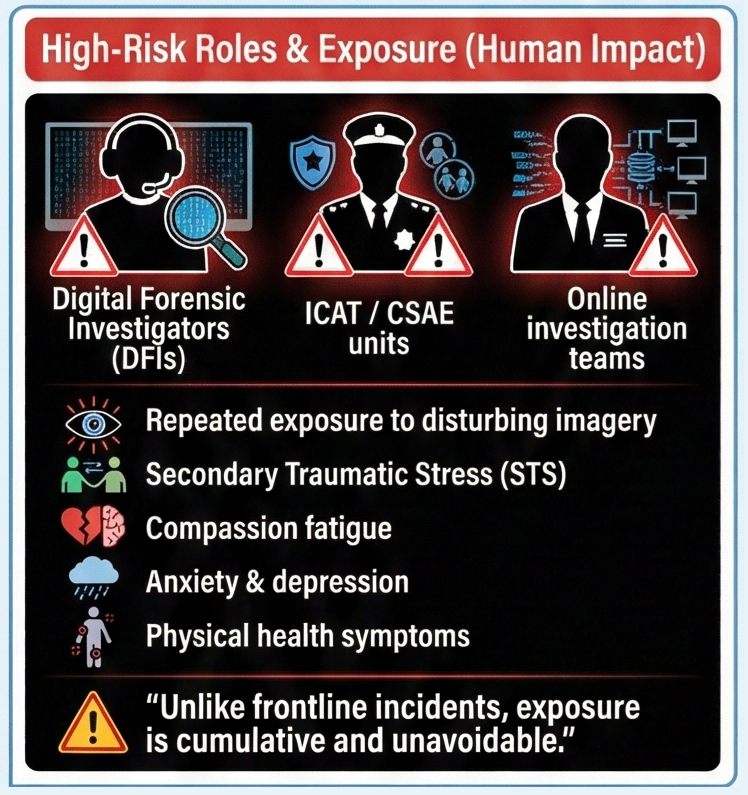
Such cumulative exposure is strongly linked to secondary traumatic stress (STS), compassion fatigue, anxiety, depression, and physical-health symptoms.
Yet national consistency in screening, support, and supervision remains elusive. By early 2025, the Enhanced Standards had been in place for nearly two years, and all police forces were expected to demonstrate adoption or measurable progress by year 2 end. However, feedback from practitioners suggested a patchwork of progress, with some forces pioneering exemplary programmes and others lagging significantly behind.
To establish a clear picture of this uneven landscape, a series of Freedom of Information (FOI) requests were submitted to every UK police force in July this year.
Findings from 36 UK Police Forces
The FOI requests were distributed to all UK police forces, including Police Scotland, the Police Service of Northern Ireland (PSNI), and the British Transport Police. Each was asked a series of structured questions designed to ensure comparability of responses and to assess compliance with the 2023 Oscar Kilo Enhanced Occupational Health Standards.
Questions Posed in the FOI Request
To understand each force’s level of implementation and operational maturity, the
following key questions were posed:
- Has your force formally adopted the Oscar Kilo Enhanced Occupational Health Standards (2023)?
- If not yet adopted, is your force currently working toward adoption or compliance?
- If adopted, on what date did your force formally adopt the Enhanced Standards?
- Has your force undertaken any audit, benchmarking, or self-assessment against the Enhanced Standards?
- Does your Occupational Health department provide psychological screening or well-being support specifically for high-risk roles (e.g., Digital Forensic Investigators, ICAT, CSAE, firearms, or major-crime teams)?
- If yes, please specify the model or tool used (e.g., NTAPS, PCL-5, EMDR, annual clinical interview, etc.).
- Has your force received or submitted an entry for an Oscar Kilo Award or similar well-being recognition?
- Please provide a copy of any internal policy or report demonstrating progress toward the Enhanced Standards.
These questions were designed not only to assess formal adoption but also to uncover the operational realities behind policy claims. The responses therefore provide valuable insight into how far forces have progressed beyond policy intention towards measurable, evidence-based well-being practice.
Response Overview
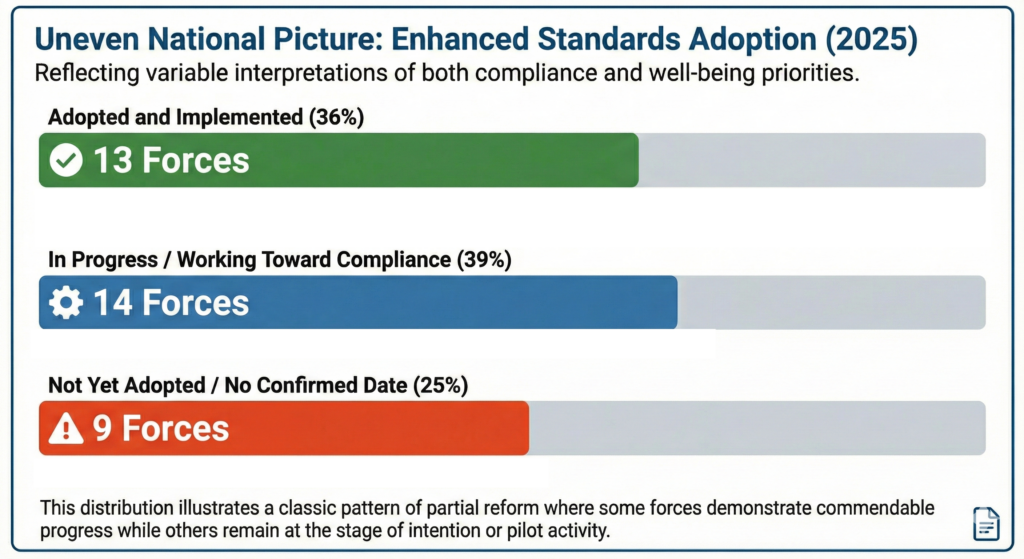
A total of 36 forces representing approximately 84% of UK policing replied. The responses reveal a distinctly uneven national picture, reflecting variable interpretations of both compliance and well-being priorities:
- 13 forces (36%) have formally adopted and implemented the Enhanced Standards. These include Merseyside, Kent, Essex, Suffolk & Norfolk, South Wales, Cumbria, Hampshire, Gwent, North Yorkshire, Dyfed-Powys, Beds/Cambs/Herts Alliance, North Wales, and Surrey (SEQOHS-accredited).
- 14 forces (39%) reported being in progress or “working toward compliance.” Examples include the Metropolitan Police, West Midlands, Cleveland, West Yorkshire, Northumbria, and Derbyshire.
- 9 forces (25%) stated that they had not yet adopted the standards and offered no confirmed implementation date. These were Leicestershire, Staffordshire, Warwickshire, Thames Valley, Lancashire, South Yorkshire, City of London, Humberside, and PSNI.
This distribution illustrates a classic pattern of partial reform where some forces demonstrate commendable progress while others remain at the stage of intention or pilot activity.
Auditing and Benchmarking
Only 13 of the 36 responding forces (36%) reported any form of audit or benchmarking activity against the Enhanced Standards. Among these, North Wales, Surrey, and Cumbria provided the most comprehensive evidence, referencing participation in SEQOHS accreditation, College of Policing audits, or independent reviews commissioned through their Police and Crime Commissioner (PCC).
The majority relied on self-assessment checklists or internal assurance processes undertaken by occupational-health leads or well-being teams. Several forces including West Midlands, Derbyshire, and Northumbria stated that audits were “planned” but had not yet been conducted.
While self-assessment tools can serve as a useful internal reflection exercise, they are insufficient for demonstrating compliance with a national clinical-governance framework. Without external validation, self-assessment risks becoming a tick-box exercise appearing to evidence progress while failing to identify meaningful gaps or risks.
This lack of external scrutiny is not a trivial gap. As we will discuss, the reliance on internal evaluation methods directly affects transparency, policy documentation, and ultimately the ability to track progress across the UK.
Policy Documentation and Transparency
Only 11 of the 36 forces (31%) provided documentary evidence demonstrating progress. 17 (47%) said documentation was in development or not retrievable, and 8 (22%) confirmed none existed or declined disclosure.
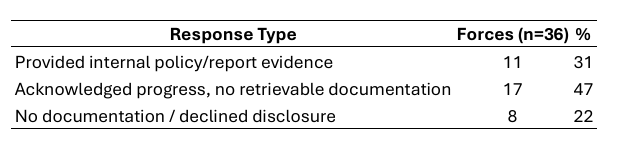
The absence of written policy raises legitimate concerns over transparency, audit readiness, and accountability. Many forces appear to remain at the stage of policy aspiration rather than embedded governance. Without documentation, progress cannot be measured, benchmarked, or independently verified.
This lack of transparency also extends to the quality and structure of psychological support available to staff.
Psychological Support Provision Across Forces
A total of 33 forces (92%) reported providing some form of psychological support to staff in high-risk roles. However, the quality, accessibility, and clinical sophistication of this support varied considerably across regions and role types.
- Structured clinical models: Kent, South Wales, Cumbria, Essex, and Dyfed Powys operate annual clinical-surveillance systems using tools such as the NTAPS, PCL-5, or clinician-led interviews.
- Hybrid or self-assessment models: Cleveland, Northumbria, and West Yorkshire rely on questionnaires or well-being surveys with optional clinical follow-up.
- Reactive-only models: Staffordshire, Warwickshire, and Leicestershire depend almost exclusively on short-term Employee Assistance Programme (EAP) counselling after symptoms arise.
Only 7 forces (19%) confirmed that they employ trauma-informed clinicians trained in EMDR or CBT. Larger southern and metropolitan forces such as Essex, Kent, South Wales, and Surrey tend to exhibit more mature frameworks, while smaller or midland forces cite resource constraints. Several, including the Metropolitan Police, Sussex, and Cleveland, treat the Enhanced Standards as advisory rather than mandatory.
Half of all respondents indicated participation in the Oscar Kilo Awards, signalling a commendable drive toward innovation. However, innovation alone does not guarantee compliance: many initiatives remain pilot-based and lack the sustainability needed for long-term cultural or clinical impact.
The data points to a fundamental inconsistency between intention and implementation. While the majority of forces recognise the importance of psychological support, very few have embedded these provisions into structured, clinically governed systems. This pattern becomes particularly concerning when viewed through the lens of digital forensics, an area where exposure to trauma is persistent and cumulative.
Impact on Digital Forensic Investigators (DFIs)
For Digital Forensic Investigators (DFIs), these findings carry immediate operational and psychological implications. Exposure to child abuse imagery, chat transcripts, and offender material is strongly associated with secondary traumatic stress (STS), burnout, and depressive symptoms. Yet, many forces continue to categorise DFIs as administrative or technical staff rather than as professionals working within trauma exposed environments.
Without dedicated screening, trauma supervision, or access to specialist therapy, DFIs remain particularly vulnerable to cumulative psychological harm.
At this point, a clear pattern emerges: six years after the 2019 Foundation Standards and two years following the launch of the Enhanced framework, only one-third of UK forces demonstrate full compliance.
Comparison with Research Recommendations
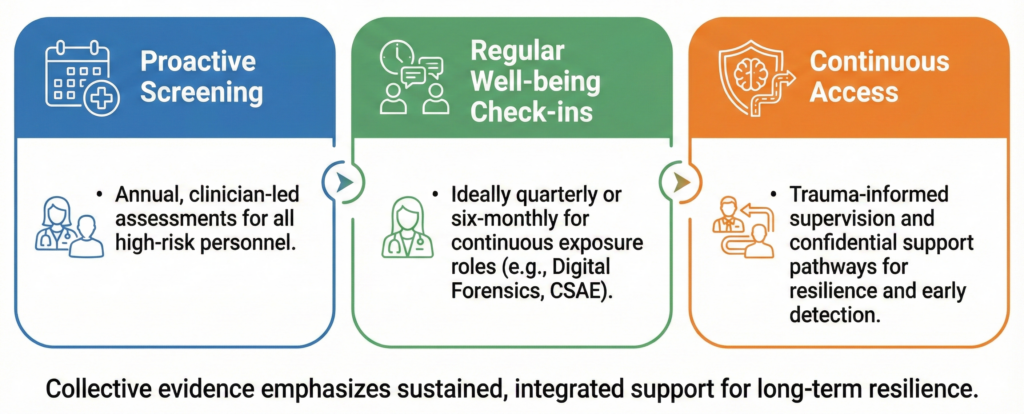
The collective evidence from recent research, alongside the Oscar Kilo Enhanced Standards (2023), presents a consistent picture of what effective psychological support should entail. Across these sources, the recommendations converge around three core principles:
- Proactive screening through annual, clinician-led assessments for all high-risk personnel.
- Regular well-being check-ins—ideally quarterly or six-monthly—with a qualified mental-health professional for those in continuous exposure environments such as Digital Forensics or CSAE units.
- Continuous access to trauma-informed supervision and confidential support pathways to sustain resilience and detect early signs of deterioration.
However, the operational reality described in the FOI responses contrasts sharply with these evidence-based expectations. While 92% of responding forces claim to offer psychological support, only 12 forces (33%) confirmed that they conduct structured, clinician-led annual screening. Of these, just 5 (14%) Kent, South Wales, Cumbria, Essex, and North Wales offer face-to-face reviews with trauma-trained professionals.
The majority still rely on reactive EAPs or self-referral counselling, typically initiated only once symptoms are apparent. Of significant note, none of the 36 forces reported offering routine quarterly or six-monthly well-being reviews as standard practice, despite multiple studies showing that such frequency significantly reduces burnout and secondary traumatic stress.
This discrepancy between research recommendations and operational practice underscores a persistent implementation gap. Even where Enhanced Standards have been adopted, most forces interpret “regular intervals” as once per year rather than as a process of continuous clinical engagement. Consequently, the national model remains largely reactive, resembling the outdated crisis-response framework that the Enhanced Standards were designed to replace.
To highlight the scale of this mismatch, we contrast the evidence-based recommendations for psychological intervention with what is happening across UK policing, as revealed by the FOI data:
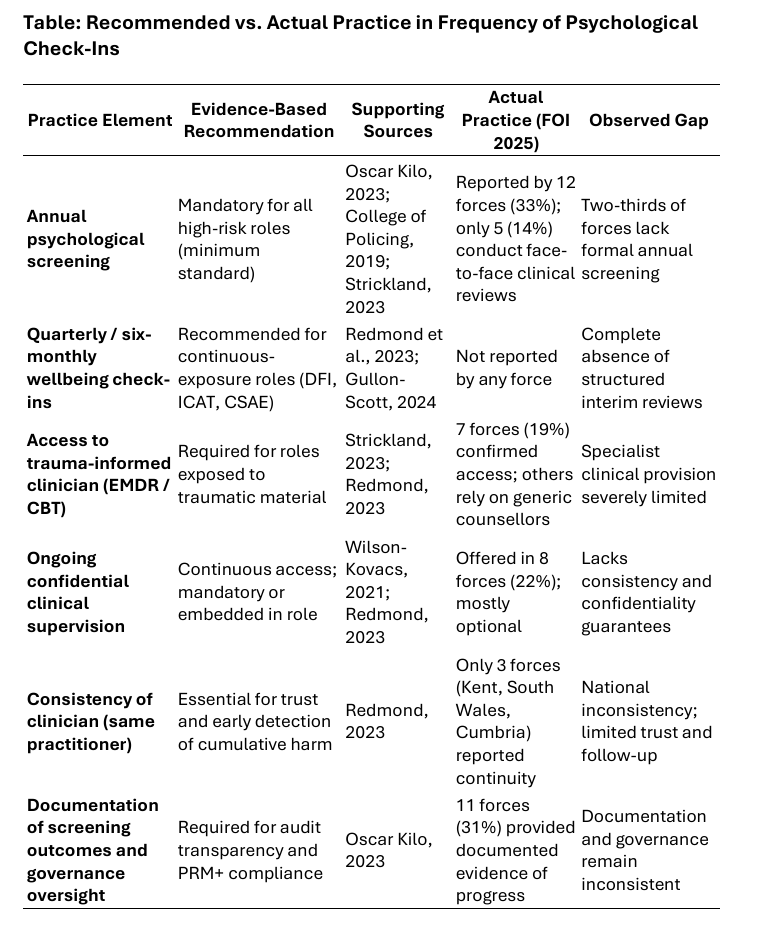
Collectively, this table captures the disconnection between evidence-based recommendations and operational practice. Whilst research calls for regular, clinician led engagement and transparent data governance, most forces remain reliant on reactive, ad-hoc counselling models.
Early Screening and Ongoing Psychological Surveillance
Research by the College of Policing (2019) and MacEachern et al. (2019) established that officers and staff working within child-protection and online-exploitation units experience significantly higher rates of secondary traumatic stress (STS), anxiety, and depression than the general population. Both reports recommended routine psychological screening, structured trauma monitoring, and sustained support from occupational-health professionals.
However, the FOI data indicates that only 13 of 36 responding forces (36%) have implemented structured mental health screening consistent with the Enhanced Standards. Many rely instead on informal or ad hoc approaches, such as EAP helplines or optional well-being surveys.
This continued reliance on reactive models highlights a systemic barrier: although the awareness of trauma risk is increasing, the mechanisms for early detection and long-term monitoring remain underdeveloped. The next section examines how this gap manifests in the limited availability of specialist, trauma-informed provision.
Specialist Trauma-Informed Provision
Studies by Redmond et al. (2023) and Strickland et al. (2023) show that personnel involved in child sexual abuse and exploitation (CSAE) investigations often report mistrust, stigma, and restricted access to clinically appropriate care even where services technically exist.
Similarly, the Forensic Focus Investigator Well-Being Survey found that respondents frequently described generic EAP support, limited therapy duration, and counsellors with little understanding of digital forensics trauma. These limitations reinforce feelings of isolation and professional misunderstanding.
Despite these evidence-based recommendations, fewer than 40% of forces have secured trauma-trained clinician specialists as mandated under the Enhanced Standards.
The lack of trauma-specific expertise not only restricts treatment quality but also erodes staff confidence in well-being systems. Now let’s look at how leadership structures, governance frameworks, and organisational culture further shape these outcomes.
Leadership, Governance, and Organisational Culture
Managerial and organisational factors play a pivotal role in determining well-being outcomes. Craun & Bourke (2014) found that supportive supervision predicts lower levels of secondary traumatic stress over time, whereas denial or emotional suppression correlates with increased distress. Likewise, Redmond et al. (2023) highlight that strong leadership engagement and psychological safety within teams significantly mitigate cumulative trauma.
Yet, the FOI data reveals that most forces have not embedded formal trauma supervision within occupational-health protocols. Only a handful such as South Wales, Cumbria, and Kent include this element as a standard provision.
Compounding this, the absence of consistent auditing further undermines leadership accountability, contradicting Oscar Kilo’s call for transparent, evidence-based governance.
This organisational shortfall links closely with another barrier repeatedly highlighted in the literature: confidentiality and stigma.
Confidentiality, Stigma, and Help-Seeking Barriers
Both Redmond et al. (2023) and Gullon-Scott (2024) identified stigma and fear of disclosure as primary obstacles to accessing psychological support. Many Digital Forensic Investigators (DFIs) expressed concern that acknowledging psychological distress could jeopardise security clearance or career progression, reinforcing the “culture of silence” widely reported across policing.
Although the Enhanced Standards explicitly require confidential self-referral pathways, the FOI responses reveal that many forces still route staff through occupational health or line-management channels. This structure compromises perceived anonymity and discourages early help-seeking.
These cultural barriers compound the structural issues already identified: limited screening, weak governance, and scarce specialist provision. Together they create a landscape in which officers must often choose between safeguarding their well-being and protecting their professional standing.
Continuum of Care and Long-Term Support
Across the research literature, there is broad consensus that individuals exposed to traumatic material require a continuum of care from pre-employment screening through in-role monitoring to post-service or exit support.
However, the FOI data shows that few forces have implemented such longitudinal frameworks. Most rely on reactive interventions capped at six therapy sessions, well below the sustained engagement (12–18 months) recommended by Strickland et al. (2023) and Gullon-Scott (2024).
This time-limited model fails to address cumulative trauma, leaving investigators vulnerable to delayed-onset psychological symptoms and relapse once short-term support ends.
When considered alongside the earlier findings, this pattern indicates a systemic shortfall: support across UK policing remains fragmented, short-term, and inconsistently governed.
Summary of Alignment and Gaps
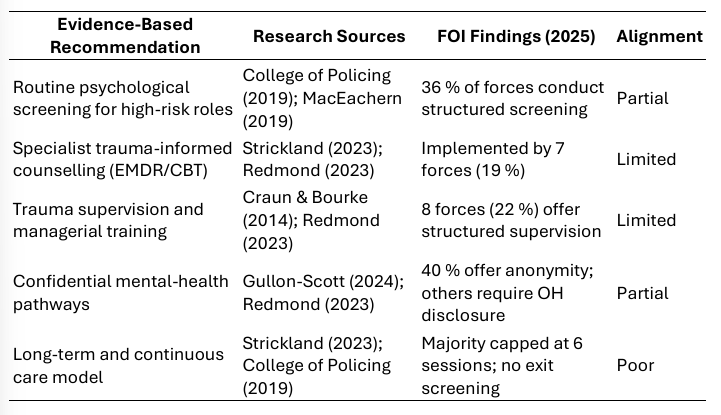
Taken together, this data exposes a consistent pattern: despite a robust body of research and a nationally endorsed set of Enhanced Standards, practical delivery lags behind policy intent. The evidence base offers a clear roadmap of proactive screening, trauma-informed care, accountable leadership, and long-term psychological surveillance, yet only a small minority of forces have operationalised these elements.
Turning Enhanced Standards Into Meaningful Action
The Oscar Kilo Enhanced Occupational Health Standards mark a significant evolution in how UK policing conceptualises and manages psychological well-being. They offer a clear, evidence-based framework that prioritises proactive surveillance, trauma informed supervision, and consistent clinical governance. However, six years after the launch of the 2019 Foundation Standards and two years following the introduction of the Enhanced Framework, implementation across UK forces remains fragmented and inconsistent.
This research highlights a persistent paradox: well-being is now universally recognised as essential to effective policing, yet it remains unevenly enacted and inconsistently governed. While a handful of forces such as Kent, Surrey, South Wales, and Cumbria demonstrate good practice through structured clinical models and independent audits, these remain exceptions rather than the national norm.
The majority of forces continue to rely on reactive Employee Assistance Programmes (EAPs), short-term counselling, and self-assessment processes that fall short of the sustained, preventative care envisioned by the Enhanced Standards. The limited use of external audits, the absence of trauma-trained clinicians, and inconsistent documentation undermine both accountability and national comparability.
For staff in high-risk roles, particularly Digital Forensic Investigators (DFIs) and those working in Child Sexual Abuse and Exploitation (CSAE) investigations, these shortcomings carry significant psychological consequences. Repeated exposure to distressing material produces measurable secondary traumatic stress, demanding structured, long-term therapeutic intervention rather than limited, reactive support.
Bridging the gap between well-intentioned policy and practical reality will require decisive leadership, sustainable investment, and a move from reactive crisis management to proactive, evidence-based psychological care.
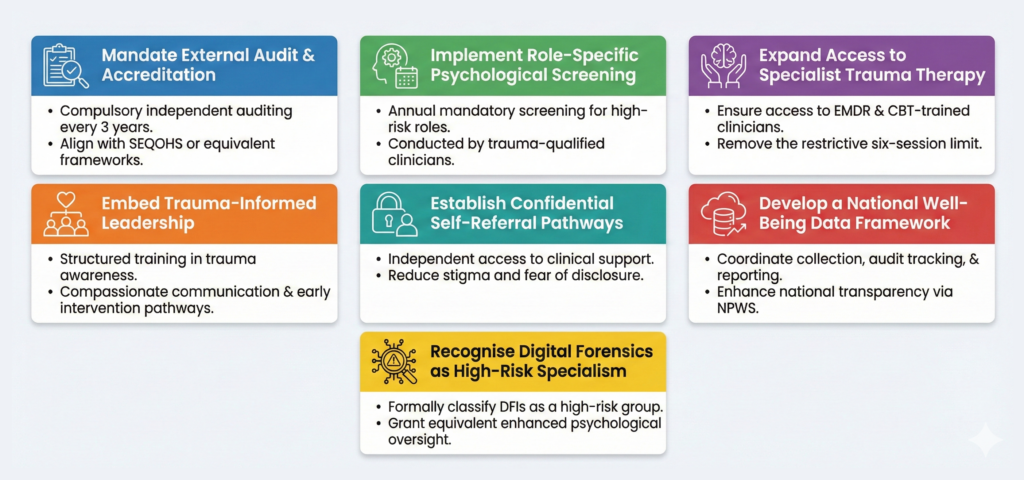
The following recommendations set out the key priorities to translate the Enhanced Standards into tangible, measurable outcomes.
Recommendations
- Mandate External Audit and Accreditation
Introduce compulsory, independent auditing of occupational health provision every three years, aligned with SEQOHS or equivalent accreditation frameworks. - Implement Role-Specific Psychological Screening
Establish annual mandatory screening for all high-risk roles, conducted by trauma-qualified clinicians using validated assessment tools. - Expand Access to Specialist Trauma Therapy
Ensure that all forces have access to EMDR- and CBT-trained clinicians and remove the restrictive six-session therapy limit. - Embed Trauma-Informed Leadership and Supervision
Provide managers with structured training in trauma awareness, compassionate communication, and early-intervention referral pathways. - Establish Confidential Self-Referral Pathways
Enable staff to access clinical support independently from line management to reduce stigma and fear of disclosure. - Develop a National Well-Being Data Framework
Coordinate well-being data collection, audit tracking, and clinical outcome reporting through the NPWS to enhance national transparency. - Recognise Digital Forensics as a High-Risk Specialism
Formally classify DFIs as a high-risk occupational group, granting them equivalent entitlement to enhanced psychological oversight as firearms and child-protection officers.
Together, these recommendations form a coherent strategy for translating policy into practice. Implementing them will depend not only on resources but on sustained cultural change across policing.
Final Thoughts
The introduction of the Enhanced Standards represents a pivotal opportunity for policing to evolve from reactive well-being rhetoric to consistent, evidence-led practice.
As this review demonstrates, the journey from policy aspiration to operational reality remains incomplete. The profession’s commitment to staff well-being must now mature into measurable capability underpinned by transparent governance, trauma informed leadership, and clinical accountability.
Without independent audit, robust documentation, and the integration of specialist care, well-being provision risks remaining symbolic rather than substantive. At present, an investigator’s access to psychological protection is determined too often by geography, budget, and local leadership priorities rather than by risk exposure or clinical need.
Those working daily with the most disturbing digital and physical evidence bear a unique and cumulative psychological burden. Their experiences demand the same recognition, protection, and structured support as any other high-risk policing role. The Oscar Kilo Enhanced Standards provide the framework for such recognition: a means of uniting UK policing behind a shared model of psychological safety and professional responsibility.
Realising this vision will require not just policy compliance but cultural transformation. It calls for courage, compassion, and coordination at every level from national policymakers to first-line supervisors. Protecting those who protect society from its darkest harms must now be seen not merely as an operational necessity but as a matter of professional integrity, moral duty, and organisational justice.
Paul Gullon-Scott BSc MA MSc MSc FMBPSS is a former Digital Forensic Investigator with nearly 30 years of service at Northumbria Police in the UK, specializing in child abuse cases. As a recognized expert on the mental health impacts of digital forensic work, Paul now works as a Higher Assistant Psychologist within the NHS and is the developer of a pioneering well-being framework to support digital forensics investigators facing job-related stress. He recently published the research paper “UK-based Digital Forensic Investigators and the Impact of Exposure to Traumatic Material” and has chosen to collaborate with Forensic Focus in order to raise awareness of the mental health effects associated with digital forensics. Paul can be contacted in confidence via LinkedIn.
References
College of Policing (2019) Supporting the wellbeing of Internet Child Abuse Teams (ICAT): Introduction and guidance. Available at: https://www.oscarkilo.org.uk/media/396/download
Craun, S.W., Bourke, M.L., Bierie, D.M. and Williams, K.S. (2014) ‘A longitudinal examination of secondary traumatic stress among law enforcement personnel’, Victims & Offenders, 9(3), pp. 299–316. Available at: https://doi.org/10.1080/15564886.2013.848828.
Gullon-Scott, P. (2024) Forensic Focus Investigator Wellbeing Survey 2024 Results. Forensic Focus Publications. Available at: https://www.forensicfocus.com/articles/forensic-focus-investigator-well-being-survey-2024-results
MacEachern, A.D., Dennis, N., Jackson, M. and MacLean, M. (2019) ‘Secondary traumatic stress in internet child exploitation investigators: Prevalence and predictors’, Frontiers in Psychiatry, 10, p. 610. Available at: https://discovery.dundee.ac.uk/ws/files/27192402/10.1007_2Fs11896_018_9277_x.pdf.
National Police Wellbeing Service (2023) Oscar Kilo Enhanced and Advanced Occupational Health Standards. Available at: https://www.oscarkilo.org.uk/services/clinical-governance-group/occupational-health/enhanced-and-advanced-occupational-health-standards.
Redmond, T., Wilson-Kovacs, D., Strickland, C. and Woodhams, J. (2023) ‘Psychological wellbeing and organisational culture in CSA/CSE investigations: A mixed-methods analysis of wellbeing support in UK policing’, Journal of Police and Criminal Psychology
Strickland, C. (2023) The mental-health impact of digital-forensics work: A qualitative study of exposure, burnout, and coping. University of South Wales.
Wilson-Kovacs, D. (2021) ‘The hidden toll of child sexual abuse investigations: Emotional labour and secondary trauma in digital forensics policing’, Policing and Society, 31(10), pp. 1183–1198.