Digital investigations have changed faster than the tools many teams are still expected to rely on.
Investigators are now routinely dealing with imagery that is harder to interpret, easier to manipulate, and more distressing to review — often under significant time pressure, and often with safeguarding decisions dependent on what can (or can’t) be understood from a single frame.
Across this landscape, three recurring bottlenecks have become increasingly clear:
- Identifying people or places from minimal visual context
- Determining whether imagery can be trusted at all
- Sustaining investigative practice when repeated exposure to explicit material is unavoidable
These are no longer edge cases. They are everyday investigative realities.
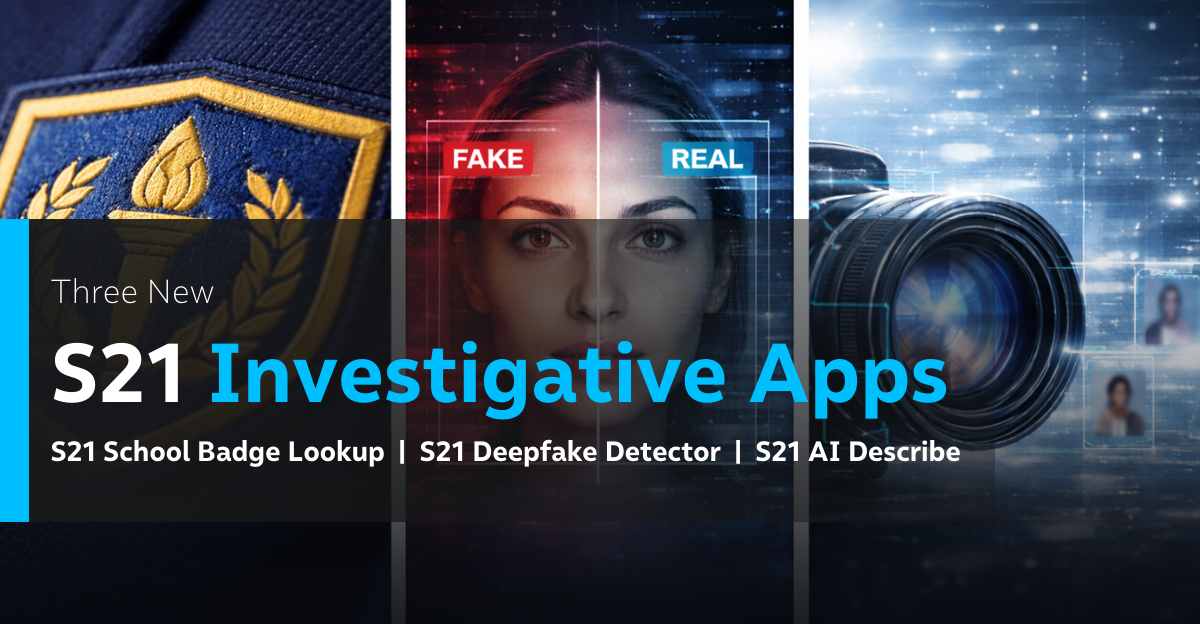
In response, Semantics 21 is releasing three standalone investigative utilities, each designed to address one of these pressure points directly. All three were developed, tested, and proven inside S21 VisionX, and are now being released independently due to sustained investigator demand.
1. When Identity Is the Only Lead
In many safeguarding and intelligence-led investigations, the only visible identifier may be a partial school badge, crest, or uniform detail.
Today, that often leads to manual searching, reliance on personal knowledge, or ad-hoc web lookups — approaches that are inconsistent, slow, and difficult to repeat under pressure.
S21 School Badge Lookup provides investigators with an offline, structured way to identify schools from imagery using a comprehensive badge collection spanning Great Britain, Ireland, Canada, the USA, and Australia.

Searches can be performed by school name, region, or partial visual description, allowing teams to move from uncertainty to clarity in seconds, rather than hours.
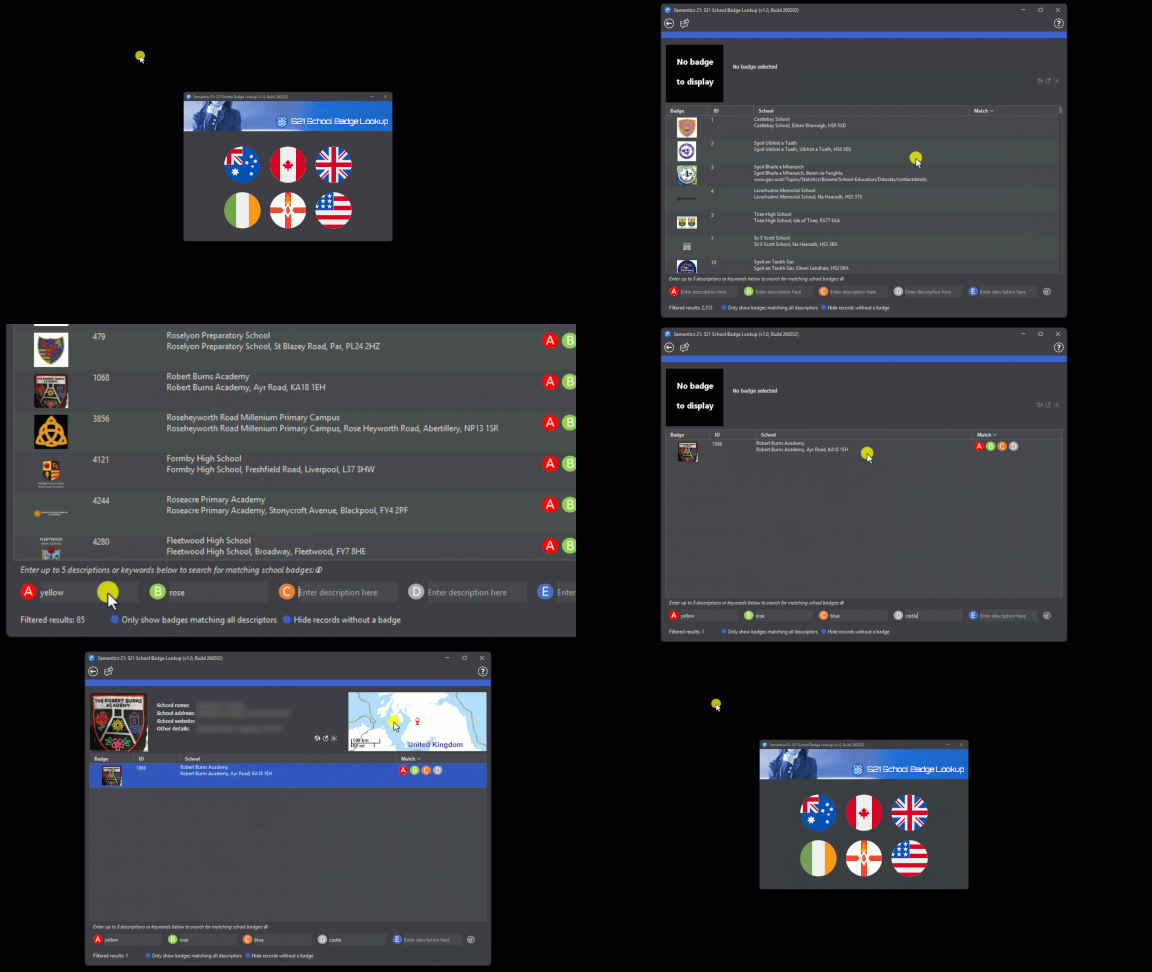
This capability removes an avoidable delay at exactly the moment speed matters most.
2. When Imagery Itself Can’t Be Trusted
Synthetic and AI-generated imagery is now appearing across a wide range of investigations — from CSAM and non-consensual fake imagery, to fraud, extremist propaganda, and manipulated documents.
In many cases, investigators are faced with a fundamental question before anything else can progress: is this real?
S21 Deepfake Detector was built to address that uncertainty.
Rather than relying solely on embedded provenance data that may not survive real-world handling, the tool assesses the visual content itself using multiple forensic indicators. Results are presented as confidence-based assessments, with transparency when the system is uncertain.
This supports informed investigative judgement, rather than forcing binary answers in complex cases.
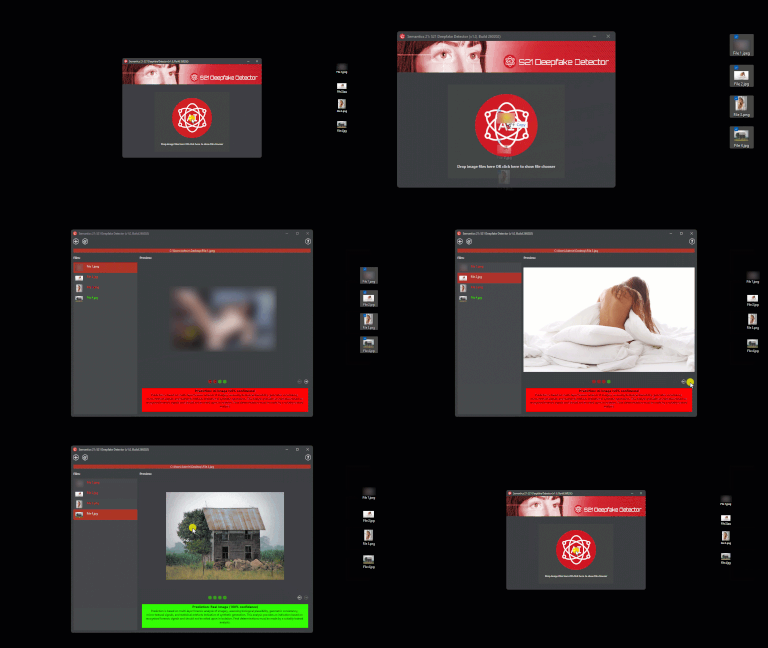
In an environment crowded with over-promised AI tools, credibility and explainability matter more than claims.
3. When Description Becomes the Burden
One of the most unavoidable and psychologically demanding aspects of digital investigations is the requirement to repeatedly view and describe explicit material.
This work is slow, emotionally taxing, and often repeated across cases and reporting workflows. The cumulative impact on investigator well-being is well understood.
Reducing unnecessary exposure is not a well-being initiative — it is an operational responsibility.
S21 AI Describe is an offline utility designed to generate clear, structured descriptions of images and video frames, significantly reducing the need for repeated, prolonged exposure.
Used daily within S21 VisionX for over a year, its outputs are also used to inspire further searches, surface overlooked details, and support hypothesis development across a wide range of media investigations.
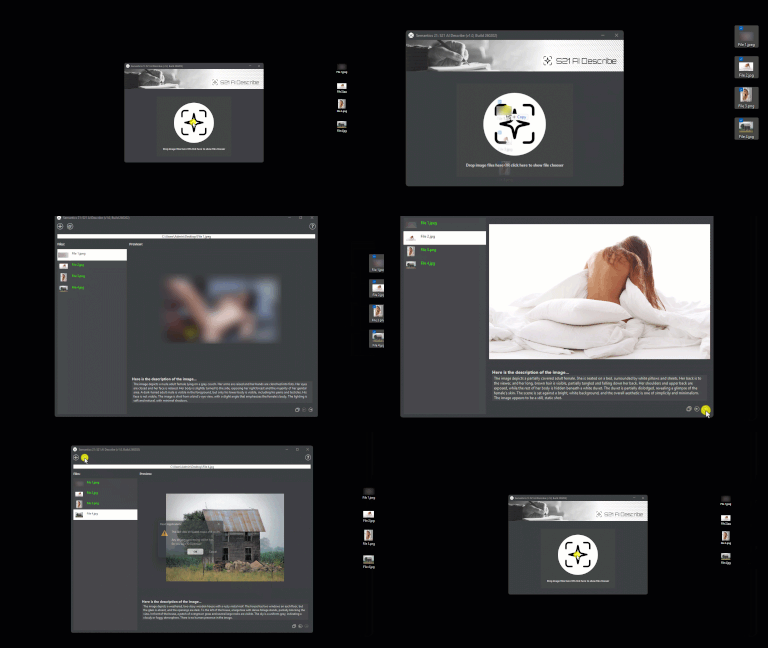
This capability was built to support sustainable investigative practice — without removing judgement or context.
Built Inside S21 Visionx – Now Available Independently
All three tools were developed and proven inside S21 VisionX, Semantics 21’s offline forensic intelligence platform. They are now available as standalone applications for teams who need these capabilities immediately or who cannot deploy the full platform at this time.
Used individually or together, they reflect a broader shift: modern digital investigations require tools that are secure, explainable, and designed around investigator reality — not theoretical workflows.
These are not experimental capabilities — they are the minimum required to operate safely, credibly, and efficiently in modern digital investigations.