By Paul Gullon-Scott, Forensic Mental Health & Well-being Lead, Spectrum Specialist Consultancy Ltd
Part one of When the Job Comes Home offered a deeply personal and reflective account of the impact that working in digital forensics can have beyond the individual investigator. Written by my wife, Fiona, the article explores the often-overlooked experiences of families who live alongside the psychological consequences of this work, highlighting the vicarious effects of trauma, the strain on relationships, and the emotional burden carried within the home environment. It provides a powerful insight into how the role does not end at the workplace, but instead extends into family life, shaping well-being, connection, and resilience in profound ways.
This article explores the same issues from my own point of view living within the role rather than alongside it. It reflects the internal weight of the work: the images that do not stay at the desk, the thoughts that follow you home, and the quiet ways it begins to shape how you see the world, the people you love, and yourself. Where Part One gives voice to the impact on the family, this piece speaks to the often-unspoken experience of carrying that burden of trying to protect those closest to you while, at times, struggling to protect your own well-being. It is an honest account of the tension between duty and humanity, and the reality that, even with the best intentions, the job has a way of crossing the threshold into home life.
When I first began working in digital forensics, I believed the challenge would be technical. Encryption, artefact recovery, timelines, reporting – that was the work. I did not anticipate that the hardest part would be what followed me home.
For years, I examined some of the most disturbing material imaginable. Child sexual abuse imagery. Extreme violence. Content that required forensic and evidential precision. I learned to focus. I learned to compartmentalise. I learned to perform. What I did not realise at the time was that the cost of that performance was not only mine, but it was also shared by the people waiting for me at home.
Irritability I Didn’t Recognise
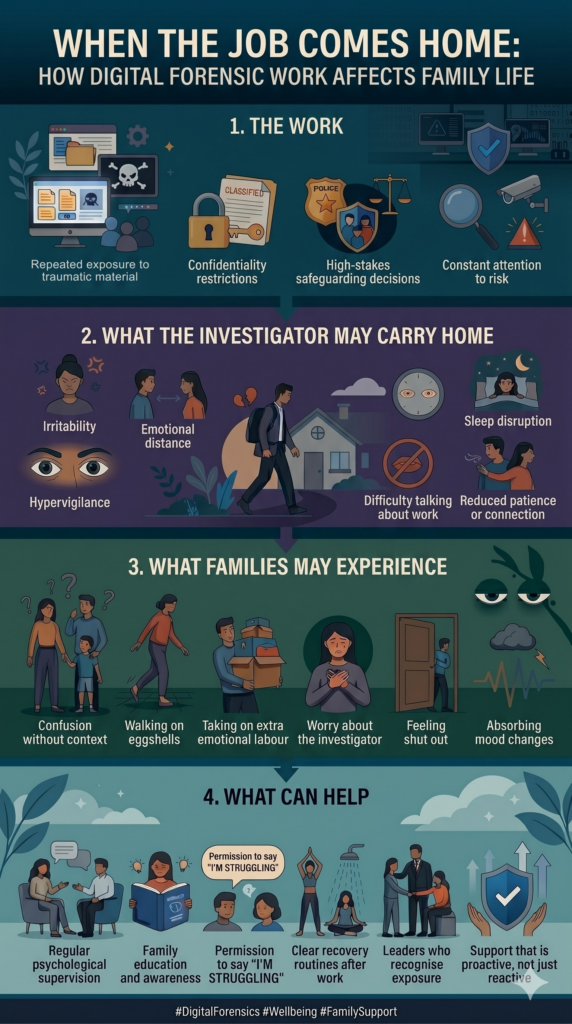
I would walk through the front door exhausted, but not the kind of exhaustion that sleep fixes. It was a wired fatigue, with my nervous system still alert, still scanning, still switched on. Small things began to irritate me. Normal household noise felt overwhelming. Minor disagreements felt disproportionate. I was less patient. Less tolerant. Less emotionally available. I did not see myself as irritable; I saw myself as exhausted. But from the outside, in the eyes of my family and friends, the change was clear. They could see I was physically present but emotionally I was distant – my mind was elsewhere.
In trauma psychology, the American Psychiatric Association describes emotional numbing and heightened arousal as core features of Post-Traumatic Stress Disorder. At the time, I would never have framed myself in clinical language. I was functioning. I was productive. I was meeting deadlines and producing evidence to standard. I did not, even for a moment, consider that I might be experiencing post-traumatic stress. I certainly did not see myself as someone “suffering from PTSD”. I saw myself as doing the job I was trained to do and doing it well.
But something had shifted.
The hypervigilance that served me well in forensic examinations – spotting subtle artefacts others might overlook, identifying behavioural patterns across devices, maintaining constant safeguarding awareness – did not simply switch off at the end of the day. In the lab, that heightened state was an asset. It sharpened my focus. It made me thorough. It ensured nothing was missed.
But hypervigilance is not a tool you neatly place back in a drawer or switch off. It followed me out of the office and into ordinary life. I would find myself scanning environments, automatically noticing exits, observing who was nearby, assessing risk in situations that did not require assessment, and never sitting with my back to the room. My awareness of online harm shaped how I viewed everyday technology use. Harmless scenarios were filtered through a lens of worst-case possibility because, professionally, I had repeatedly witnessed worst-case reality.
At home, that constant alertness did not feel like diligence. It felt like tension. Normal childhood behaviour could trigger disproportionate concern. Innocent digital interactions carried imagined threat. Background noise grated because my system was already overstimulated. Even moments that should have been relaxing carried an undercurrent of readiness as though something might require immediate action.
To my family, this did not present as “protective expertise.” It presented as watchfulness, intensity and, at times, unease. The difficulty with hypervigilance is that it narrows the nervous system’s range. It prepares you for danger, not connection. And connection – patience, playfulness, emotional openness, love – requires the opposite state; it requires safety. For me, hypervigilance felt tight, controlled. It felt like I was holding my breath waiting for something to happen.
The Silence That Created Distance
Confidentiality was non-negotiable; I could not discuss cases. I could not describe what I had seen. I believed that silence was protective, but it was more than policy, I simply did not want to talk about it.
How do you explain to your partner that you have just spent eight hours examining videos depicting babies being abused? How do you translate that into something that can sit alongside a family meal or a normal evening at home? Some realities do not belong in domestic spaces. I could not find words that would not contaminate my home, my safe space.
So, I said nothing.
Part of that silence was professional obligation. Part of it was self-preservation. And part of it was fear, fear that if I described even a fraction of what I had seen, I would transfer those images into the minds of the people I loved most. I did not want to risk traumatising my family. I did not want them carrying pictures they had never asked to see. In trying to shield them from the content, I also shielded them from the emotional weight of it, or that was my intention.
They did not see the material. What I didn’t see was that instead they felt the after-effects: the quietness, the distance, the reduced emotional connection, the days when I seemed somewhere else entirely. The nights when sleep was almost non-existent, the shortened fuse, the flat tone and the absence.
Silence protected them from the detail. It did not protect them from the impact.
“I can’t talk about it.”
“It’s just work.”
“I’m fine.”
They became regular phrases I would use to shut down any conversations about work. I remember finishing a particularly traumatic investigation involving multiple victims, one of whom was a six-month-old baby. Following the successful prosecution of the offender, our team was awarded individual Chief Constable’s commendations. I was encouraged to take my family along to the ceremony.
What I had not anticipated was the depth of detail that would be shared in that room when describing what we had uncovered. As the speaker outlined aspects of the case, I found myself glancing over at my son and daughter. I will never forget the look of concern and fear on their faces as they looked back at me, or their quiet struggle to hold back tears as the reality of what I did for a living and the investigation unfolded before them.
My wife sensed the shift in me as I tensed before I could say a word. She gently placed her hand on mine, a small, quiet but powerful gesture grounding me, steadying me, and somehow transferring her strength in a moment where mine felt like it had slipped away.
When I returned to my seat after receiving the award, they all hugged me tightly. In that embrace, there was pride but also something deeper. An unspoken understanding of the weight behind what had just been shared.
On reflection, something shifted in me that day. For the first time, the wall of steel I had built between work and home cracked, not because I had chosen to speak, but because the job had followed me into a space I had tried so carefully to keep separate. I had told myself I was shielding my family from the realities of the role. In many ways, I was, but what I had not appreciated was that silence also removes context. When mood changes occur without explanation, the people closest to you are left to interpret them.
Why is he withdrawn?
Why is he short-tempered?
Why does he seem distant?
Does he still love us?
Without language, those questions quietly eroded the connection between myself and my family. The truth was never that I did not care, the truth was that I was overloaded. I had no vocabulary for cumulative exposure. No framework for secondary traumatic stress. No organisational culture that openly acknowledged what this work can do over time. So, I carried the weight quietly, and my family carried the consequences.
Protective Instincts That Became Hypervigilance
Working in CSAM investigations changes how you see the world. It certainly changed how I saw the digital landscape.
I became intensely aware of online risks. Safeguarding was no longer theoretical; it was daily reality. That awareness influenced how I approached parenting, technology use and safety conversations. Some of that vigilance was appropriate and informed. But there were times when it tipped into anxiety. The line between professional knowledge and personal fear can easily become blurred when you repeatedly witness the worst outcomes of digital harm.
Again, my intentions were protective. But heightened alertness does not always feel reassuring to those around you. It can create tension, restriction and an atmosphere of caution. I was trying to keep everyone safe. I did not realise I was also bringing the emotional tone of the job into the home.
The Research Caught Up with What I Had Lived
As I began researching mental health and well-being in digital forensics, I encountered studies that gave a voice to my experience. Work published demonstrated associations between exposure to aversive crime material and depressive symptoms, emotional exhaustion and secondary traumatic stress.
Reading those studies was both validating and sobering. Validating because it confirmed that the reactions I had experienced were not weakness. They were human responses to repeated exposure to traumatic material. Sobering because I realised how little structured support existed when I needed it most, not only for me but also for my family.
Trauma is rarely contained within one person. It influences systems. It shifts dynamics. It alters communication patterns. I did not need a diagnostic label to know that something had changed both in my home life and myself during those years.
The day I realised I could not do this job anymore, I could barely function. I was a shell of my former self. When I stepped through the front door, I looked at my wife and could no longer hold back the tears. The only words I could manage were, “I am broken. I can’t do this anymore.” Those words were met not with fear or judgement, but with love. She wrapped her arms around me and quietly said, “You have done your duty. Don’t go back; we’ll be fine.” In that moment, everything shifted. The weight I had been carrying for so long finally had somewhere to fall. And from that day on, I never returned to the frontline again.
What I Wish Had Been Different
Looking back, there are several things I wish had been normalised.
I wish someone had explained early on that irritability and withdrawal can be occupational signals, not personal failings.
I wish family education sessions had existed – simple briefings acknowledging that digital forensic work carries psychological weight.
I wish structured psychological supervision had been embedded in the role, rather than support being reactive or time limited.
And I wish there had been clearer cultural permission to say, “I’m struggling,” without fearing professional judgement.
Under UK health and safety frameworks, psychological risk is foreseeable in roles involving repeated exposure to traumatic material. Digital forensic investigators are not exempt from that reality simply because the trauma is digital rather than physical. When we talk about protecting investigators, we must also talk about protecting their families.
The Families Behind the Screens
Behind every digital forensic workstation is someone absorbing mood shifts, altered communication and emotional fatigue. Partners often adjust quietly. They take on additional emotional labour. They attempt to decode unspoken stress. Children sense tension without understanding the cause. For years, I believed I was carrying the burden alone. I was not.
My family carried it with me. They all did.
Why This Conversation Matters
This is not about blame. It is not about suggesting that digital forensic work inevitably damages relationships. Many investigators maintain strong, healthy family lives.
It is about recognising risk honestly. Resilience is not the absence of reaction; it is the presence of recovery structures. It is supervision that allows processing. It is leadership that acknowledges cumulative exposure. It is organisational culture that validates human response, and it is giving families language.
When the job comes home it does it does not mean the investigator is weak. It means they are human. If we are serious about sustaining this profession, we must widen the lens beyond the lab. Resilience does not end at the office door. It lives, and is tested, in the families behind the screens.
A Closing Reflection
There is something else I need to say: not as a researcher, not as a former investigator, not as the well-being lead for Forensic Focus, but as a husband and a father.
To my family, I am profoundly sorry.
I am sorry for the distance you felt but could not name. I am sorry for the days when I was physically present yet emotionally elsewhere. I am sorry for the shortened temper, the restless nights, and the atmosphere of tension that sometimes settled in our home without explanation.
You did not choose this work, yet you absorbed its consequences.
You adapted quietly. You walked on eggshells when you sensed I was overloaded. You offered patience when I was depleted. You carried confusion when I offered silence.
At the time, I believed I was protecting you. I now understand that protection without context can feel like exclusion, and strength without vulnerability can feel like absence. If resilience exists in my story, much of it belongs to you.
Thank you for loving me and supporting me through a period when I did not always know how to show up and be present fully, and I am sorry for the things you lived through because of the job I chose to do.
I could not have recovered without your support, and I promise never to return to the coal face.
All my love.
Paul Gullon-Scott BSc MA MSc MSc FMBPSS is a former Digital Forensic Investigator with nearly 30 years of service at Northumbria Police in the UK, specializing in child abuse cases. As a recognized expert on the mental health impacts of digital forensic work, Paul now works as a Higher Assistant Psychologist within the NHS and is the developer of a pioneering well-being framework to support digital forensics investigators facing job-related stress. He recently published the research paper “UK-based Digital Forensic Investigators and the Impact of Exposure to Traumatic Material” and has chosen to collaborate with Forensic Focus in order to raise awareness of the mental health effects associated with digital forensics. Paul can be contacted in confidence via LinkedIn.