By Paul Gullon-Scott BSc, MA, MSc, MSc, FMBPsS
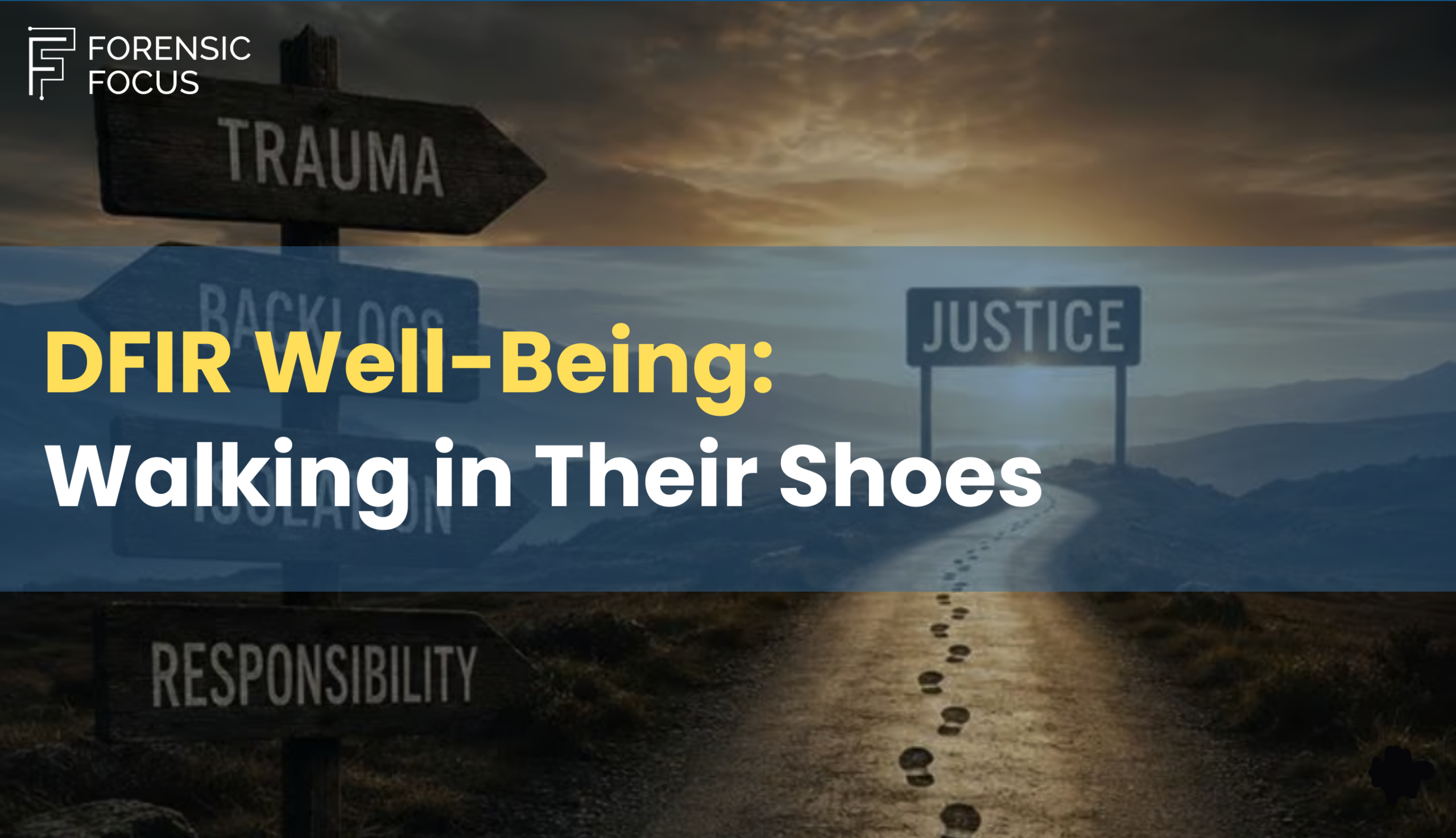
There is an old saying most of us have heard since childhood: before you judge someone, walk a mile in their shoes. It is usually offered as a gentle reminder to be kind, to withhold judgement, to remember that everyone is carrying something we cannot see. But for one group of professionals, the saying takes on a weight that most people could not begin to imagine. Because to walk a mile in the shoes of a digital forensic investigator is to walk through some of the darkest material humanity produces — not once, not occasionally, but every working day.
The Job Nobody Sees
Ask the average person what a digital forensic investigator (DFI) does and they will probably reach for something from a television drama: a technician in a lab, recovering a deleted text message that cracks the case in the final ten minutes of the episode. The reality is profoundly different.
DFIs are the people who examine the phones, computers, hard drives, and cloud accounts seized in criminal investigations. Their work underpins prosecutions for fraud, terrorism, homicide, stalking, and organised crime. But a substantial and unavoidable part of the role involves something far more harrowing: the identification, grading, and cataloguing of child sexual abuse material (CSAM).
Read that sentence again, slowly. Somewhere right now, an investigator is sitting at a workstation viewing images and videos of children being abused because someone has to. Someone has to confirm what the material contains. Someone has to grade its severity for the courts. Someone has to identify victims so they can be safeguarded. Someone has to build the evidential picture that puts offenders behind bars. That someone is a DFI.
They do not get to look away. Looking is the job.
A Mile Measured in Images
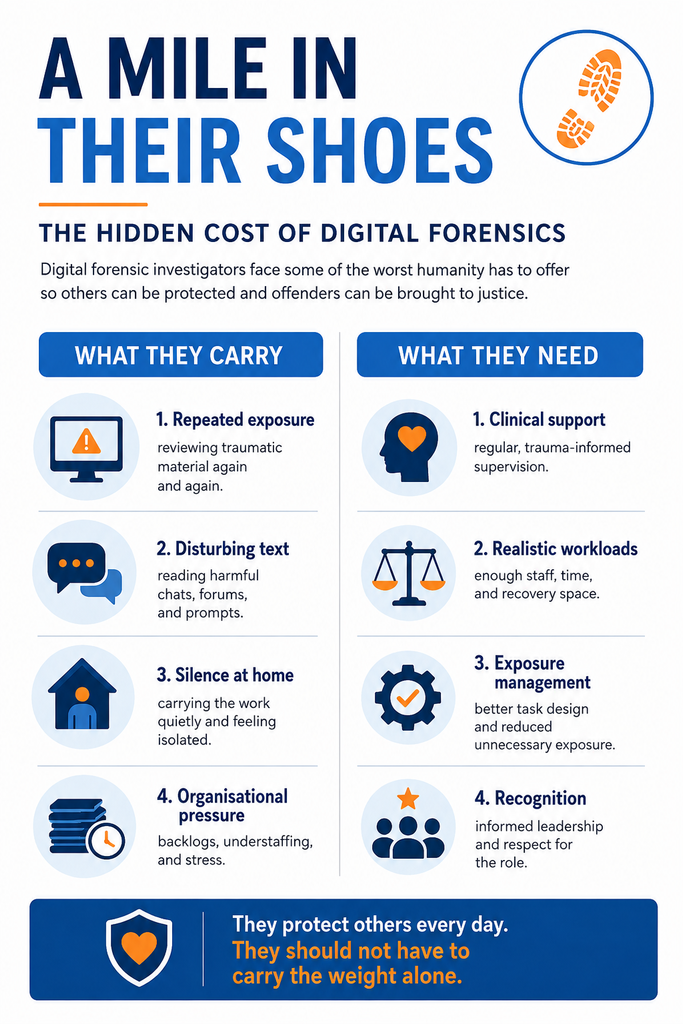
When we talk about exposure in this field, we are not talking about a distressing image encountered once in a career. Caseloads in digital forensics frequently involve devices containing thousands, sometimes hundreds of thousands, of files. Investigators may spend hours at a time reviewing material that most people could not tolerate for seconds. And when one case closes, another opens. The backlog never ends; in many units it grows.
This is repeated, cumulative, occupationally mandated exposure to traumatic material. Psychologically, that matters enormously. We have long understood that police officers, paramedics, and firefighters face traumatic incidents in the course of their duties. But those exposures, however severe, are typically episodic. For the DFI, trauma exposure is not an event that interrupts the working day. It is the working day.
The consequences are measurable. Research consistently finds elevated rates of post-traumatic stress symptoms, secondary traumatic stress, depression, anxiety, and burnout among DFIs. Findings from the Forensic Focus International Well-Being Study, which surveyed digital forensic investigators across multiple countries, paint a sobering picture: significant proportions of practitioners reporting clinically meaningful levels of PTSD symptoms, anxiety, and low mood, alongside the physical complaints — sleep disturbance, headaches, exhaustion — that so often accompany chronic psychological strain.
The Silence That Follows Them Home
Here is something the saying about shoes captures perfectly: the loneliness of a walk nobody else can join.
Most of us decompress from a hard day by talking about it. We tell our partner about the difficult meeting, the unreasonable customer, the deadline that got moved. DFIs cannot do this. The material they work with is illegal to describe in detail, operationally sensitive, and — more to the point — unspeakable in the most literal sense. What would they even say across the dinner table? How do you tell the person you love what you spent eight hours looking at, without transferring some of that weight onto them?
So most don’t. They carry it silently. They develop what many describe as a kind of double life: the professional self who can clinically grade abuse imagery, and the home self who watches their own children play and tries not to make connections. The protective instinct to shield family and friends from the work is admirable and isolating. Isolation, we know from decades of trauma research, is one of the most reliable amplifiers of psychological harm.
And there is another, crueller layer to the silence: stigma. Many investigators worry that admitting they are struggling will be read as weakness, or worse, will raise questions about their fitness for the role. In a field where psychological screening exists in some organisations, disclosing distress can feel professionally dangerous. So the people most exposed to traumatic material can become the people least likely to ask for help.
It Is Not Only the Images
When people do try to imagine this work, they picture the images. But if you genuinely walked that mile, you would discover that some of the heaviest material a DFI carries is not visual at all. It is written.
Devices seized in these investigations contain conversations: chat logs, messaging threads, forum posts between individuals who share a sexual interest in children. Investigators must read every message, because within those exchanges lies the evidence of intent, of grooming, of conspiracy, of contact offences planned or already committed. And what those conversations contain is, by the accounts of many investigators, among the most disturbing material they ever encounter. Offenders discussing children the way the rest of us might discuss a hobby. Trading fantasies in graphic detail. Coaching one another on how to gain access to a child, how to build trust with a family, how to avoid detection. Sometimes the child being discussed is real, named, and identifiable, and the investigator is reading, in the offender’s own words, exactly what he hopes to do to them.
Images can sometimes be processed at a kind of clinical distance; software can blur, thumbnail, and filter. Text offers no such mercy. Reading is comprehension. To read a grooming conversation is to be walked, sentence by sentence, through the offender’s mind — his rationalisations, his patience, his appetite. Many investigators describe this as a different, and in some ways deeper, intrusion than imagery: the images show what was done, but the chat logs show the thinking behind it, and that thinking lingers.
And now a new layer has been added. The rise of generative AI means investigators increasingly encounter the text prompts offenders write to create synthetic abuse imagery. To produce these images, offenders must describe in deliberate, specified, painstaking detail exactly what they want to see done to a child. The age. The acts. The setting. The expressions. These prompts are, in effect, written abuse fantasies refined into instructions, and DFIs must read and assess them as evidence. Practitioners responding to the Forensic Focus International Well-Being Study described precisely this: an escalating operational burden, the psychological toll of this new category of material, and the unsettling erosion of certainty as investigators are forced to ask, of every image, whether a real child was harmed in its making, knowing that behind even the synthetic ones sits a mind that composed every detail.
There is no walking past this material. It must be read closely, catalogued accurately, and presented to the courts with precision. The investigator does not get to skim.
And It Is Not Only the Material
There is a further truth the research increasingly confirms, and it surprises many people outside the field. Ask DFIs what wears them down most, and the answer is often not the material at all. It is the organisation around them.
The pressures are familiar across the profession:
- Crushing backlogs and chronic understaffing, leaving investigators with more devices, more cases, and less time to deal with them properly.
- Pressure from courts and senior officers to turn devices around faster, even as workloads continue to grow.
- Pay that lags behind equivalent private-sector technical roles, making it harder to recruit and retain experienced specialists.
- A sense of being an invisible support function, rather than recognised investigators whose work directly secures convictions.
- Promotion structures that do not fit specialist technical careers, forcing practitioners to choose between progression and remaining in the work they are skilled at.
In study after study, organisational stressors emerge as powerful predictors of psychological distress, in some analyses outstripping the traumatic material itself.
This finding should stop every police leader and forensic manager in their tracks. It means a meaningful portion of the harm done to this workforce is not an inevitable cost of confronting evil. It is a product of how we choose to resource, structure, and value the work. Inevitable harm demands mitigation; chosen harm demands change.
The same research highlights a gap that would be unthinkable in comparable professions. Clinical supervision — protected, regular, psychologically informed support — is standard practice for therapists who hear about trauma second-hand. Yet substantial numbers of DFIs, who view primary traumatic material daily, report receiving no formal supervision at all.
Where good supervision exists, it is associated with fewer trauma symptoms.
We know what helps. Too often, we simply are not providing it.
Why They Keep Walking
Given all of this, the obvious question is: why does anyone do this job?
Spend time with DFIs — really listen to them — and the answer is remarkably consistent. They do it for the children in the images. Every victim identified is a child who can be found and safeguarded. Every offender convicted is a measure of protection for children not yet harmed. Investigators describe holding onto this purpose like a handrail: the knowledge that their willingness to look at the worst of humanity is precisely what allows the rest of us never to have to.
That sense of mission is genuinely protective. So is resilience, the capacity to recover and adapt, which research links to lower psychological distress in this population. But here we must be careful, because “resilience” has too often been weaponised by organisations as a way of relocating responsibility onto the individual. Build a resilience workshop, tick the well-being box, change nothing about workload, supervision, or culture. Personal resilience matters, but it is not a substitute for organisational responsibility, and it should never be used as one. No amount of individual hardiness should be expected to compensate for systems that fail to protect the people working within them.
A Very Particular Kind of Strength
It is worth pausing on what kind of person can do this work at all, because we rarely name it for what it is.
We reserve words like brave and strong for those who run towards physical danger, and rightly so. But there is another form of courage that receives no medals and makes no headlines: the courage to deliberately open a file knowing what it contains, because a child’s safety may depend on what you find. To do that not once, in a moment of adrenaline, but methodically, carefully, thousands of times, with the precision the courts demand. To absorb what those images hold and still produce evidence that is meticulous, objective, and fair even to the accused.
That is strength of an extraordinary order. It is the strength to feel horror and keep working. The strength to compartmentalise without becoming cold, to stay human in the face of inhumanity. The strength to protect everyone around you from what you know, and to come back the next morning and do it again. Many DFIs would shrug this off — “someone has to do it” is the standard reply — and that quiet, unceremonious modesty is perhaps the clearest marker of the character involved. These are not people who consider themselves remarkable. They are simply, by any honest measure, remarkable people.
None of this contradicts what the research tells us about the toll the work takes. Quite the opposite: the strength and the suffering coexist. Acknowledging how exceptional these practitioners are is not an excuse to lean on that strength indefinitely. It is precisely the reason they deserve better protection than they currently receive. We do not honour strong people by testing how much they can carry. We honour them by making sure they never have to carry it alone.
What Walking the Mile Asks of the Rest of Us
The saying is not really about shoes, of course. It is about imagination and obligation — the effort of understanding lives unlike our own, and what that understanding then requires of us.
That obligation looks different depending on where we stand:
- For police forces and forensic providers, it means treating psychological protection as core safety infrastructure, not an optional extra. That includes mandatory access to high-quality clinical supervision, realistic workloads, effective exposure management, leadership that understands the work, and career structures that recognise these practitioners as the skilled investigators they are.
- For policymakers, it means acknowledging that the digital forensic workforce is critical national infrastructure for child protection, and that its sustainability is a safeguarding issue, not merely an HR one.
- For the rest of us, perhaps it simply means remembering that they exist. Behind every headline about an offender convicted of possessing indecent images were investigators who viewed that material so that justice could be done. They will never be named. They will rarely be thanked publicly. They will log off, drive home, sit down to dinner, and say nothing about their day.
We cannot truly walk a mile in their shoes, and they would not want us to. The entire point of their work is that we never have to.
But we can refuse to let them walk it unsupported, unrecognised, and alone.
That much, at least, we owe them.